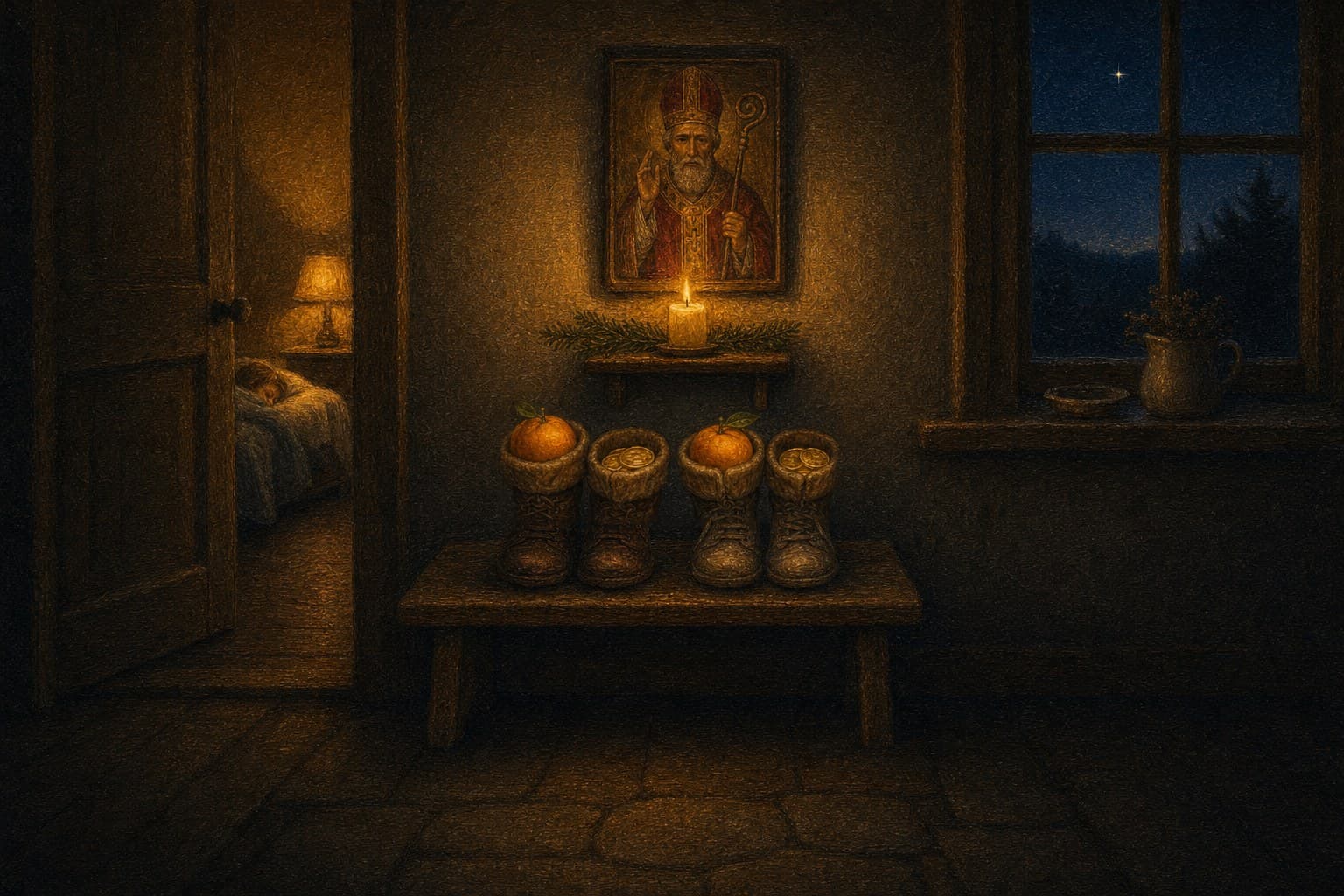
An oil painting of an icon of St. Nicholas the bishop, with miter and crozier, above a small lit candle in a home at night, and children’s boots on a bench below holding oranges and gold coins.

Feast: December 6

St. Nicholas of Myra

The fourth-century bishop behind Santa Claus: what we know, what was told later, the shoes by the door, and a family prayer for December 6.

Pray to St. Nicholas ›

St. Nicholas of Myra was a fourth-century bishop on the southern coast of modern Turkey, the patron saint of children and sailors, and the man behind Santa Claus. His feast, St. Nicholas Day, is December 6, which in 2026 is the Second Sunday of Advent, so families keep his customs at home that weekend.

Quick Facts

  • Bishop of Myra, a port on Turkey’s southern shore, during the fourth century
  • Feast day December 6 (December 19 in Churches that keep the old Julian calendar)
  • In 2026, December 6 is the Second Sunday of Advent, so his memorial is not kept at Mass that day
  • Patron of children and sailors, and of merchants and bakers
  • His relics have rested in Bari, Italy, since 1087
  • Santa Claus is his name, carried to America and changed along the way

Prayer to St. Nicholas

Lord God, you gave your servant Nicholas

a heart that gave in secret

and a shepherd’s care for the poor and the young.

Bless the children of this house.

Keep them safe, and help them grow up kind.

Teach our family to give the way he gave:

quietly, gladly, without needing thanks.

As we wait for Christmas, make room in us

for your Son, the greatest gift of all.

St. Nicholas, pray for us.

Amen.
“That thy alms may be in secret, and thy Father who seeth in secret will repay thee.”
Matthew 6:4 (Douay-Rheims)

Go deeper

Who Was St. Nicholas?

Nicholas was bishop of Myra, a port on the southern shore of modern Turkey, during the fourth century. That is very nearly all we know for certain. Nothing he wrote survives, and neither does anything written by people who knew him.

What we do have is the devotion, and it is early and solid. His tomb in Myra became a place of prayer and pilgrimage. In the sixth century the emperor Justinian built a church for him in Constantinople, and the liturgy ascribed to St. John Chrysostom named him. Few saints of any century have been loved so widely.

The stories came later. The first full account of his life, by a Greek monk who was an archimandrite, the head of a monastery, was written around 700 or in the early 800s (scholars disagree), three to five centuries after him. It is where the best-known story first appears: a ruined neighbor of the young Nicholas, three daughters with no dowry, and a bag of gold tossed through the window after dark, on three separate nights, so the girls would not be sold. On the third night the father caught him and Nicholas made him promise to tell no one.

The same Life tells other stories too, of three innocent men saved from the executioner and of sailors brought through a storm at sea. It also names Patara, a nearby port, as his birthplace, and later tradition adds that he was jailed under Diocletian. Other famous tales, such as the boys in the pickling tub or Nicholas striking Arius at Nicaea, appear many centuries later, and the sections below show when.

He was not a martyr. He died in Myra on a December 6, in a year no one knows, and his feast is still kept on that day. In 1087 sailors from Bari carried his bones to Italy, where they rest today.

Why St. Nicholas Matters Today

Every one of the old stories about Nicholas has the same shape. Someone is about to be lost, three girls to be sold, a prisoner to the sword, a ship to the sea, and a bishop steps in. Whatever is legend in them, the Church has kept the picture for sixteen hundred years because it is the picture of a shepherd.

The dowry story also carries a lesson families can use in December. He gave at night, through a window, and asked the father to keep it quiet. That is the Gospel put into practice: “But when thou dost alms, let not thy left hand know what thy right hand doth” (Matthew 6:3).

His day sits early in Advent, weeks before Christmas, and that may be its best gift. A small surprise in a shoe on December 6 lets children taste what it is to give and to be given something, while Christmas Day stays what it is: the birth of Christ.

When and How to Pray to St. Nicholas

This is a family prayer, written for this page. Pray it on the evening of December 5, when the shoes go by the door, or on the morning of December 6, before anyone looks inside them. One parent can lead and everyone can answer the last line together: St. Nicholas, pray for us.

It asks God for what Nicholas is remembered for, and asks Nicholas to pray with us. Small children can say just the last line. Older ones can name one person they would like to help in secret before Christmas.

Novena to St. Nicholas

There is no single official novena to St. Nicholas. A family that wants nine days can pray the prayer on this page each night from November 27 to December 5, the eve of his feast and the night the shoes go out.

In 2026 those nine days begin the day after Thanksgiving and run through Advent’s first week. If you miss a night, pick it up the next evening rather than starting over.

Was St. Nicholas real? History and legend, story by story

He was real. But almost everything people know about him comes from stories written long after he died, and it helps to know which is which. The Catholic Encyclopedia of 1911 says plainly that “there is scarcely anything historically certain about him except that he was Bishop of Myra in the fourth century.” The Roman Martyrology, the Church’s book of the saints for each day of the year, remembers him on December 6 as bishop of Myra in Lycia, renowned for his holiness and for his intercession before the throne of grace.

What is history. A bishop named Nicholas led the church at Myra during the fourth century. His tomb there became a place of pilgrimage. By the sixth century the emperor Justinian had built a church for him in Constantinople, and his name was in the liturgy of the Eastern Churches. In 1087 his relics were carried from Myra to Bari, which we know from accounts written within a few years of it.

What is legend, and how old it is:

  • The three daughters’ dowries. First written down in the oldest Greek Life of Nicholas, by an archimandrite (the head of a monastery), around 700 or in the early 800s. Historians still argue over whether a real memory lies behind it.
  • The three condemned men. Among the oldest stories of all. The Life says its readers already knew it from an earlier account.
  • Storms at sea. In the same Life: sailors who called on him and were brought safely to port.
  • Nicholas at the Council of Nicaea. Uncertain. Most surviving copies of the list of bishops at the council in 325 leave him out, and the Catholic Encyclopedia doubted he was there. A few copies name him, one of them in a church history of the early sixth century, but scholars disagree over whether his name there is original or a later addition.
  • Striking Arius at the Council. Legend, and a late one. The scholar Roger Pearse, following Gustav Anrich’s edition of the sources, found no text before the late fourteenth century, and that first version speaks only of “a certain Arian.” Arius himself is first named in a text of the sixteenth century.
  • The boys in the pickling tub. Legend, and Western. No Greek source tells it. It first appears by about 1100, in Latin hymns and a Latin play that seems to come from Hildesheim in Germany, and in the French verse Life by Wace a few decades later. Three students murdered by an innkeeper become, in later versions, three little children and a butcher.

None of this makes him less of a saint. The Church honors Nicholas for a holy life and a long tradition of prayer answered, not for any single story, and the stories all point the same way: to a bishop who would not let the weak be lost.

Why is St. Nicholas the patron saint of children and sailors?

Because of the stories. The three daughters saved from being sold, the boys raised from the tub, and a Byzantine tale of a boy carried off by pirates and brought home on Nicholas’s feast all made him the saint parents asked to watch over their children. In the Middle Ages schoolboys took him as their own and kept his day with songs and plays, and in the Netherlands, Germany and Switzerland he became the secret bringer of gifts to children on his feast. The page on the patron saint of children has more.

The sailors came first in time. Myra was a port, its bishop lived among seafaring people, and the stories of ships saved in a storm traveled with the ships. Harbor churches named for him rose in port after port, first in the Mediterranean and later in the north; the page on the patron saint of sailors tells his story at sea.

The Catholic Encyclopedia adds merchants, bakers and travelers to his care, and names places from Greece and Russia to Lorraine, Sicily and Moscow that claim him as patron. His symbols in art are three gold balls or purses, for the dowries, and a bishop’s miter and staff.

How did St. Nicholas become Santa Claus?

By a long road, and most of it ran through New York. In much of Europe, Nicholas kept his place as the bishop who brings small gifts to children on December 6: Sinterklaas in the Netherlands and Belgium, Sankt Nikolaus in Germany and Austria. Reformers, Protestant and Catholic alike, tried to put an end to his customs, with little lasting success outside England, and families on the continent went on filling shoes on his night.

It is often said that the Dutch brought him to New Amsterdam. Historians have found little evidence of it. What we can trace is a group of New Yorkers after the Revolution who wanted a patron for their city:

  • 1809: Washington Irving’s comic History of New York gives the city a pipe-smoking, jolly St. Nicholas who comes down chimneys.
  • 1810: John Pintard, founder of the New-York Historical Society, has the first American picture of him made for a December 6 dinner, with stockings at the fireplace.
  • 1821: a children’s book calls him “Sante Claus” and moves him to Christmas Eve, with a sleigh and a reindeer.
  • 1823: the poem “A Visit from St. Nicholas,” better known as “The Night Before Christmas,” fixes the round little gift-bringer in American homes.
  • 1863 to 1886: Thomas Nast draws him every year for Harper’s Weekly, white beard, fur and all.

Through the 1920s, magazine illustrators settled on a life-size Santa in a red suit, so he was already familiar when Coca-Cola’s famous ads began in 1931. The name followed the same road: “Santa Claus” grew out of the Dutch and German forms of Saint Nicholas through New York spellings like “Sancte Claus” and “Sante Claus.”

Families keep Santa in different ways, and nothing on this page asks you to change yours. Whatever your house does, a child who asks who Santa really is can hear an answer that is both true and happy: behind Santa Claus stands a real saint, a bishop who loved Christ, gave to the poor, and did it so that no one would know.

St. Nicholas Day traditions: shoes by the door and what goes in them

The customs vary from country to country and from family to family. These are the ones families most often ask about:

  • Shoes by the door. On the evening of December 5, the eve of his feast, children set out a shoe or a boot, cleaned and polished, by the door, the fireplace or the bed. In the morning it holds small treats. In many tellings the gold of the dowry story landed in stockings or shoes drying by the fire, which is where the custom is said to come from.
  • Gold coins and oranges. Gold-foil chocolate coins, and an orange or a tangerine, stand for the bags or balls of gold he gave away. Nuts, apples, cookies, a holy card or a small book often join them.
  • Something for the horse. Dutch children leave a carrot or a little hay in the shoe for Sinterklaas’s horse, hoping it will be traded for sweets.
  • A visit from the bishop. In some parishes and schools, someone dressed as St. Nicholas comes in a bishop’s miter and cope, carrying a crozier, to ask the children about their year and hand out small gifts. He is a bishop, not Santa, and the children can tell the difference.

Keep it small. A few treats in a shoe are enough; the big gifts can wait for Christmas.

St. Nicholas Day 2026 falls on the Second Sunday of Advent

In 2026, Advent begins on Sunday, November 29, so December 6 is the Second Sunday of Advent. That matters for the Mass. St. Nicholas has an optional memorial on the general Roman calendar, and the Church’s Universal Norms on the Liturgical Year and the Calendar rank the Sundays of Advent among the highest days of the year, above every solemnity of a saint (no. 5 and the Table of Liturgical Days). A memorial is folded into the celebration of a weekday (no. 14), and when two celebrations fall on one day the higher in the Table is kept (no. 60), so the memorial gives way to the Sunday. The U.S. bishops’ liturgical calendar lists December 6, 2026, simply as the Second Sunday of Advent, with no mention of St. Nicholas.

So at Mass that day you will hear the Sunday readings, not those of St. Nicholas: Isaiah 40, the Second Letter of Peter, and the Gospel of John the Baptist crying in the desert (Mark 1:1–8). Isaiah’s words fit the bishop of Myra well: “He shall feed his flock like a shepherd: he shall gather together the lambs with his arm” (Isaiah 40:11).

At home, nothing changes. The shoes go out on Saturday night, December 5, and the feast is kept at breakfast on Sunday, before or after Mass. The second candle of the Advent wreath is lit the same day.

In 2027, December 6 falls on a Monday, and his optional memorial returns to the calendar. For the season itself, why it is violet and how its four weeks run, see the season of Advent.

How a Catholic family can celebrate St. Nicholas Day

The best way to honor Nicholas is to do what he did. Jesus said it first: “That thy alms may be in secret, and thy Father who seeth in secret will repay thee” (Matthew 6:4). A few ways families do it:

  • Give one gift in secret. Let each child choose someone (a grandparent, a neighbor, a lonely classmate) and leave something on their doorstep without a name.
  • Fill a shoe for someone else. Some families fill one extra shoe with food or warm socks for a parish pantry or a shelter.
  • Tell the true story. Read the dowry story at breakfast, and, as the children grow, help them see which parts are history and which are the stories people loved to tell.
  • Pray together. The family prayer above fits the evening the shoes go out. The blessing below fits the moment you set them down.

Lord Jesus, tonight we set our shoes by the door,

as children have done for hundreds of years.

Bless them, and bless the feet that wear them.

Wherever they walk this Advent,

help us carry kindness to someone in need.

St. Nicholas, pray for us.

Amen.

For a prayer for each day of the season, the Second Sunday included, see the Advent prayers for every day.

Where are St. Nicholas’s relics? Bari and the manna

For about seven hundred and fifty years his body lay in its tomb in Myra. In the spring of 1087, with Turkish forces advancing across Asia Minor, sixty-two sailors and merchants from Bari, sailing home from Antioch on three ships, landed near Myra, forced the monks who guarded the tomb to show it to them, and carried the bones away. They reached Bari on Sunday, May 9, 1087. The basilica’s own history does not hide that the monks were made to talk at sword point.

On October 1, 1089, Pope Urban II placed the relics under the altar in the crypt of the new church, the Basilica of San Nicola, where they rest today. Since 1951 the basilica has been in the care of the Dominicans. Bari keeps May 9 every year as the day his relics came home to the city, the Translation, and so do Orthodox Christians of the Russian tradition.

A clear liquid collects in the tomb, as it did at Myra; it is called the manna of St. Nicholas. It is drawn out once a year, on the evening of May 9. The basilica treats it with care: it is a relic, since it has touched his bones, and many people say it has comforted them, but the friars neither push it nor promise anything from it.

St. Nicholas in the East: Nicholas the Wonderworker

In the Eastern Churches, Catholic and Orthodox, few saints are loved more. His feast there is a great one, and the Byzantine calendar gives him his full title: our holy father Nicholas, archbishop of Myra in Lycia, the Wonderworker. After Prince Vladimir of Kyiv was baptized, his stories traveled north, and in Russia he became the best loved of saints; his icon hangs in Orthodox churches and homes all over the world.

Churches that follow the old Julian calendar keep his feast on December 6 by that calendar, which is December 19 on ours. Greece and Russia both count him a patron of the whole nation. Whatever calendar they follow, Catholics and Orthodox are honoring the same bishop of Myra.

Questions people ask

Was St. Nicholas real?

Yes. He was bishop of Myra, on the coast of modern Turkey, during the fourth century, and Christians made his tomb there a place of pilgrimage. Most of the famous stories about him, such as the dowries and the boys in the tub, were written down centuries later. A few may keep a real memory; others are plainly legend. He is not in the Bible; he lived long after the New Testament was written.

Is St. Nicholas a Catholic saint?

Yes, and an Orthodox one too. The Church venerated him as a saint long before formal canonization existed. The Roman Martyrology lists him on December 6, and he has an optional memorial on the general Roman calendar.

When is St. Nicholas Day?

December 6, with the customs starting on the evening of December 5. In 2026 the day is a Sunday, the Second Sunday of Advent, so the Sunday Mass is said instead of his memorial, but families still keep the day at home. Churches that use the Julian calendar keep it on December 19.

What do you put in shoes for St. Nicholas Day?

Small things: chocolate coins, an orange or a tangerine, nuts, a candy cane, sometimes a holy card or a little book. The coins and the orange stand for the gold he threw through the window. Children put their shoes out on the night of December 5 and find them filled in the morning.

Is Santa Claus really St. Nicholas?

In a way, yes: Santa Claus grew out of him. New York writers and artists of the 1800s turned the Dutch and German Saint Nicholas into a jolly figure who came on Christmas Eve. The bishop of Myra is the real man behind the red suit.

What is St. Nicholas the patron saint of?

Children and sailors above all, and also merchants, bakers and travelers. He is patron of Greece and Russia, and of Bari, where his relics rest, and of many port cities.

What three miracles did St. Nicholas perform?

The three best-known stories are the bags of gold for three poor sisters, the three innocent men he saved from execution, and the sailors he brought through a storm. All come from accounts written centuries after him, so they are told as tradition, not as history.

How did St. Nicholas die?

Peacefully, as far as anyone knows; he did not die a martyr. By tradition he died in Myra on December 6, and the year is uncertain: 343 is the date most often repeated, while the 1911 Catholic Encyclopedia gave 345 or 352.

Where are St. Nicholas’s relics?

In the Basilica of San Nicola in Bari, in southern Italy. Sailors from Bari took them from Myra in 1087, and Pope Urban II placed them under the altar of the crypt in 1089, where they still are.

Keep praying with St. Nicholas

Back to all saints