The St. Benedict Medal: What Every Letter Means
The St. Benedict medal is a Catholic sacramental carrying the cross of St. Benedict and abbreviated Latin prayers against evil. The letters stand for full sentences, not a code. It must be blessed by a priest to be a sacramental, and it is worn as a profession of faith rather than as a charm.
What the medal is
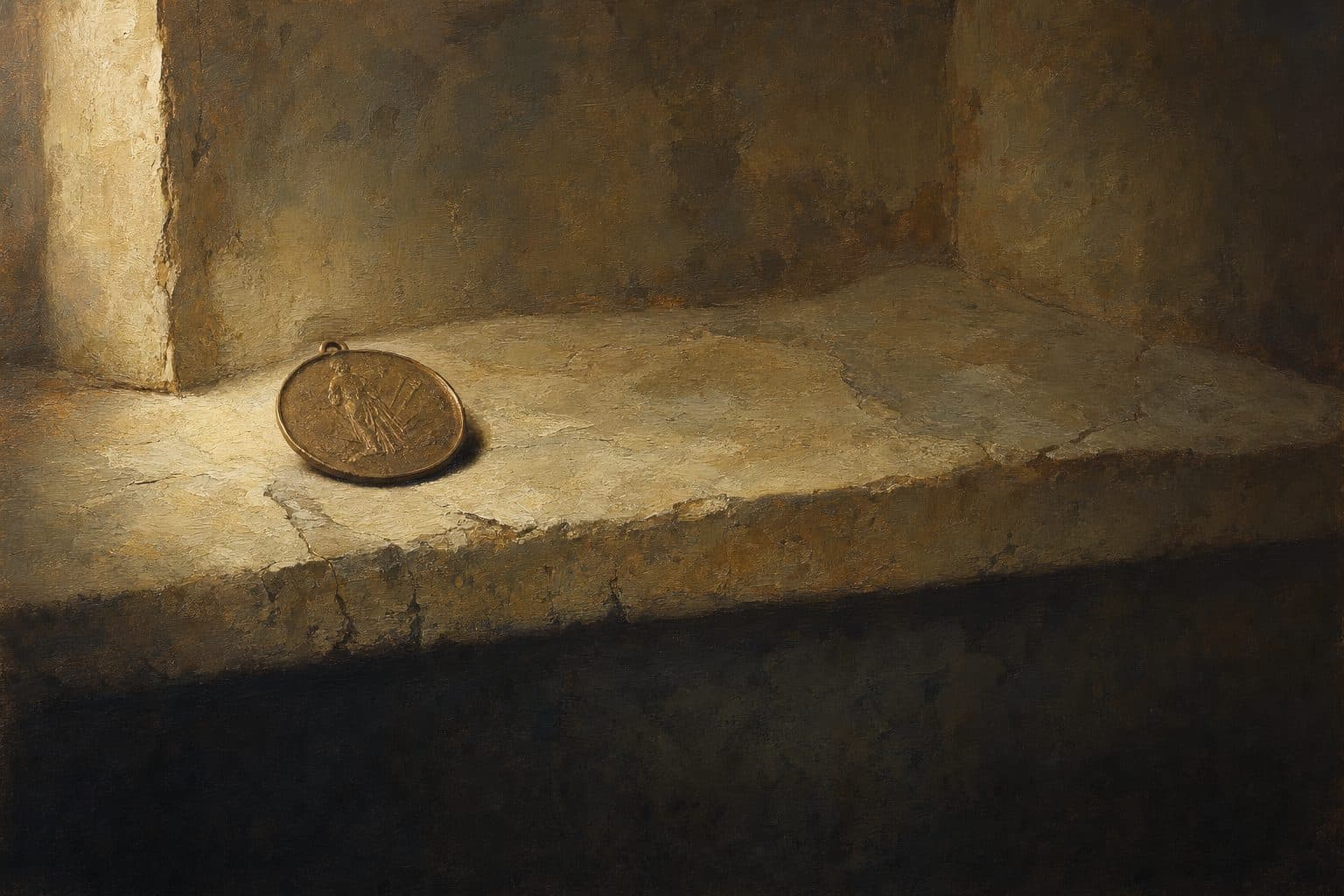
The St. Benedict medal is one of the oldest and most widely used sacramentals in the Catholic Church. On one side is St. Benedict himself, holding a cross and the Rule he wrote. On the other is a cross surrounded by letters, and those letters are why people search for it.
They are not a code, a cipher, or a secret. They are initials, in the ordinary medieval way of abbreviating a sentence everyone already knew. Decoded, they are two Latin prayers and two labels.
Every letter, decoded
On the arms of the cross: CSSML NDSMD
Crux Sacra Sit Mihi Lux, Non Draco Sit Mihi Dux.
May the holy cross be my light, may the dragon never be my guide.
Around the edge: VRSNSMV SMQLIVB
Vade Retro Satana, Nunquam Suade Mihi Vana; Sunt Mala Quae Libas, Ipse Venena Bibas.
Step back Satan, never tempt me with your vanities; what you offer me is evil, drink your poison yourself.
In the corners of the cross: CSPB
Crux Sancti Patris Benedicti. The cross of holy father Benedict.
Above the cross: PAX
Peace. The motto of the Benedictine order, and a deliberate final word after everything else on the medal.
The poison line has a source. Accounts of Benedict’s life include an attempt by monks to poison him, and the cup breaking when he blessed it. The inscription is not a general curse; it is a specific memory.
A careful note about the Vade Retro
Something on this medal needs handling honestly, because a lot of material online gets it wrong.
The edge inscription is addressed to Satan directly. Wearing that inscription is entirely proper and the Church has encouraged this medal for centuries. But there is a real distinction between an inscription carried on a blessed object and a lay person taking up imperative address to a spirit as their own prayer formula.
Catholic practice for the laity is deprecatory: we ask God, Our Lady and the saints to act. Commanding a spirit directly belongs to the solemn rite of exorcism, which under Canon 1172 requires a priest with his bishop’s express permission. That is not a technicality invented recently; it exists because addressing spirits without authority has a long history of going badly for the person doing it.
So: wear the medal, and know what it says. If you want words to pray, use the St. Michael prayer, which asks God to send the archangel Michael rather than commanding anything, and is exactly what the laity are given for this.
How to use it
Have it blessed. Unblessed, it is jewellery. Any priest can bless it and there is a specific blessing for this medal in the Church’s books. It takes under a minute; ask after Mass.
Wear it, or place it. On a chain, on a rosary, in a car, in a wallet, at the doorways of a house, or set into the foundations of a building. There is no rule and no wrong position.
Let it do the one thing an object can do. A medal reminds you, constantly and without words, what you have decided to believe. That is not a small function. Most of what erodes faith does so through forgetting rather than through argument.
Get the Daily Protection Prayer
Free in your inbox every morning
No spam. Unsubscribe anytime. We respect your privacy.
The line between devotion and superstition
This is worth saying plainly, because the medal attracts exactly this error.
A sacramental is not a mechanism. It does not work automatically, it does not work on someone who is treating it as a lucky charm, and it does not work harder if you own more of them. The Catechism classes the mechanical use of holy things as superstition and treats it as a sin against the first commandment, which is a serious classification for a habit most people would call harmless.
The reason is straightforward. A charm is something you use to manage a risk. A sacramental is something the Church prays over so that you carry that prayer with you. One of those is a relationship and one is a technique, and it is possible to swap the first for the second without noticing.
Wear the medal. Have it blessed. Know what it says. And keep going to confession, because that is what actually closes doors, and no medal was ever offered as a substitute for it.
Frequently Asked Questions
What do the letters on the St. Benedict medal mean?
They are initials of Latin sentences rather than a code. On the arms of the cross, CSSML NDSMD stands for Crux Sacra Sit Mihi Lux, Non Draco Sit Mihi Dux: may the holy cross be my light, may the dragon never be my guide. Around the edge, VRSNSMV SMQLIVB stands for Vade Retro Satana, Nunquam Suade Mihi Vana; Sunt Mala Quae Libas, Ipse Venena Bibas. In the corners, CSPB is Crux Sancti Patris Benedicti, the cross of holy father Benedict, and above the cross is the word PAX, peace.
Does the medal have to be blessed?
To be a sacramental, yes. An unblessed medal is a piece of metal with an inscription on it. Any priest can bless one, it takes a moment, and there is a specific blessing for this medal in the Church’s books. Ask after Mass.
How do you wear a St. Benedict medal?
There is no rule. It is commonly worn on a chain, attached to a rosary, kept in a car or a wallet, or placed at the foundations or doorways of a house. What matters is not the position but that wearing it means something to you: it is a profession of what you believe, worn on the body.
Is the medal a charm or protection against evil?
It is not a charm, and the distinction is not pedantic. A sacramental works through the prayer of the Church joined to the disposition of the person using it, not automatically through the object. A medal worn by someone who treats it as a lucky token is not doing what they think. The Catechism classes the mechanical use of holy things as superstition and treats it as a sin against the first commandment.
Who was St. Benedict?
A sixth-century Italian monk who wrote the Rule that shaped Western monasticism and, through it, much of European civilisation. Accounts of his life include attempts to poison him, which is the background to the medal’s inscription about drinking your own poison. He is a patron of Europe, and his feast is July 11.
Get the Daily Protection Prayer
Free in your inbox every morning
No spam. Unsubscribe anytime. We respect your privacy.
Related Prayers
Related Guides
Holy Water: What It Is, How It Is Made, and How to Use It
What holy water actually is, why only a priest or deacon can bless it, whether you can drink it, and how Catholics use it at home. Plainly answered.
Demonic Oppression: The Distinctions the Church Actually Makes
What demonic oppression is, how it differs from temptation and possession, why the Church rules out medical causes first, and what a lay Catholic may pray.
The full daily armour routine
Sacramentals are one part of a routine. The course covers the whole of it.
Start Free TrialFull access includes all 8 chapters, guided prayer, and deeper community features.
Upcoming · Sep 23
St. Padre PioSee the full liturgical calendar — every feast this year, and an embed for your parish site.