Prayer · Emergency
The Jesus Prayer: “Lord Jesus Christ, Son of God, Have Mercy on Me, a Sinner”
Lord Jesus Christ, have mercy on me
The Jesus Prayer is the short prayer “Lord Jesus Christ, Son of God, have mercy on me, a sinner.” It comes from the monks of the Christian East, the “spiritual writers of the Sinai, Syria, and Mt. Athos”, as the Catechism says (CCC 2667), and it joins the confession that Jesus is Lord to the cry for mercy of the tax collector and the blind men in the Gospels. It is prayed by repeating it slowly and attentively, often many times, sometimes in rhythm with the breath, as a way of obeying St. Paul’s “pray without ceasing”. Catholics and Orthodox both pray it.
THE JESUS PRAYER
This ancient prayer, used by Christians for over 1,500 years, is one of the most powerful short prayers in existence. Repeat it slowly, from the heart:
"Lord Jesus Christ, Son of God, have mercy on me, a sinner."
HOW TO PRAY:
1. Breathe in slowly as you pray: "Lord Jesus Christ, Son of God..."
2. Breathe out slowly as you pray: "...have mercy on me, a sinner."
3. Repeat continuously, letting the prayer sync with your breathing.
This prayer can be prayed anywhere, anytime — walking, driving, lying in bed, in moments of fear or temptation. The Desert Fathers taught that this prayer, prayed continuously, becomes a shield against every spiritual attack.
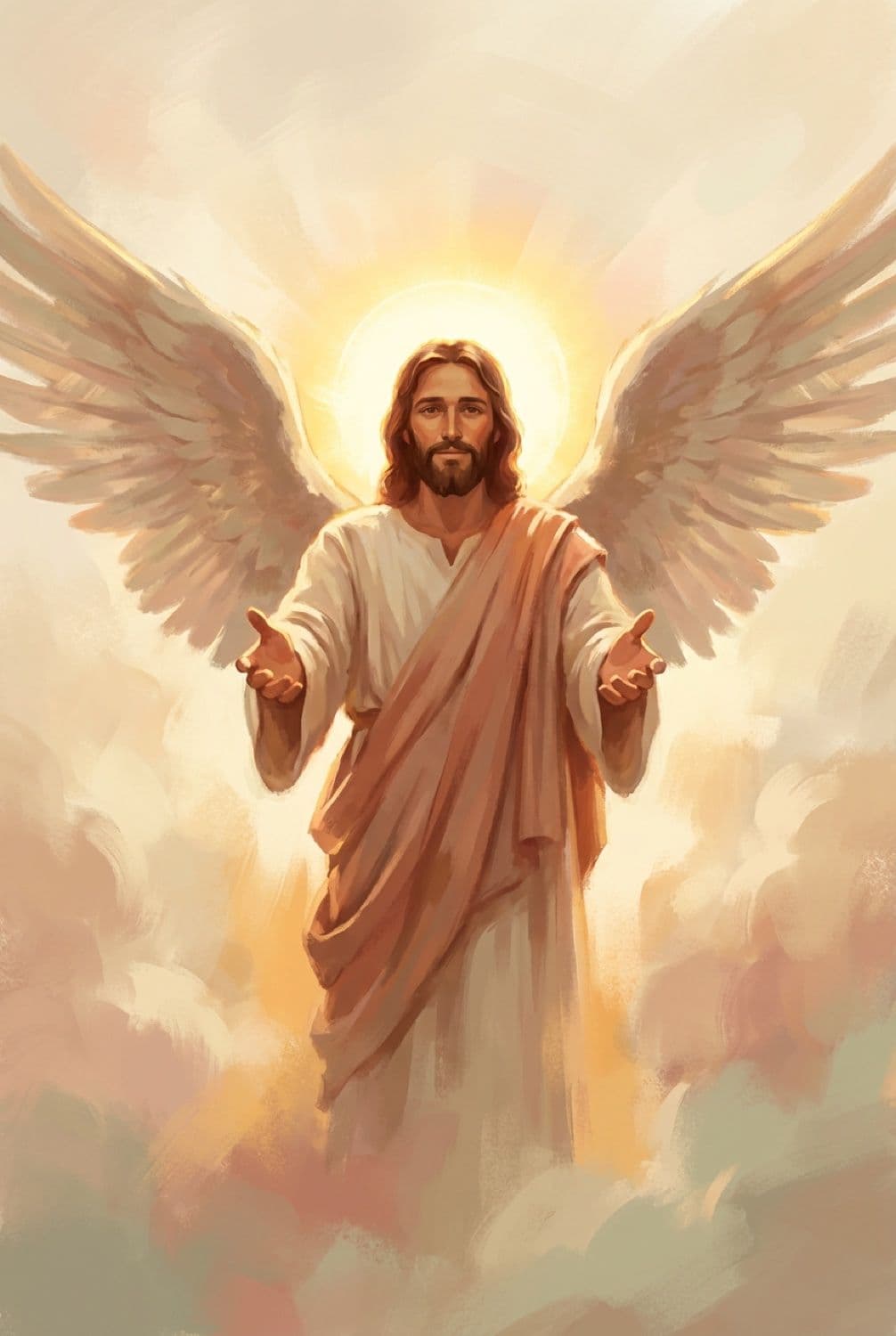
When you are under attack, the name of Jesus is your most powerful weapon. Demons cannot stand before His name. They must flee.
"That in the name of Jesus every knee should bow, of those that are in heaven, on earth, and under the earth." — Philippians 2:10
Go deeper
The words of the Jesus Prayer, and its shorter forms
1 min readThe most common form is the one above: “Lord Jesus Christ, Son of God, have mercy on me, a sinner.”
The most common form is the one above: “Lord Jesus Christ, Son of God, have mercy on me, a sinner.” It has several shorter and longer forms, all of them the same prayer:
- “Lord Jesus Christ, Son of God, have mercy on us sinners”: the form the Catechism gives (CCC 2667), for praying with or for others.
- “Lord Jesus Christ, Son of God, have mercy on me”: the form in The Way of a Pilgrim, and in the Holy See’s 1989 letter on Christian meditation.
- “Lord Jesus Christ, have mercy on me.”
- “Lord Jesus, have mercy.”
- Simply “Jesus”: “the one name that contains everything” (CCC 2666).
None of these is more effective than another. The tradition’s advice is to choose one form and keep to it, so that the words become familiar enough to carry attention rather than demand it. The name is what matters: “To pray ‘Jesus’ is to invoke him and to call him within us” (CCC 2666).
Where the words come from in Scripture
2 min readThe Catechism says the prayer “combines the Christological hymn of Philippians 2:6-11 with the cry of the publican and the blind men begging for light” (CCC 2667).
The Catechism says the prayer “combines the Christological hymn of Philippians 2:6-11 with the cry of the publican and the blind men begging for light” (CCC 2667). Each part has a Gospel behind it:
- “Lord Jesus Christ”: the confession at the end of that hymn, that “every tongue should confess that Jesus Christ is Lord” (Philippians 2:11).
- “Son of God”: the faith of Peter and of the centurion at the Cross.
- “Have mercy on me”: the blind man at Jericho, who kept shouting over the crowd, “Jesus, you son of David, have mercy on me!” (Luke 18:38).
- “A sinner”: the tax collector in the Temple, who would not lift his eyes, praying “God, be merciful to me, a sinner!” (Luke 18:13), and went home justified.
And the practice of repeating it answers a command: “Pray without ceasing” (1 Thessalonians 5:17). Is repeating it the “vain repetitions” Jesus warns against (Matthew 6:7)? The Catechism answers directly: when the holy name is repeated “by a humbly attentive heart, the prayer is not lost by heaping up empty phrases” (CCC 2668). The warning is against thinking we will be heard for many words; the Jesus Prayer is the opposite, a few words that hand everything over.
Where the Jesus Prayer comes from: the desert, Sinai and Athos
1 min readIts roots are in the Egyptian desert of the fourth and fifth centuries, where the Desert Fathers and Mothers taught short, repeated prayers as a way of keeping the mind on God through a day of work.
Its roots are in the Egyptian desert of the fourth and fifth centuries, where the Desert Fathers and Mothers taught short, repeated prayers as a way of keeping the mind on God through a day of work. The Catechism names the traditions that shaped the prayer into its usual form: “the spiritual writers of the Sinai, Syria, and Mt. Athos” (CCC 2667).
Some milestones. St. John Climacus, abbot of the monastery at Mount Sinai, who died in the seventh century, recommended in his Ladder of Divine Ascent a “one-worded” prayer, the name of Jesus, prayed often. A discourse on Abba Philemon, who lived around the year 600, gives the words almost exactly as we say them today: “Lord Jesus Christ, Son of God, have mercy upon me.” In the fourteenth century the monks of Mount Athos, defended by St. Gregory Palamas, made it the center of hesychasm, the prayer of stillness (hesychia).
So the prayer is old, but it was not written at one sitting. It grew, the way a path grows by being walked, from the desert’s one-word cries to the full sentence the Eastern Churches hand on today.
The Philokalia and The Way of a Pilgrim
1 min readTwo books carried the Jesus Prayer from the monasteries to the whole world.
Two books carried the Jesus Prayer from the monasteries to the whole world.
The Philokalia, “love of the beautiful”, is an anthology of writings on prayer by Eastern monks and bishops across many centuries. It was compiled by St. Nikodemos of the Holy Mountain and St. Makarios of Corinth and first published in Greek at Venice in 1782. St. Paisius Velichkovsky’s Slavonic translation appeared in Moscow in 1793, and St. Theophan the Recluse made a five-volume Russian version in 1877. An English translation began in 1979.
The Way of a Pilgrim is a short Russian book, anonymous, first published in Kazan in 1884. Its narrator hears St. Paul’s “pray without ceasing” and cannot stop wondering how it is possible. He walks from church to monastery asking, until a spiritual father, a starets, teaches him the Jesus Prayer, and he sets off across Russia with the Slavonic Philokalia in his bag, praying it.
In the twentieth century the Pilgrim became a classic in the West too; J. D. Salinger’s Franny and Zooey (1961) turned a generation of readers toward it. It is an easy, moving book to read, and a good way to learn the prayer’s spirit before its method.
How to pray the Jesus Prayer
2 min readThe method is very simple; the tradition’s warnings are about not making it complicated.
The method is very simple; the tradition’s warnings are about not making it complicated.
- Sit quietly, somewhere you will not be interrupted, for a few minutes to begin with: five or ten is plenty.
- Say the prayer slowly, aloud or silently: “Lord Jesus Christ, Son of God, have mercy on me, a sinner.” Mean each word. Do not hurry to the end.
- Keep your attention on the words, not on images or feelings. When the mind wanders, and it will, come back to the next word without scolding yourself. Coming back is the prayer.
- Let it follow your breathing, if that helps: “Lord Jesus Christ, Son of God” as you breathe in, “have mercy on me, a sinner” as you breathe out. The Holy See’s 1989 letter on Christian meditation says that this practice “can, at least for a certain time, be of real help to many people”, and adds that not everyone is suited to such methods (Orationis formas 27). It is an aid, not the point.
- Carry it into the day. Once the words are familiar, pray them while walking, waiting, washing up, falling asleep. This is what the Catechism means by “the simplest way of praying always” (CCC 2668).
In the Eastern Churches many pray it on a prayer rope, a knotted cord (komboskini in Greek, chotki in Russian), one knot for each prayer, the way a rosary counts Hail Marys. The more intensive methods of the hesychast tradition, long periods and bodily techniques, have always been taught under the guidance of a spiritual director, and the tradition insists that the prayer is not a technique for producing calm or experiences. It is a cry to a Person. If you want to go further, ask a priest or spiritual director to guide you.
Can Catholics pray the Jesus Prayer?
1 min readYes.
Yes. It is in the Catechism of the Catholic Church, which quotes it and calls the invocation of the name of Jesus “the simplest way of praying always” (CCC 2667–2668). It is an Eastern Christian treasure, prayed in the Eastern Catholic Churches as in the Orthodox Churches, and the Latin Church has received it gratefully; the 1989 letter on Christian meditation points to it as an example of how Eastern Christian prayer can help Western Christians (Orationis formas 27).
It sits naturally beside Western devotions to the same name: the Holy Name of Jesus, and the Divine Mercy prayer, whose short form “Jesus, I trust in you” is another cry of the same kind. The Divine Mercy Chaplet repeats its own petition for mercy on every bead.
The Jesus Prayer in fear, panic and temptation
1 min read
Because it is short and can be said on one breath, the Jesus Prayer is the prayer many people reach for when they cannot pray anything longer: in fear, in a wave of panic, in the middle of the night, or in a moment of temptation. That is a very old use of it. The desert monks used short prayers exactly this way, to turn to God the moment a troubling thought came.
If fear or panic is frequent, severe, or keeps you from living your life, please speak to a doctor: panic and anxiety are treatable, and prayer and medical care go together. If you are in danger now, reach help first.
Lord Jesus Christ, Son of God, have mercy on me, a sinner.
Lord Jesus Christ, Son of God, have mercy on me, a sinner.
Lord Jesus Christ, Son of God, have mercy on me, a sinner.
The prayer does not promise that the fear will vanish on the spot. It keeps you with Christ while it passes, which is the thing that matters. For spiritual fear in particular there is a prayer against spiritual attack, and for anxiety, a short way of praying Philippians 4:6–7.
Questions
What is the full Jesus Prayer?
“Lord Jesus Christ, Son of God, have mercy on me, a sinner.” The Catechism gives it as “Lord Jesus Christ, Son of God, have mercy on us sinners” (CCC 2667). Shorter forms, down to the name “Jesus” alone, are the same prayer.
What is considered the Jesus Prayer?
The short invocation of the name of Jesus with a plea for mercy, repeated attentively, that grew up among the monks of the Christian East, “the spiritual writers of the Sinai, Syria, and Mt. Athos” (CCC 2667). It is prayed by both Catholics and Orthodox.
Where does the Jesus Prayer come from in the Bible?
It joins the confession that “Jesus Christ is Lord” (Philippians 2:11) to the cry of the blind man, “Jesus, you son of David, have mercy on me!” (Luke 18:38), and the tax collector’s “God, be merciful to me, a sinner!” (Luke 18:13).
How do you pray the Jesus Prayer?
Sit quietly, say the words slowly and attentively, and when your mind wanders, return to the words. Some let the prayer follow the breath, the first half breathing in and the second breathing out. Then carry it into the day: walking, waiting, falling asleep.
Is repeating the Jesus Prayer “vain repetition”?
No. The Catechism says that when the name of Jesus is repeated “by a humbly attentive heart, the prayer is not lost by heaping up empty phrases” (CCC 2668). The warning in Matthew 6:7 is against expecting to be heard for many words.
Can Catholics pray the Jesus Prayer?
Yes. It is in the Catechism of the Catholic Church (CCC 2667–2668), and the Holy See’s 1989 letter on Christian meditation commends it as a real help to many people (Orationis formas 27).
What is the Philokalia?
An anthology of Eastern Christian writings on prayer, compiled by St. Nikodemos of the Holy Mountain and St. Makarios of Corinth and published at Venice in 1782. Its Slavonic translation is the book the pilgrim carries in The Way of a Pilgrim.
What is The Way of a Pilgrim?
An anonymous Russian book, first published in Kazan in 1884, about a wanderer who learns the Jesus Prayer from a spiritual father while searching for how to “pray without ceasing”. It made the prayer known far beyond the monasteries.
What is a prayer rope?
A knotted cord used in the Eastern Churches to count repetitions of the Jesus Prayer, one per knot; komboskini in Greek, chotki in Russian. It plays the part a rosary plays for the Hail Mary.

Guided narration · How it’s made
Upcoming · Sep 29
Sts. Michael, Gabriel and RaphaelSee the full liturgical calendar — every feast this year, and an embed for your parish site.