
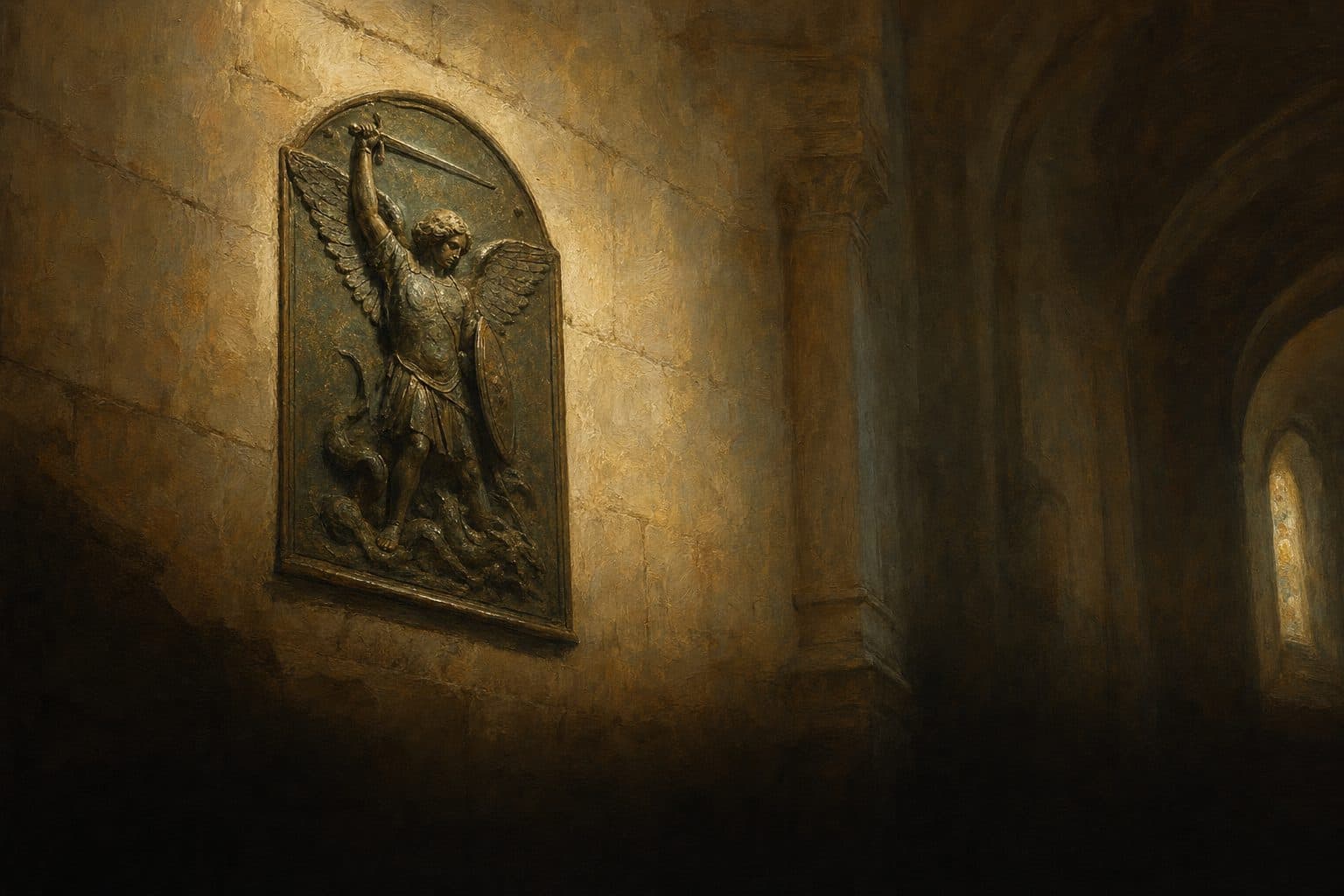
The Chaplet of St. Michael
Nine salutations, one for each choir of angels, and what is actually promised
The Chaplet of St. Michael is nine salutations, one addressed to each of the nine choirs of angels, each followed by one Our Father and three Hail Marys. Four more Our Fathers close it: for St. Michael, St. Gabriel, St. Raphael, and your own guardian angel. It takes about fifteen minutes and needs no special beads, though chaplets made for it exist.
Quick Summary
- Nine salutations, one per choir of angels, in the traditional order
- Each is followed by one Our Father and three Hail Marys
- Four closing Our Fathers: St. Michael, St. Gabriel, St. Raphael, your guardian angel
- About fifteen minutes; ordinary rosary beads work
- Its origin is a private revelation, and the documentation for it is thin
- Pope Pius IX indulgenced it on August 8, 1851, which approves the prayer, not the promises
Full Explanation
The Chaplet of St. Michael is built on the nine choirs of angels, and that is the thing to understand before praying it. It is not nine repetitions of the same prayer. Each salutation addresses a different rank of the heavenly host, in the traditional order: Seraphim, Cherubim, Thrones, Dominions, Powers, Virtues, Principalities, Archangels, and Angels. After each, one Our Father and three Hail Marys.
When the nine are finished, four Our Fathers close it — one for St. Michael, one for St. Gabriel, one for St. Raphael, and one for your own guardian angel. That last is the hinge of the whole devotion. It moves from the seraphim, who are as far from you as anything in creation, down to the one assigned to you personally, and the descent is the point.
The origin is where honesty is required. The chaplet is traditionally attributed to a private revelation given to a Carmelite, Antonia d’Astonac, in which St. Michael is said to have asked for this form of prayer and attached promises to it. The documentation for that account is thin, and dates given for her vary between sources. This is not a reason to avoid the devotion, which the Church permits and which has been prayed for a long time. It is a reason to be careful about how the promises are held.
Those promises, in the usual telling, include an escort of one angel from each choir when approaching Holy Communion, and assistance in life and after death for those who pray it. As with the Twelve Promises of the Sacred Heart, this is private revelation. The Church does not oblige belief in it, and a devotion prayed to collect on a promise has become a transaction. Pray it because the nine choirs are worth thinking about one at a time.
If you want the structure without the beads, the chaplet works perfectly well counted on an ordinary rosary: nine sets of four, then four more. Chaplets made for it follow the same shape, nine groups of one large and three small beads and four more beads for the closing Our Fathers, usually with a medal of St. Michael.
The Chaplet of St. Michael: the full prayer
This is the chaplet word for word as EWTN prints it. Every prayer in it is addressed to God, asking through the intercession of St. Michael and each choir of angels, or to St. Michael, asking him to pray and to protect; nothing in it addresses an evil spirit.
O God, come to my assistance. O Lord, make haste to help me. Glory be to the Father, etc. [Say one Our Father and three Hail Marys after each of the following nine salutations in honor of the nine Choirs of Angels] 1. By the intercession of St. Michael and the celestial Choir of Seraphim may the Lord make us worthy to burn with the fire of perfect charity. Amen. 2. By the intercession of St. Michael and the celestial Choir of Cherubim may the Lord grant us the grace to leave the ways of sin and run in the paths of Christian perfection. Amen. 3. By the intercession of St. Michael and the celestial Choir of Thrones may the Lord infuse into our hearts a true and sincere spirit of humility. Amen. 4. By the intercession of St. Michael and the celestial Choir of Dominions may the Lord give us grace to govern our senses and overcome any unruly passions. Amen. 5. By the intercession of St. Michael and the celestial Choir of Powers may the Lord protect our souls against the snares and temptations of the devil. Amen. 6. By the intercession of St. Michael and the celestial Choir of Virtues may the Lord preserve us from evil and falling into temptation. Amen. 7. By the intercession of St. Michael and the celestial Choir of Principalities may God fill our souls with a true spirit of obedience. Amen. 8. By the intercession of St. Michael and the celestial Choir of Archangels may the Lord give us perseverance in faith and in all good works in order that we may attain the glory of Heaven. Amen. 9. By the intercession of St. Michael and the celestial Choir of Angels may the Lord grant us to be protected by them in this mortal life and conducted in the life to come to Heaven. Amen. Say one Our Father in honor of each of the following leading Angels: St. Michael, St. Gabriel, St. Raphael and our Guardian Angel. Concluding prayers: O glorious prince St. Michael, chief and commander of the heavenly hosts, guardian of souls, vanquisher of rebel spirits, servant in the house of the Divine King and our admirable conductor, you who shine with excellence and superhuman virtue deliver us from all evil, who turn to you with confidence and enable us by your gracious protection to serve God more and more faithfully every day. Pray for us, O glorious St. Michael, Prince of the Church of Jesus Christ, that we may be made worthy of His promises. Almighty and Everlasting God, Who, by a prodigy of goodness and a merciful desire for the salvation of all men, has appointed the most glorious Archangel St. Michael Prince of Your Church, make us worthy, we ask You, to be delivered from all our enemies, that none of them may harass us at the hour of death, but that we may be conducted by him into Your Presence. This we ask through the merits of Jesus Christ Our Lord. Amen.
Two small differences between printed versions are worth knowing, so that neither worries you. Some texts, including another page of EWTN’s own, put the Virtues fifth and the Powers sixth; the text above, like the old Raccolta, puts the Powers first. The order of the middle choirs has never been fixed: Pseudo-Dionysius and St. Gregory the Great ranked them differently, and St. Thomas Aquinas called both orders reasonable; see the hierarchy of angels. And some texts say “Dominations” where this one says “Dominions”. Either way it is the same prayer.
How to pray the St. Michael chaplet, step by step
- Begin on the medal or the first bead with “O God, come to my assistance. O Lord, make haste to help me,” and a Glory Be.
- First salutation, to the Seraphim, then one Our Father on the large bead and three Hail Marys on the three small ones.
- Repeat for the other eight choirs in order, Cherubim to Angels: each time the salutation, one Our Father and three Hail Marys. That is nine groups of four beads.
- Four more Our Fathers on the four beads nearest the medal: in honour of St. Michael, St. Gabriel, St. Raphael and your guardian angel.
- Close with “O glorious prince St. Michael…”, the versicle “Pray for us, O glorious St. Michael…”, and the prayer “Almighty and Everlasting God…”.
Without a chaplet, use an ordinary rosary: the Our Father bead and the first three Hail Mary beads of each decade serve for one choir, and five decades and the pendant give you more than enough beads for nine groups and four closing Our Fathers. Or count on your fingers. The beads are a help, not a requirement. At an unhurried pace the whole chaplet takes about fifteen minutes.
The nine salutations: what each choir is asked for
Each salutation asks God, through St. Michael and one choir of angels, for one grace, and the order is not random. It begins with love, the Seraphim’s fire, and ends with the angels who guard us in this life and lead us home:
- Seraphim: perfect charity.
- Cherubim: to leave the ways of sin and follow the way of Christian perfection.
- Thrones: a true spirit of humility.
- Dominions: to govern our senses and overcome unruly passions.
- Powers: protection against the snares and temptations of the devil.
- Virtues: to be kept from evil and from falling into temptation.
- Principalities: a true spirit of obedience.
- Archangels: perseverance in faith and good works.
- Angels: their protection in this life and their guidance into heaven.
Read as a whole, it is a short course in the Christian life: love, conversion, humility, self-mastery, protection, obedience, perseverance, and the last things. That is why many people pray it daily. And it matches the Scripture it stands on: “For he will put his angels in charge of you, to guard you in all your ways” (Psalm 91:11).
Where the Chaplet of St. Michael comes from
The usual story, printed by EWTN among others, is that a Servant of God named Antonia d’Astonac had a vision of St. Michael, who asked to be honoured by nine salutations to the nine choirs. Many pages add that she was a Portuguese Carmelite and that the vision took place in 1751. We could not find a source for either detail.
The oldest account we could read is the English Raccolta of 1857, the official collection of indulgenced prayers. It calls the origin “a pious tradition”: that St. Michael told “a holy personage” that he would be pleased by these prayers. It then says that “a holy Carmelite nun, of the convent of Vetralla, in the diocese of Viterbo, who died with the reputation of sanctity in the year 1751, made it her delight to practise this method of prayer”, and that it was at the request of the nuns of her convent that the Pope indulgenced it. So the one firm date is her death, in Italy, and she is not named.
A vision like this, if it happened, is a private revelation. The Catechism is clear about how the Church holds those: some “have been recognized by the authority of the Church”, but “They do not belong, however, to the deposit of faith. It is not their role to improve or complete Christ’s definitive Revelation, but to help live more fully by it in a certain period of history” (CCC 67). No Catholic has to believe the chaplet began with an apparition. Its prayers stand on their own.
What the Church approved: Pius IX and the indulgence of 1851
What is documented is that the Church adopted the prayer. By a decree of the Sacred Congregation of Rites dated August 8, 1851, Pope Pius IX granted indulgences to those who prayed the chaplet, at the request of the Carmelite nuns of Vetralla. The grant is recorded in the 1857, 1878 and 1910 editions of the Raccolta. Those particular grants belong to the old Raccolta and were superseded when the Church revised its list of indulgences in 1968, so they should not be quoted as current.
That approval is an approval of the prayer: it is sound, it is Catholic, and the Church encourages it. It is not a confirmation of the vision or of the promises attached to the chaplet, and the Raccolta speaks only of “signal favours”, not of any of them.
The promises of the St. Michael chaplet
As EWTN gives them, St. Michael promised that whoever practises this devotion would have, when approaching Holy Communion, an escort of nine angels, one from each choir, and that those who pray the chaplet daily would have his continual help and that of all the holy angels during life. One of EWTN’s two pages adds deliverance from purgatory after death for them and their relations; the other does not, and the 1857 Raccolta speaks only of “signal favours”.
These promises belong to the private-revelation account, not to the Church’s teaching. They can be held with devotion; they cannot be held as a guarantee. The Catechism names the risk precisely: to attribute the efficacy of prayers “to their mere external performance, apart from the interior dispositions that they demand, is to fall into superstition” (CCC 2111). Pray the chaplet for what it asks, charity, humility, perseverance and protection, and leave the rest to God.
Many people pray it through the nine days before Michaelmas as a St. Michael novena, or close it with the short prayer to St. Michael the Archangel of Pope Leo XIII.
Who the archangel is in Scripture and in the Church’s calendar: St. Michael the Archangel — Daniel, Jude and Revelation, and why the Church invokes him against evil.
Praying toward his feast? The St. Michael novena runs nine days, from September 20 to the eve of Michaelmas on September 29.
What the Bible Says
There was war in heaven: Michael and his angels fought against the dragon.
The passage the whole devotion stands on, and the reason St. Michael rather than another archangel is asked for defence.
For by him all things were created, in the heavens and on the earth, things visible and things invisible, whether thrones or dominions or principalities or powers.
Four of the nine choirs are named here. The list of nine is assembled from passages like this one; it is a tradition of ordering rather than a single revealed list.
Above him stood the seraphim, and one called to another, Holy, holy, holy.
The first salutation addresses these. Whatever else the chaplet does, it begins by putting you in a room where that is going on.
What the Catechism Says
CCC 328The existence of the spiritual, non-corporeal beings that Sacred Scripture usually calls angels is a truth of faith.
CCC 336From its beginning until death, human life is surrounded by their watchful care and intercession. Beside each believer stands an angel as protector and shepherd leading him to life.
CCC 350Angels are spiritual creatures who glorify God without ceasing and who serve his saving plans for other creatures.
Common Questions
Related Prayers
Related Topics
Upcoming · Oct 28
Sts. Simon and Jude
See the full liturgical calendar — every feast this year, and an embed for your parish site.