Novena
The St. Michael Novena
Nine days asking St. Michael to defend you and yours, September 20 to 28, with a prayer and narration each day.
The St. Michael novena is nine days of prayer asking St. Michael the Archangel to intercede for protection, each day with its own intention, from defense to eternal glory. To close on the eve of Michaelmas, September 29, pray it September 20 to 28, or begin on any day.
Quick facts
- Prayed to:
- St. Michael the Archangel
- Feast day:
- September 29, the Feast of Sts. Michael, Gabriel and Raphael (Michaelmas)
- When to pray:
- Begin on September 20 so that the ninth day falls on September 28, the eve of the Feast of Sts. Michael, Gabriel and Raphael — Michaelmas. Many people pray it at other times too, and there is no rule that ties it to the feast.
- Prayed for:
- Protection, courage under spiritual attack, and defence for the people in your care.
When to start the St. Michael novena: September 20 to 28
The feast of St. Michael the Archangel is September 29, which the Church keeps as the one feast of Sts. Michael, Gabriel and Raphael, and which is still called Michaelmas. To finish the novena on the eve of the feast, so that the feast itself is the day of thanksgiving, begin on September 20:
- Day 1: September 20, St. Michael, defender of the Church
- Day 2: September 21, healer of body and soul
- Day 3: September 22, guide for our decisions
- Day 4: September 23, protector of the family
- Day 5: September 24, intercessor for the holy souls
- Day 6: September 25, guardian of the Church
- Day 7: September 26, calling souls to conversion
- Day 8: September 27, for a holy death
- Day 9: September 28, the eve of Michaelmas, the crown of eternal glory
If you would rather the ninth day fall on the feast itself, begin one day later, on September 21. Both are sound; the only difference is which day you want to be the last. And the calendar is a custom, not a condition. Most people who pray this novena begin it on the day they need it, in March or in July, and count nine days from there.
What each of the nine days prays for
Every day follows the same pattern: the Sign of the Cross, a passage of Scripture about the angels, a prayer for that day’s intention, your own intention named in silence, and the prayer to St. Michael the Archangel that Pope Leo XIII gave the Church. What changes is the intention, and the order is deliberate. It moves outward from yourself to the people you love, to the dead and the Church, and ends at the last things.
- Defender. The war in heaven of Revelation 12, and a request for defence of body, soul and the people you love.
- Healer. The aches, the diagnoses and the old wounds of the heart, brought to the one the day calls the Great Physician.
- Guide. “Aren’t they all serving spirits, sent out to do service for the sake of those who will inherit salvation?” (Hebrews 1:14). Decisions, and the courage to follow the right one.
- Family. Each person at home, by name, and the peace of the house.
- The holy souls. Your own dead by name, and the dead no one prays for.
- The Church. The Pope, the bishops, priests, and the parish you belong to.
- Conversion. The people you have prayed for so long you sometimes lose hope, and your own lukewarm places.
- A holy death. The old prayer that St. Michael, the standard-bearer, lead the dead into the holy light.
- Eternal glory. The great multitude of Revelation 7, and the goal of all the others.
Each day is written out in full and narrated on its own page, linked in the list above, so the novena can be prayed by reading or by listening. The St. Michael novena with audio starts at Day 1 and plays straight through for anyone who would rather listen than read.
Which prayer to add each day
The one prayer that belongs to every day of this novena is the short prayer to St. Michael the Archangel, “St. Michael the Archangel, defend us in battle…”, which Pope Leo XIII added to the prayers after Low Mass in 1886 and which the whole Latin Church said there until 1964. It is already inside each day’s prayer. If you pray a novena of your own words instead, close each day with it; the full text, its history and what it asks for are on the page for the St. Michael prayer.
Some people pray the Chaplet of St. Michael on each of the nine days as well, or instead. The chaplet has its own nine-fold shape, one salutation for each choir of angels, and it takes about fifteen minutes, so it suits a novena kept in the evening. Neither is required. One prayer, said faithfully for nine days, is the whole of a novena.
Who is St. Michael? The four places Scripture names him
St. Michael appears by name four times in the Bible, and each one explains something the novena asks for. In Daniel an angel tells the prophet that when he was opposed for twenty-one days, “Michael, one of the chief princes, came to help me” (Daniel 10:13), which is St. Michael the Archangel as the one who comes to help. Later in Daniel he is the protector of God’s people in the worst of times: “At that time Michael will stand up, the great prince who stands for the children of your people” (Daniel 12:1), the archangel standing guard.
The Letter of Jude gives the most surprising picture of the archangel:
But Michael, the archangel, when contending with the devil and arguing about the body of Moses, dared not bring against him an abusive condemnation, but said, “May the Lord rebuke you!” (Jude 1:9)
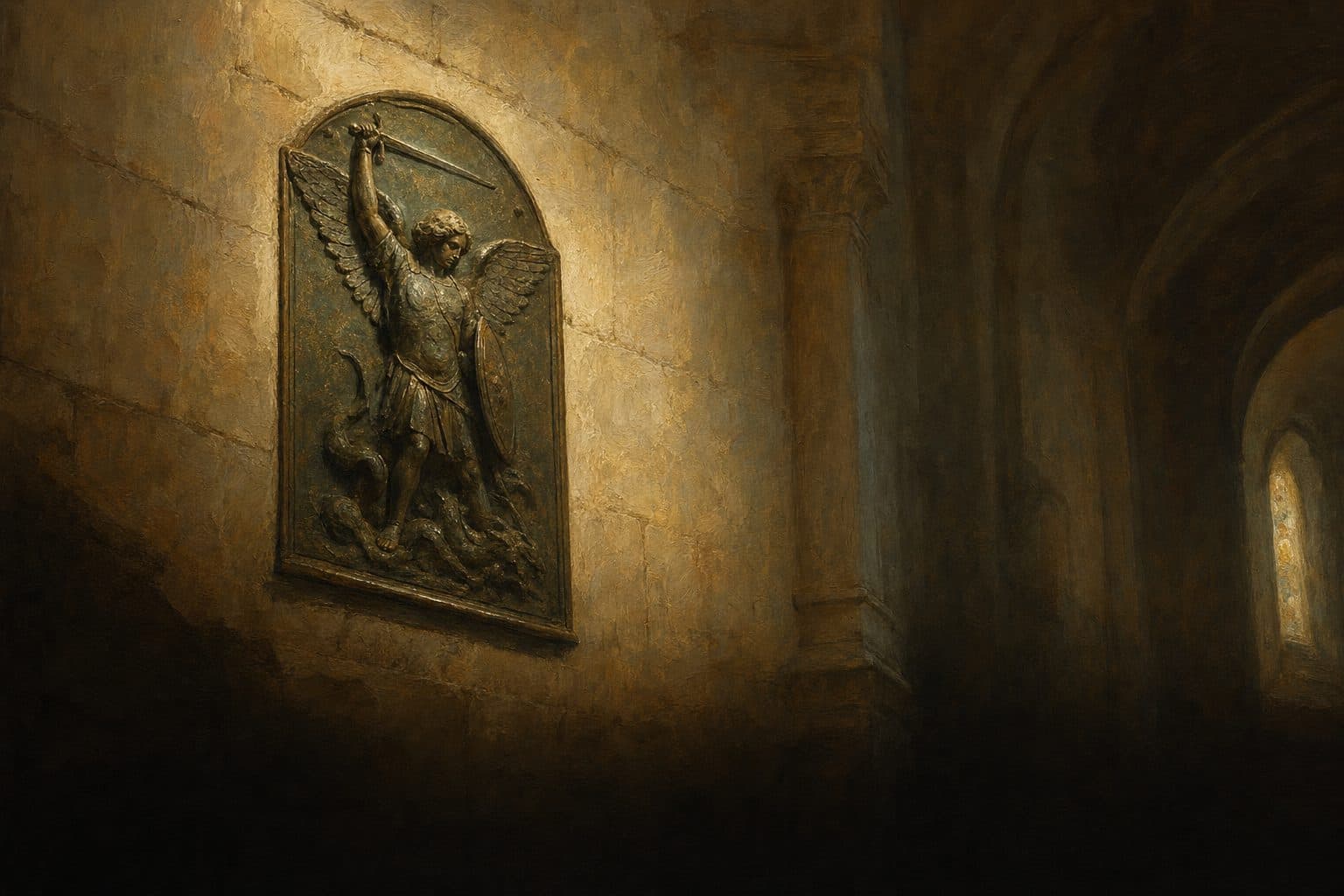
Even the archangel does not rebuke the devil on his own authority; he leaves it to God. That is exactly why the novena asks God to act rather than addressing evil spirits directly. And Revelation gives the image every statue is made from: “There was war in the sky. Michael and his angels made war on the dragon” (Revelation 12:7), the archangel at the head of the host.
His name is itself a question, Who is like God?, and it is the whole of his theology: no creature is. For his life and patronages, see the page on St. Michael the Archangel.
What if I start late or miss a day?
If you find this page after September 20, begin today. You can pray the nine days straight through and let them run past the feast, or pray two days together until you catch up. Neither is wrong, and a novena that ends on September 30 is not a failed novena. If you miss a day in the middle, pray it with the next one, or add a day at the end.
The reason for nine days is the nine days Mary and the apostles spent in prayer between the Ascension and Pentecost: “All these with one accord continued steadfastly in prayer and supplication, along with the women and Mary the mother of Jesus, and with his brothers” (Acts 1:14). What that asks of you is perseverance, the thing Jesus taught in the parable of the widow “that they must always pray and not give up” (Luke 18:1). It is not a count that has to come out right.
Is the St. Michael novena guaranteed to work?
No novena is, and a St. Michael novena is sometimes passed around with promises that it “never fails” or must be shared with a number of people. Ignore both. The Catechism names the error behind them: attributing the power of prayers to their merely external performance, apart from the interior dispositions they demand, is superstition (CCC 2111). A novena is not a mechanism that obliges God on the ninth day.
What it is, is asking: nine days of asking God, with St. Michael’s intercession, to protect what you cannot protect yourself. God answers every prayer, and not always with the thing asked for. Sometimes what changes first is your own fear. That is not a small answer.
“When Michael the archangel, disputing with the devil, contended about the body of Moses, he durst not bring against him the judgment of railing speech, but said: The Lord command thee.”
Go deeper
What is this novena?
The St. Michael Novena is nine consecutive days of prayer asking the archangel to intercede for protection. St. Michael is the one Scripture places at the head of the heavenly host, and the Church has turned to him under threat for as long as there has been a Church. A novena is simply nine days of asking for the same thing. The number comes from the nine days the apostles and Mary spent in prayer between the Ascension and Pentecost, which is the first novena and the pattern for every one since. Nothing about it is magical. It is a way of not giving up after one attempt, and of letting a request settle into something steadier than a moment of panic. What makes the St. Michael novena distinctive is its register. It is not a novena of consolation. It is a novena of defence, prayed by people who feel exposed, and the Church has always kept it firmly within what a lay person may pray: we ask God to send St. Michael, we do not command spirits ourselves. That distinction matters and it is not a technicality. Commanding a spirit directly belongs to the solemn rite of exorcism, which under Church law is reserved to a priest with his bishop’s express permission. What you are doing across the nine days is asking, repeatedly and specifically, for God to place his protection over something you cannot protect yourself. That is the whole shape of it, and it is available to anyone.
Keeping the nine days
Pray the same prayer once a day for nine days in a row. Pick a fixed time and keep it there, because the hardest part of any novena is day four, when the novelty is gone and the answer has not come. Name your intention on the first day and keep it the same throughout. A novena that changes its request each day is nine separate prayers rather than one sustained one. If you miss a day, carry on rather than restarting. There is no rule that a broken novena is void. The tradition of nine unbroken days is a discipline, not a mechanism, and the point of it is your perseverance rather than an unbroken chain. The nine days below are the ones AngelGuard publishes, each with its own short reflection and prayer, and each is narrated if you prefer to listen.
The ninth day falls on September 28, the eve of the Feast of Sts. Michael, Gabriel and Raphael — Michaelmas. Many close each of the nine days with the Prayer to St. Michael the Archangel — the short petition Pope Leo XIII gave the whole Church in 1886, with its longer form and narrated audio.
On the feast itself, some pray the Chaplet of St. Michael as well: a salutation to each of the nine choirs of angels, and an honest account of where the devotion comes from.
When there is no time for nine days, St Teresa of Calcutta prayed a Flying Novena instead: the Memorare nine times in a row, and a tenth in thanks.
St. Michael is also the patron saint of police officers — why the patronage fits, and the prayer most often carried.
The nine days
Questions people ask
When should I start the St. Michael novena?
Begin on September 20 if you want the ninth day to fall on September 28, the eve of the Feast of Sts. Michael, Gabriel and Raphael (Michaelmas, September 29). It can be prayed at any time of year, and many people pray it whenever they feel they need it rather than tying it to the calendar.
What is the St. Michael novena prayed for?
Protection, courage under spiritual attack, and defence for the people in your care. It is a novena of defence rather than consolation, and it is most often prayed by people who feel exposed.
Does a novena stop working if I miss a day?
No. The nine unbroken days are a discipline rather than a mechanism, and there is no rule that a missed day voids the novena. Carry on from where you are instead of starting over.
Why nine days?
The number comes from the nine days the apostles and Mary spent in prayer between the Ascension and Pentecost, described at the start of Acts. That was the first novena, and every later one follows its pattern.
Is it safe for a lay person to pray to St. Michael against evil?
Yes. Asking God to send St. Michael the Archangel to protect you is exactly what a lay person may pray, and the Church has encouraged it for centuries. What is reserved is commanding a spirit directly, which belongs to the solemn rite of exorcism and requires a priest with his bishop’s express permission.
What do you pray on each day of the St. Michael novena?
Each day has its own intention: defence, healing, guidance, family, the holy souls, the Church, conversion, a holy death and eternal glory. Every day closes with your own intention named in silence and the prayer to St. Michael the Archangel of Pope Leo XIII.
Can I start the St. Michael novena late?
Yes. Begin on the day you find it and pray nine days, even if they run past the feast on September 29, or pray two days together until you catch up. A late or interrupted novena is still a novena; the nine days are a discipline, not a count that has to come out right.