
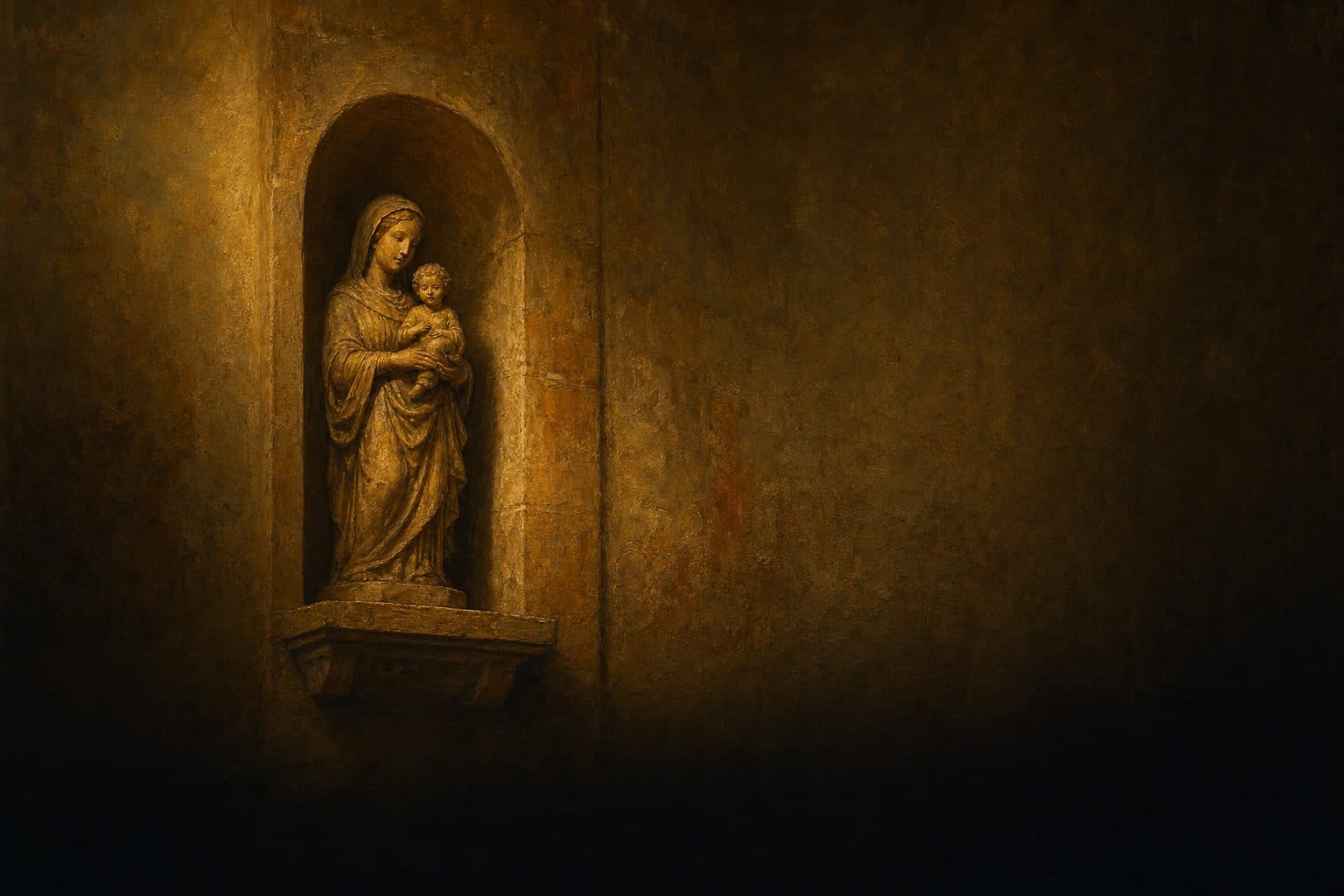
The Memorare
A short prayer asking Our Lady’s intercession, reached for most often when something has gone wrong and there is no time to compose anything. It takes about twenty-five seconds. Nine of them said in a row, with a tenth in thanksgiving, is the Flying Novena.
Remember, O most gracious Virgin Mary, that never was it known that anyone who fled to thy protection, implored thy help, or sought thy intercession, was left unaided. Inspired by this confidence, I fly unto thee, O Virgin of virgins, my Mother. To thee do I come, before thee I stand, sinful and sorrowful. O Mother of the Word Incarnate, despise not my petitions, but in thy mercy hear and answer me. Amen.
The Flying Novena
St Teresa of Calcutta’s practice, and the reason most people have heard of it. A novena is normally nine days; this one is nine in a row, said now, because the situations it is used for do not wait nine days.
- 1
Say the Memorare nine times
One after another, without pausing between them. Not nine days — nine in a row, now. That is what makes it "flying": the novena is compressed into the few minutes you actually have.
- 2
Then say it a tenth time, in thanksgiving
Before you know the answer. That is the whole point of the tenth, and the part people leave out. It is an act of trust rather than a receipt.
About four minutes in total — short enough for a walk to the car park, or a wait outside a hospital room.
Who actually wrote it
Almost every source will tell you the Memorare was written by St Bernard of Clairvaux. It was not. The prayer appears in none of his manuscripts, and its earliest witnesses are from the late fifteenth century, where it forms the closing lines of a longer Marian prayer. What actually happened is that a different Bernard spread it: Father Claude Bernard, a seventeenth-century Paris priest known as "the poor priest", who ministered to prisoners and to men awaiting execution and had the text printed and given away in enormous numbers. Somewhere between his Bernard and the saint's, the credit moved. The prayer is no less good for having an uncertain author, and knowing where it actually comes from is worth more than a comfortable legend: it was carried by a man who used it with people at the end of their rope, which is still where most people reach for it.
“The prayer that never fails”
It is often called "the prayer that never fails", and that name deserves care rather than repetition. The Memorare does not say that every petition is granted; it says that no one who sought Mary's intercession was left unaided, which is a different and larger claim. Aid is not always the thing asked for. A prayer is not a lever that moves God when pulled correctly, and a page that implies otherwise leaves the reader concluding their faith was defective when the answer turns out to be no. What the prayer actually does is put you in the position it describes — standing before her, sinful and sorrowful, with nothing to offer but confidence. That much never fails.
Print it, or learn it
This page prints as a plain sheet. The prayer is short enough to memorise in an afternoon, which is worth doing — the moments it is made for are the ones where you will not have a phone in your hand.
It also closes the Rosary well, after the Hail Holy Queen.
For a situation that has tangled rather than broken — an estrangement, a marriage under strain — many turn to Our Lady with the Mary, Undoer of Knots novena — nine days, and no fixed date to aim at.
For a cause that already looks lost, the saint the Church most often turns to is St. Jude, the patron saint of lost causes — why the patronage attached to him, and how Catholics ask his help.
Pray the Memorare in the app
Guided Memorare prayer in the app, with your daily streak tracked automatically.
More free tools
- Liturgical calendarToday’s season and feast, and ten years of movable dates.
- Easter countdownDays until Easter, and the paschal moon it is reckoned from.
- How to pray the RosaryA bead diagram, every prayer in full, and today’s mysteries.
- The mysteries of the RosaryAll twenty, by day, with the Gospel verse under each.
- Chaplet of Divine MercyOn ordinary rosary beads, in about eight minutes.
- Stations of the CrossAll fourteen in order, with the prayers at each.
- Litany of HumilityThe full prayer, traditionally attributed to Cardinal Merry del Val, with each response.
- The Advent wreathWhich candle, which Sunday, and why the third one is rose.
- What to give up for LentTwelve with a reason and a cost, and the other two thirds of Lent.
- How to become CatholicThe steps, how long it takes, and whether your past disqualifies you.
- How to go to confessionThe words in order, how long it takes, and what if it has been years.
- Examination of conscienceFor confession, by the Ten Commandments.
- Family night prayer generatorTonight’s night prayer from the Church’s own prayers, with your names, to print.
- Prayers for the deadEternal Rest and others, for a graveside or an anniversary.
All free, no sign-up, and nothing to keep updated — the dates are computed rather than typed. See all 15 tools.