
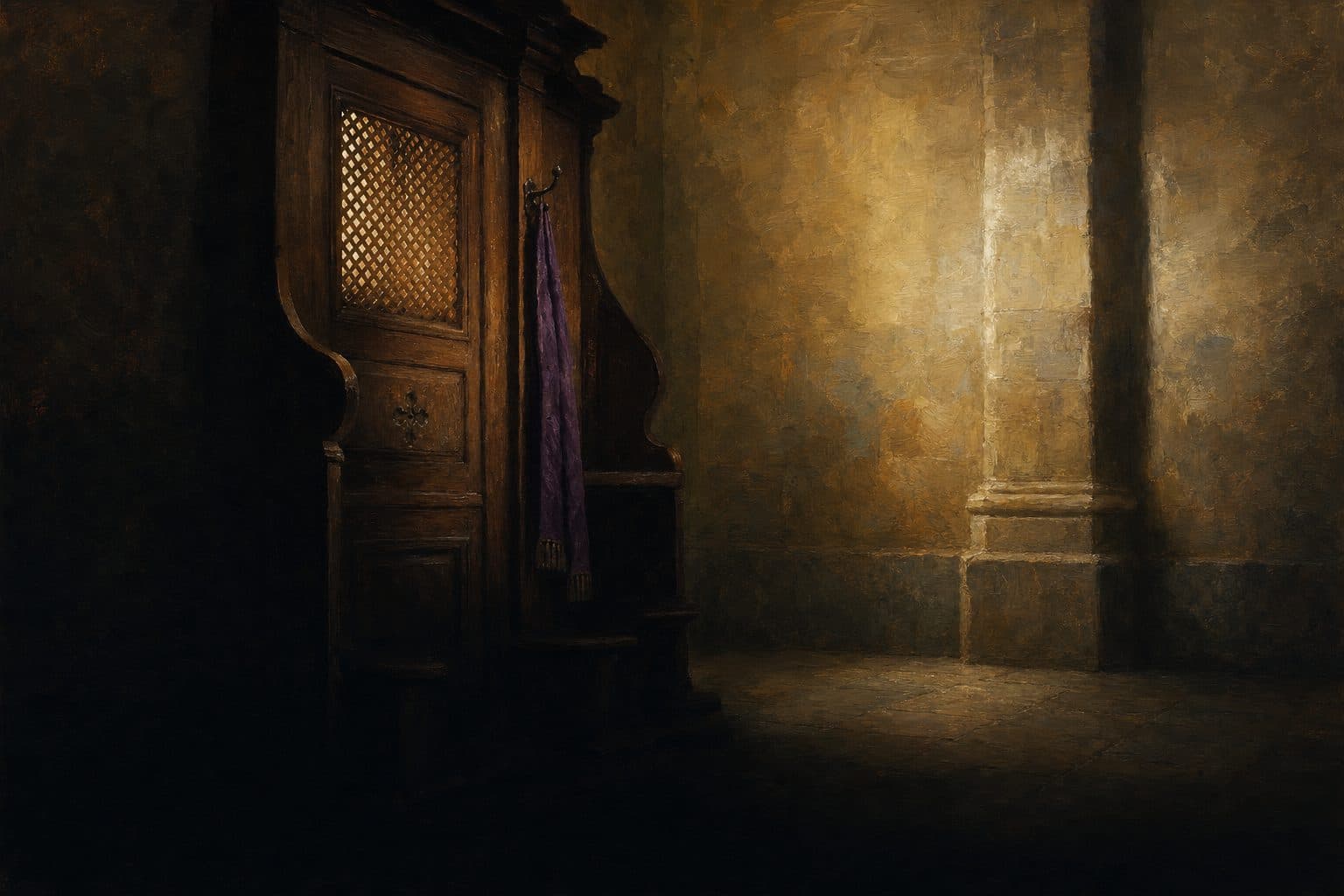
How to Go to Confession
The words, in order, with what the priest says back. It takes two or three minutes. If it has been twenty years, that is further down — and it is the most ordinary thing a priest hears.
Go in, make the Sign of the Cross, and say “Bless me, Father, for I have sinned. It has been ___ since my last confession.” Say what you did and roughly how often. Close with “For these and all the sins of my past life, I am sorry.” He gives you a penance, you pray an Act of Contrition, he absolves you, and you go. Two or three minutes.
The eight steps, with the words
1. Go in, and choose your seat
Most churches offer both a screen and a chair facing the priest. Neither is more correct, neither is more grown-up, and you may pick a different one next time. If there is a queue, people leave a pew or two of space; that is courtesy, not suspicion.
You can ask for the screen even in a room with only a chair. Priests are asked this often.
2. Make the Sign of the Cross and open
The priest may greet you first, or may wait. Either way, the opening is a fixed form and saying it tells him you know where you are and lets him take the lead from there.
Bless me, Father, for I have sinned. It has been ___ since my last confession.
If you cannot remember how long, say so — "a long time", "since school", "I am not sure" are all complete answers. Nobody is checking.
3. Confess your sins, plainly
Say what you did and roughly how often. You are not required to explain, to give background, or to name anyone else — and you should not name anyone else. Mortal sins must be confessed in kind and number as best you can remember; everything else may be, and it is good to.
Plain words are better than careful ones. The priest has heard it. What he has not heard is a version so polished he cannot tell what happened.
4. Say that is all
A short sentence closes the list and hands the conversation back to him.
For these and all the sins of my past life, I am sorry.
5. Listen
He may say something brief, ask a question, or say nothing much at all. Then he gives you a penance — usually a prayer or two, sometimes a small action. If you do not catch it, ask him to repeat it. That is not an interruption.
A short penance does not mean he thought little of it. It usually means he thought you would actually do it.
6. Pray the Act of Contrition
He will ask for it, or pause for it. There is no single authorised text and no form you are obliged to use; several are in ordinary use and a priest will not correct you for choosing one over another.
O my God, I am heartily sorry for having offended Thee, and I detest all my sins because of Thy just punishments, but most of all because they offend Thee, my God, who art all good and deserving of all my love. I firmly resolve, with the help of Thy grace, to sin no more and to avoid the near occasions of sin. Amen.
If it goes out of your head, say you are sorry in your own words. That is an act of contrition.
7. Absolution
The priest extends his hand and absolves you. This is the moment the sacrament does what it does, and it is his to say, not yours. He ends: "I absolve you from your sins, in the name of the Father, and of the Son, and of the Holy Spirit." Answer "Amen", and make the Sign of the Cross with him.
Whatever you felt while confessing has no bearing on whether this worked. It is not a transaction in feelings.
8. Go and do the penance
He will dismiss you — often "Go in peace" — and you answer "Thanks be to God." Do the penance soon, ideally before you leave the building. If you forget it entirely, it does not undo the absolution; do it when you remember.
The part that actually stops people
Not one of these is unusual, and none of them is a reason to stay away. They are the six things people say at the door.
“It has been twenty years.”
Then say that, in those words, and let him take it from there. Long gaps are ordinary — priests hear them constantly, and most will tell you it is the part of the job they are gladdest of. You do not need to reconstruct twenty years; confess what you can remember and what weighs on you, and say that it has been a long time and your memory is incomplete. That is a complete confession.
“I do not remember how it goes.”
Say so as you sit down. "I am sorry, I have forgotten how to do this" is a perfectly good opening line, and the priest will simply walk you through it a sentence at a time. He would far rather do that than have you not come.
“I am afraid of being judged, or recognised.”
A priest may never, under any circumstances, reveal anything he hears in confession — not to police, not to your family, not to you afterwards outside the confessional. The seal is absolute and has no exceptions. If it would help, choose the screen, or go to a parish that is not your own; both are entirely normal and neither is evasion.
“I will freeze and forget everything.”
Bring a list. Written notes are common, entirely permitted, and no priest thinks less of anyone who reads from one. Prepare with an examination of conscience beforehand and take the paper in with you; tear it up afterwards if you like.
“What if I forget a sin?”
A sin genuinely forgotten is forgiven with the rest — the sacrament does not fail on a memory lapse. Mention it next time if it comes back to you. What is not covered is deliberately holding something back, which is a different thing entirely and which you would know you were doing.
“I am not sure this even counts as a sin.”
Say it and say you are unsure. That is one of the things a priest is there for, and getting an actual answer is far better than carrying the question around for another year. If you find yourself agonising over whether small things are sins, tell him that too — scrupulosity is a well-known difficulty and it is treated gently.
How long it takes
For an ordinary confession, two or three minutes. First-time-in-years confessions run longer, perhaps ten, and priests expect that — if there is a queue and you need more time, say so at the start and he will manage it. Nobody is timing you, and nobody outside can hear how long you took or what was said.
When you can go, and how often
Most parishes hear confessions on Saturday afternoon, often for half an hour before the vigil Mass, and many also offer a slot before weekday Mass. Times are on the parish website or the newsletter. You can also ring the office and ask for an appointment, which is ordinary and is often easier if it has been a long time — there is no queue behind you and no clock.
The Church asks at least once a year if you are conscious of grave sin, and requires confession before receiving Communion in that state. Beyond that it is a matter of practice rather than precept: monthly is a common rhythm, and many go more often. Going more frequently than that is not a sign of anxiety, and going less is not a scandal.
Before you go
An examination of conscience is how most people prepare — it prints as a plain sheet you can take in with you. The Act of Contrition has every form in ordinary use side by side, if you want to learn one before you go. And in Lent, when most parishes add extra times, Lent has the dates.
For the days before and after, there are Catholic prayers for forgiveness — for forgiveness of sins, for forgiving someone who hurt you, and for when you cannot forgive yourself.
This page describes the sacrament. It is not a substitute for it, and nothing here is a confession — only a priest can absolve.
Print it and take it in
This page prints as a plain sheet with the navigation and colours stripped out. Taking the words in on paper is entirely permitted and very common; no priest thinks less of anyone who reads from one.
For after the absolution: Psalm 103 — the psalm that measures forgiveness in distances, as far as the east is from the west.
If you are still one step before the confessional, deciding whether to go at all: prayers of repentance — from the tax collector and the good thief to what to do after you repent.
Practice the words before you go
A guided walkthrough of confession and an examination of conscience, both in the app.
More free tools
- Liturgical calendarToday’s season and feast, and ten years of movable dates.
- Easter countdownDays until Easter, and the paschal moon it is reckoned from.
- How to pray the RosaryA bead diagram, every prayer in full, and today’s mysteries.
- The mysteries of the RosaryAll twenty, by day, with the Gospel verse under each.
- Chaplet of Divine MercyOn ordinary rosary beads, in about eight minutes.
- Stations of the CrossAll fourteen in order, with the prayers at each.
- The MemorareThe full prayer, and the Flying Novena: nine in a row, plus one.
- Litany of HumilityThe full prayer, traditionally attributed to Cardinal Merry del Val, with each response.
- The Advent wreathWhich candle, which Sunday, and why the third one is rose.
- What to give up for LentTwelve with a reason and a cost, and the other two thirds of Lent.
- How to become CatholicThe steps, how long it takes, and whether your past disqualifies you.
- Examination of conscienceFor confession, by the Ten Commandments.
- Family night prayer generatorTonight’s night prayer from the Church’s own prayers, with your names, to print.
- Prayers for the deadEternal Rest and others, for a graveside or an anniversary.
All free, no sign-up, and nothing to keep updated — the dates are computed rather than typed. See all 15 tools.