Prayer · Forgiveness
Catholic Prayers for Forgiveness
Ask God's forgiveness — 1 John 1:9
A short Catholic prayer for forgiveness: “Lord Jesus Christ, Son of God, have mercy on me, a sinner. I am sorry for what I have done and for the good I failed to do. Wash me clean, and teach me to forgive as you forgive me. Amen.” Below: prayers for forgiveness of sins, the Act of Contrition, when you need confession, and prayers to forgive others and yourself.
Merciful Father, I come before You with a humble and contrite heart. I have sinned against You in thought, word, and deed — by what I have done and by what I have failed to do.
I confess my sins to You now. Not to earn Your forgiveness — for it is freely given through the Blood of Jesus — but because confession brings freedom, and I desperately need to be free.
Lord, I have:
• Failed to love You with all my heart, soul, mind, and strength
• Failed to love my neighbor as myself
• Given in to temptation when I knew better
• Spoken words that wounded others
• Harbored thoughts that grieve Your Holy Spirit
• Neglected the duties and callings You have given me
"If we confess our sins, He is faithful and just and will forgive us our sins and purify us from all unrighteousness." — 1 John 1:9
Lord, I claim that promise. Wash me clean. Remove my guilt. Restore my innocence. Let the Blood of Jesus cover every sin — past, present, and every failing yet to come.
I renounce every hold the enemy has gained through my sin. I close every door I have opened. I reclaim every ground I have surrendered.
Create in me a clean heart, O God, and renew a right spirit within me. Do not cast me from Your presence or take Your Holy Spirit from me. Restore to me the joy of Your salvation.
— Based on Psalm 51
In Jesus' name. Amen.
Go deeper
A prayer for forgiveness of sins
2 min readFor when you know you have done wrong and want to come back to God.
For when you know you have done wrong and want to come back to God. It borrows from Psalm 51 and from the tax collector in the Temple who could only say “God, be merciful to me, a sinner!” (Luke 18:13). Name the sin to God plainly; you do not have to explain it.
Merciful Father,
I have sinned against you, and I am sorry.
I have done what I knew was wrong,
and left undone the good I could have done.
I bring it to you by name, and I do not hide it.
Forgive me, for the sake of your Son,
who died so that sins could be forgiven.
Have mercy on me, according to your loving kindness.
Wash me, and make me clean.
Give me true sorrow, not only for what my sin has cost me,
but because it offended you, who are all good.
Give me the courage to put right what I can,
and the humility to go to confession where I must.
Create in me a clean heart, O God.
Through Christ our Lord. Amen.
Short prayers for forgiveness, for when a longer prayer will not come:
- “Lord Jesus Christ, Son of God, have mercy on me, a sinner.” (the Jesus Prayer)
- “God, be merciful to me, a sinner!” (Luke 18:13)
- “Create in me a clean heart, O God. Renew a right spirit within me.” (Psalm 51:10)
The prayer for repentance goes further, into turning away from a sin rather than only being sorry for it.
The Act of Contrition
1 min readThe Church’s prayer of sorrow for sin, said in confession and, traditionally, every night.
The Church’s prayer of sorrow for sin, said in confession and, traditionally, every night. This is the form most English-speaking Catholics learned:
O my God, I am heartily sorry for having offended Thee, and I detest all my sins because of Thy just punishments, but most of all because they offend Thee, my God, who art all good and deserving of all my love. I firmly resolve, with the help of Thy grace, to sin no more and to avoid the near occasions of sin. Amen.
It moves in two steps: sorrow out of fear of just punishment, which the Church calls imperfect contrition and still counts as real sorrow, then “most of all because they offend Thee”, sorrow out of love of God, called perfect contrition (Catechism of the Catholic Church, 1451–1453). Other forms, modern and older, are side by side on the Act of Contrition page, and sorrow in your own words is an act of contrition too.
Is a prayer for forgiveness enough, or do I need confession?
2 min readIt depends on the sin.
It depends on the sin. For everyday sins, which the Church calls venial, sincere sorrow and prayer are enough. The Our Father, Scripture, acts of charity and every sincere act of repentance contribute to the forgiveness of sins (CCC 1434–1437), and the Eucharist wipes away venial sins (CCC 1394). Confessing them is not required, though the Church strongly recommends it (CCC 1458).
For mortal sin, grave matter committed with full knowledge and deliberate consent (CCC 1857), the ordinary way of forgiveness is the sacrament. Individual confession and absolution “remain the only ordinary way” to be reconciled with God and the Church, unless that is physically or morally impossible (CCC 1484). Only God forgives sins, and Christ gave his apostles the power to forgive in his name (CCC 1441–1442).
A prayer does not replace confession for mortal sin, but it is not wasted. Perfect contrition, sorrow out of love of God, obtains forgiveness even of mortal sin if it includes the firm resolution to go to confession as soon as possible (CCC 1452). So if you are conscious of grave sin tonight and cannot see a priest until Saturday, pray the Act of Contrition, mean it, and go on Saturday. Until you are absolved, do not receive Communion unless there is a grave reason and no way to confess first (CCC 1457).
If it has been years, or you are afraid of what to say, how to go to confession gives the words in order and what the priest will say back. An examination of conscience is how to prepare.
A prayer to forgive someone who hurt you
2 min readFor when you want to forgive but cannot feel it yet.
For when you want to forgive but cannot feel it yet. Catholic forgiveness is first a decision, not a feeling: to stop wishing the other person harm, to give up revenge, and to hand the debt to God. The Catechism admits that “it is not in our power not to feel or to forget an offense”, but says a heart offered to the Holy Spirit can turn the hurt into intercession (CCC 2843). Say their name where the prayer has “N.”
Lord Jesus, from the cross you prayed for the men who crucified you:
“Father, forgive them, for they don’t know what they are doing.”
I bring you N., and what they did to me.
You know how much it hurt, and how much it still does.
I do not feel forgiveness yet, but I choose it, as far as I can today.
I give up the wish to get even, and hand this debt to you, who judge justly.
Heal the memory, so that it stops ruling my days.
Bless N., and bring them to the good you want for them.
And when the anger comes back tomorrow, help me to forgive again,
with your strength and not my own.
Amen.
You may need to pray it more than once. Asked whether seven times was enough, Jesus answered “until seventy times seven” (Matthew 18:22), and that is often true of a single hurt, forgiven again each time it returns. If the hurt is inside a family or friendship you want to repair, there is a prayer for healing of relationships.
Forgiving is not excusing harm, or staying in danger
1 min readIf someone has abused you, is hurting you now, or has harmed a child, read this before any prayer on this page.
If someone has abused you, is hurting you now, or has harmed a child, read this before any prayer on this page. Forgiveness is often preached in a way that keeps people in danger, and that is not what the Church teaches.
- Forgiving is not saying it did not matter. You forgive something precisely because it was wrong.
- Forgiving is not staying. You can forgive someone and still leave, keep your distance, or never be alone with them again. Reconciliation needs the other person’s repentance and a safe situation; forgiveness needs neither, and never requires you to go back into harm.
- Forgiving is not giving up justice. You may report a crime, testify and seek protection. The Catechism distinguishes the desire for revenge, which is wrong, from seeking restitution to maintain justice, which is praiseworthy (CCC 2302). Harm to a child should always be reported to the civil authorities.
- Forgiving is not forgetting, and keeps no timetable. It is often slow, and that is not a failure.
If someone is hurting you now, your safety comes first; prayer comes with it, not instead of it. For the long road afterwards, there is a prayer for healing from trauma.
A prayer for when you cannot forgive yourself
2 min read“Forgiving yourself” is not a phrase from Scripture or the Catechism.
“Forgiving yourself” is not a phrase from Scripture or the Catechism. In Catholic terms the real question is whether you will accept a forgiveness God has already offered. Refusing to believe you can be forgiven is not humility; the Church calls it despair, a sin against hope (CCC 2091).
Father of mercy,
I have confessed this, and I still carry it.
I keep going back to it as if you had not forgiven me.
Teach me that my sin is not bigger than your mercy.
You have removed it from me, as far as the east is from the west;
help me to stop going back to look for it.
Where there is harm I can still repair, give me the courage to repair it.
Where there is nothing left to do, give me the grace to let it go.
Amen.
If guilt keeps returning after confession, tell the priest: anxious guilt over sins already forgiven is called scrupulosity, and confessors know how to help. For shame about who you are, rather than guilt about what you did, there is a prayer for healing from shame. If guilt has turned into thoughts of harming yourself, please read the crisis note just above and reach out today.
Forgiveness in the Our Father: “as we forgive those who trespass against us”
1 min read
Matthew gives the Our Father’s petition as “Forgive us our debts, as we also forgive our debtors” (Matthew 6:12), and it is the one petition Jesus comes straight back to: “For if you forgive men their trespasses, your heavenly Father will also forgive you. But if you don’t forgive men their trespasses, neither will your Father forgive your trespasses” (Matthew 6:14–15).
The Catechism calls this petition “astonishing”, because its two halves are joined by the single word “as” (CCC 2838). It is not that God rations his mercy: a heart closed against a brother or sister is closed to the Father’s mercy too (CCC 2840). Doing this on our own is impossible, and possible with God (CCC 2841–2842), and there is no limit or measure to it (CCC 2845). There is a line-by-line way of praying it in the Lord’s Prayer prayed slowly.
Scripture on forgiveness
2 min readThe passages Catholics turn to most, quoted in the World English Bible, Catholic Edition.
The passages Catholics turn to most, quoted in the World English Bible, Catholic Edition.
Psalm 51:1–2. “Have mercy on me, God, according to your loving kindness. According to the multitude of your tender mercies, blot out my transgressions. Wash me thoroughly from my iniquity. Cleanse me from my sin.” The Church’s great psalm of repentance, prayed every Friday morning in the Liturgy of the Hours; the whole psalm is on Psalm 51.
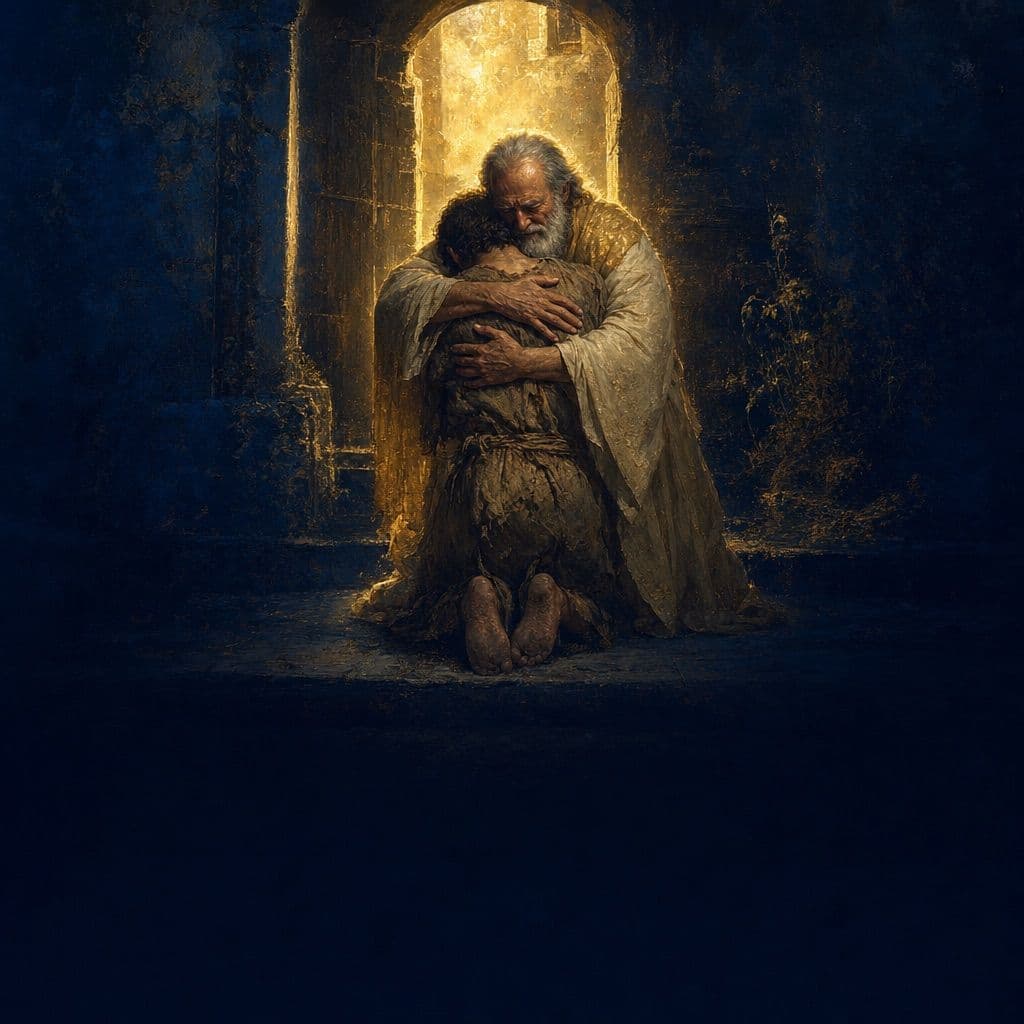
Luke 15:20. “But while he was still far off, his father saw him and was moved with compassion, and ran, fell on his neck, and kissed him.” The prodigal son had rehearsed a speech; his father does not let him finish it. The Catechism says that in the Our Father we return to God like the prodigal son (CCC 2839).
1 John 1:9. “If we confess our sins, he is faithful and righteous to forgive us the sins and to cleanse us from all unrighteousness.”
Matthew 18:21–22. “Lord, how often shall my brother sin against me, and I forgive him? Until seven times?” Jesus said to him, “I don’t tell you until seven times, but, until seventy times seven.” Not a bigger number to count to, but an end to counting.
Ephesians 4:32. “And be kind to one another, tender hearted, forgiving each other, just as God also in Christ forgave you.” We forgive because we were forgiven first.
More passages are on Bible verses about forgiveness.
What the Catholic Church teaches about forgiveness
1 min readThe sacrament of Penance is where God’s forgiveness is given.
The sacrament of Penance is where God’s forgiveness is given. Each of its names says something true: the sacrament of conversion, of Penance, of confession, of forgiveness, because through the priest’s absolution God grants “pardon and peace”, and of Reconciliation (CCC 1423–1424). Those who receive it are pardoned by God and reconciled with the Church their sin has wounded (CCC 1422), and it is usually followed by peace and serenity of conscience (CCC 1468). Even humanly, saying your sins aloud frees us and makes a new future possible (CCC 1455).
The one thing that blocks forgiveness is refusing it. There are no limits to the mercy of God, but someone who deliberately refuses to repent rejects the forgiveness offered (CCC 1864). That is the “unforgivable sin”, and confessors often point out that being afraid you have committed it is a sign you have not.
Questions
What is a short prayer for forgiveness?
The shortest is the tax collector’s in Luke 18:13: “God, be merciful to me, a sinner!” The Jesus Prayer, “Lord Jesus Christ, Son of God, have mercy on me, a sinner”, is another. In confession Catholics say the Act of Contrition.
Does God forgive every sin?
Every sin that is repented of. The Catechism says there is no offence, however serious, that the Church cannot forgive (CCC 982). The only sin not forgiven is the one a person refuses to repent of, which is what Jesus calls blasphemy against the Holy Spirit (CCC 1864).
Do I need to go to confession, or is prayer enough?
For everyday (venial) sins, sincere prayer and sorrow are enough, though confession is strongly recommended (CCC 1458). For mortal sin, confession is the ordinary way of being forgiven (CCC 1484). Until you can get there, perfect contrition with the firm intention of confessing as soon as possible obtains forgiveness even of mortal sin (CCC 1452); you still go, and do not receive Communion until you have.
How do I forgive someone who is not sorry?
You can forgive without an apology, because forgiveness is something you give up rather than something they earn: the wish for revenge, and the debt you hold against them. Jesus forgave from the cross people who had not asked (Luke 23:34). What needs their repentance is reconciliation, and you are not obliged to pretend that has happened.
Does forgiving someone mean I have to let them back into my life?
No. Forgiveness does not require trust or contact, and it never requires you to return to a situation where you or a child could be harmed. You can forgive, keep your distance and still seek justice (CCC 2302). If you are in danger, please read the crisis note on this page.
How do I forgive myself?
In Catholic terms, by accepting the forgiveness God has already given instead of trying to earn it again. Confess the sin, make what amends you can, and treat it as closed, because God does. If guilt keeps returning after confession, tell a priest; it may be scrupulosity, which is common and can be helped.
Guided narration · How it’s made
Upcoming · Sep 29
Sts. Michael, Gabriel and RaphaelSee the full liturgical calendar — every feast this year, and an embed for your parish site.