
How to Become Catholic
Ring a parish. That is genuinely the first step, and most of what follows takes about nine months and ends at the Easter Vigil — March 27, 2027 next. Below: the stages, what it costs, and a straight answer to whether your past disqualifies you.
Contact the Catholic parish nearest you and say you are interested. You will join OCIA — the Order of Christian Initiation of Adults, called RCIA until 2024 — usually a weekly group running from autumn to Easter. If you were never baptised you are baptised, confirmed and receive Communion at the Easter Vigil. It costs nothing, there is no test, and nothing in your past disqualifies you.
The stages
1. Ring the parish, or just turn up
Any time. Most groups form in late summer or early autumn.Find the Catholic parish nearest you and email or ring the office saying you are interested in becoming Catholic. That is the whole first step and it is genuinely all that is required to start. If ringing is too much, going to a Sunday Mass and speaking to someone afterwards works too — you may attend Mass any time, as often as you like, without being Catholic and without telling anyone.
You are not committing to anything by asking. People enquire and decide not to continue, and that is a normal outcome rather than a failure.
2. Meet, and be asked what brought you
Within a week or two of asking.A first conversation with a priest or the person who runs the parish’s programme. They will ask about your background — whether you were baptised, whether you have been married, what has brought you — not to vet you but because the answers change what your path looks like. Someone baptised Anglican follows a different route from someone never baptised at all.
3. OCIA
Autumn through spring, most commonly.The Order of Christian Initiation of Adults — called RCIA until the American bishops renamed it in 2024, and still called that by most people. It is usually a weekly evening or Sunday-morning group covering what the Church believes and why. It is not an exam, there is no test, and asking the awkward question is the point of being there rather than a lapse.
It is a process rather than a course, and it is meant to move at your pace. If you are ready sooner, or not ready by Easter, both are provided for. Nobody is pushed through on a timetable.
4. The Rite of Election, and Lent
The first Sunday of Lent.Around the start of Lent, those going forward are presented to the bishop at the cathedral. Lent then becomes the final stretch of preparation, with a few short rites at Sunday Mass.
5. The Easter Vigil
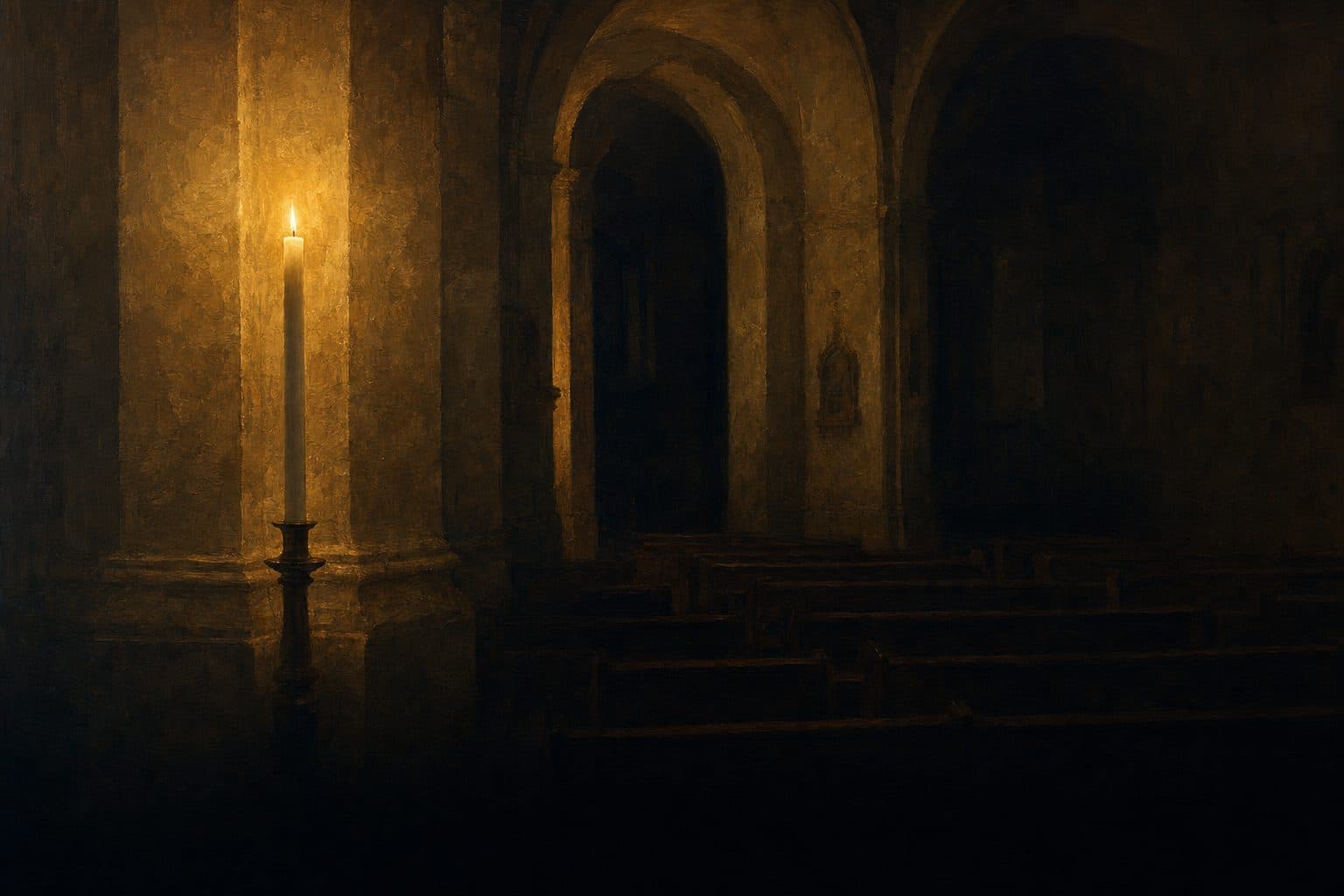
Holy Saturday.On Holy Saturday night, in a dark church lit from one candle. If you were never baptised, you are baptised, confirmed and receive Communion for the first time, all in the same liturgy. It is long, it is the most beautiful night of the Catholic year, and your family may come.
If you were already validly baptised in another Christian church, you are NOT baptised again — see below. You may be received at the Vigil or at another time; increasingly parishes do it separately, and that is not a lesser welcome.
“Am I allowed?”
This is the part almost nobody writes down, and it is the part people actually search for. The short version is that you are allowed, and the longer version is below.
Does my past disqualify me?
No. Not what you have done, not how long ago you stopped believing, not what you were before. This is not a character reference and there is no threshold of respectability to clear — the Church exists for people who need it, and baptism forgives everything that came before it without exception. If you are already baptised, confession does the same work. Nobody in the parish office is going to assess whether you have earned it.
Do I need to have my life in order first?
No, and waiting until you do is the commonest reason people never start. The process is nine months long precisely because it is meant to change you while it happens rather than after. Come as you are and start the conversation; sorting things out is the work, not the entry requirement.
I have been divorced.
Divorce on its own is no obstacle at all, and a great many Catholics are divorced — this is the single commonest misunderstanding on the subject. If you have remarried, or want to, the earlier marriage does need to be looked at before you can receive Communion, because the Church takes the first promise seriously. That process exists, it is ordinary, and the parish will walk you through it. Say it at the first meeting rather than the last: it is far easier to begin early than to discover it in Lent.
My situation is complicated.
Then say so to a priest, early and plainly, and let him tell you what it actually means. A web page cannot answer a particular life, and the honest thing is not to pretend otherwise. What can be said is that priests hear complicated situations constantly, that almost nothing is the barrier people fear it is, and that the ones that are real have a path through them rather than a wall.
I am not sure I believe all of it.
That is an ordinary place to start and not a disqualification. OCIA assumes you have questions and objections — that is what the months are for. Nobody is asked to pretend certainty they do not have, and arriving with doubts is considerably more useful to the process than arriving with none.
If you were already baptised
You are not baptised again. The Catholic Church recognises baptism in most other Christian churches as genuinely valid — Anglican, Lutheran, Methodist, Presbyterian, Orthodox and many more — and baptising someone twice is not permitted. What you make instead is a profession of faith, followed by confirmation and first Communion. Bring your baptismal certificate if you can find one; if you cannot, the parish will help you work out what is needed. If you were baptised in a church that does not use the Trinitarian formula, or you are unsure what happened, say so and let them check — that is a question with an actual answer.
You can go to Mass tomorrow
Yes, from today, as often as you like, and you need tell nobody. Anyone may attend Mass. Sit where you like, stand and sit with everyone else or stay seated throughout, and nobody will mind or approach you. The one thing to know is that you do not receive Communion yet — stay in your seat when the rows go up, or join the queue with your arms crossed over your chest and the priest will give you a blessing instead. That is a normal and unremarkable thing to do.
How long, and what it costs
Usually about eight or nine months for someone who joins a group in the autumn and is received at the Easter Vigil. But it is not a fixed-length course and it is not meant to be: someone already well-formed may be ready sooner, and someone with more ground to cover — or a marriage question to settle — may take a year or two. Both are provided for, and neither is a mark against you.
Nothing. There is no fee to become Catholic, no charge for the sacraments, and no expectation that you give anything. Some parishes ask a small amount toward books; if that is difficult, say so and it will be waived. Anyone who suggests otherwise has misunderstood something fundamental.
The five precepts — what is asked once you are in
People search for “the five requirements for Catholics” and mean these. They are the minimum the Church asks of a Catholic, not a checklist for joining.
- 1. Attend Mass on Sundays and holy days of obligation, and rest from work that would prevent it.
- 2. Confess your sins at least once a year.
- 3. Receive Holy Communion at least during the Easter season.
- 4. Observe the days of fasting and abstinence set by the Church.
- 5. Provide for the material needs of the Church, according to your means.
While you are waiting
You do not have to wait to start praying. How to pray the Rosary has a bead diagram and every prayer in full, and the liturgical calendar tells you what season the Church is in today. When your first confession comes, how to go to confession has the words in order — and Lent is the season your final preparation will fall in.
This page describes what generally happens. A particular situation — a previous marriage especially — is for a priest, so ask him rather than assume the answer.
For parishes
This page prints as a plain sheet with the navigation and colours stripped out. Enquirers ask the same questions every autumn, and you are welcome to print it and hand it out at an enquiry evening.
Learning to pray the Psalms? Many begin where the Psalter does, with Psalm 1 — the two ways a life can go.
Keep going after this page
The Act of Contrition and a daily prayer reminder to keep you going, in the app.
More free tools
- Liturgical calendarToday’s season and feast, and ten years of movable dates.
- Easter countdownDays until Easter, and the paschal moon it is reckoned from.
- How to pray the RosaryA bead diagram, every prayer in full, and today’s mysteries.
- The mysteries of the RosaryAll twenty, by day, with the Gospel verse under each.
- Chaplet of Divine MercyOn ordinary rosary beads, in about eight minutes.
- Stations of the CrossAll fourteen in order, with the prayers at each.
- The MemorareThe full prayer, and the Flying Novena: nine in a row, plus one.
- Litany of HumilityThe full prayer, traditionally attributed to Cardinal Merry del Val, with each response.
- The Advent wreathWhich candle, which Sunday, and why the third one is rose.
- What to give up for LentTwelve with a reason and a cost, and the other two thirds of Lent.
- How to go to confessionThe words in order, how long it takes, and what if it has been years.
- Examination of conscienceFor confession, by the Ten Commandments.
- Family night prayer generatorTonight’s night prayer from the Church’s own prayers, with your names, to print.
- Prayers for the deadEternal Rest and others, for a graveside or an anniversary.
All free, no sign-up, and nothing to keep updated — the dates are computed rather than typed. See all 15 tools.