The Brown Scapular: What It Promises and What It Does Not
The brown scapular is a Carmelite sacramental worn as a sign of devotion to Our Lady of Mount Carmel. A priest enrols the wearer once. The promise attached to it has never been taught as a guarantee of salvation regardless of how a person lives, and the Church has repeatedly warned against reading it that way.
What it is, and where it came from
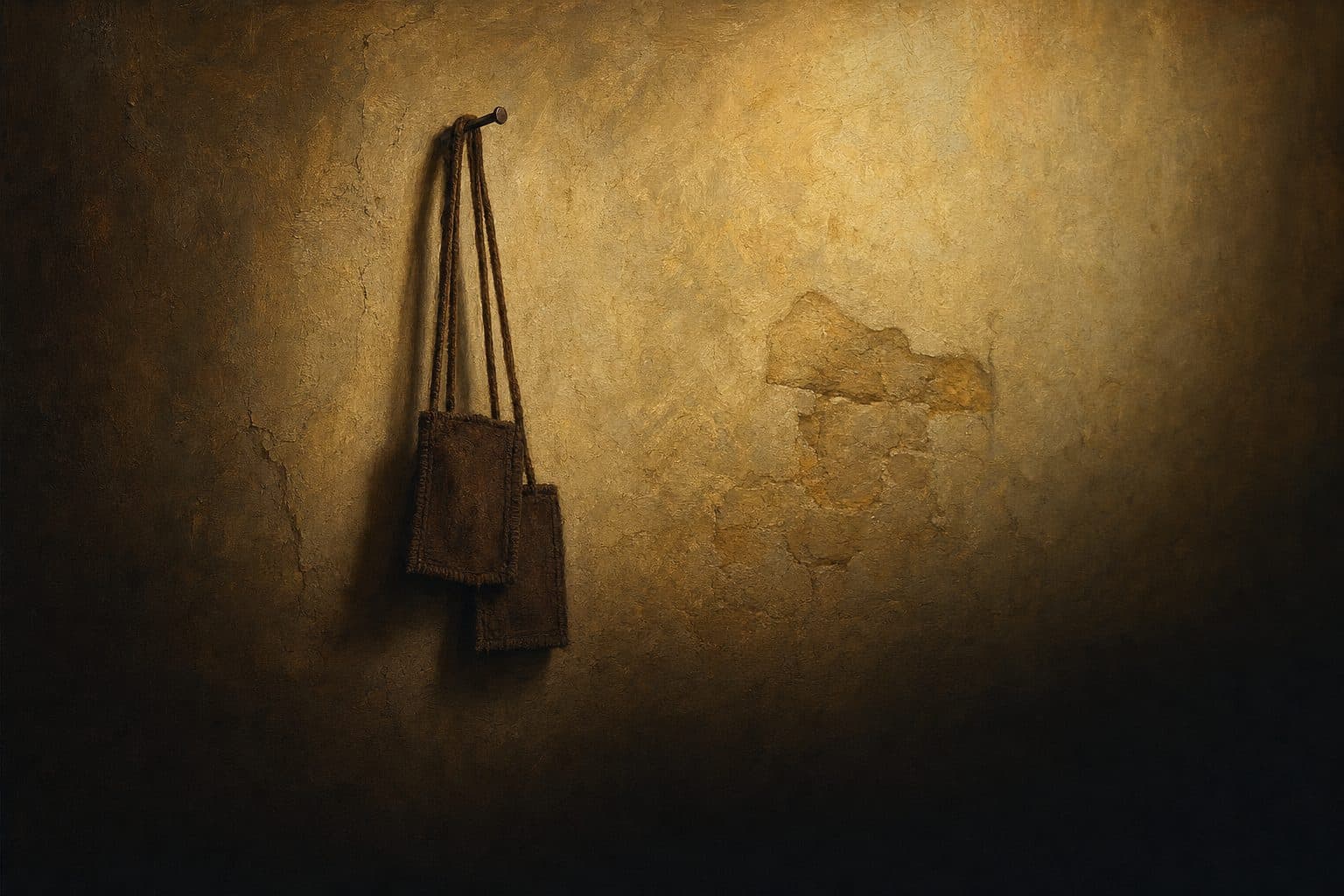
The brown scapular is two small panels of brown wool joined by cords, worn over the shoulders so that one panel hangs at the chest and one at the back. It is deliberately unimpressive.
That is because it is a miniature. The full scapular is the working apron of a monk, the garment worn over the habit for labour, and the Carmelites gave a small version of it to lay people who wanted to be associated with the order without entering it. Wearing it is a way of saying you belong to something.
Carmelite tradition holds that Our Lady appeared to St. Simon Stock in 1251 and gave him the scapular with a promise attached. That promise is the reason most people search for this, and it is where care is needed.
What the promise actually says, and what it does not
The traditional wording is that whoever dies wearing the scapular will not suffer eternal fire.
Read as a transaction, that is a guarantee of heaven attached to a piece of cloth, and a great deal of material online reads it exactly that way. The Church does not. It has taught consistently that the promise is not independent of how a person lives, and Carmelite authorities have said the same repeatedly and at length.
The scapular is a sign of a commitment: to Our Lady, to prayer, to living as a Christian. The promise attaches to the commitment the sign represents. Worn by someone who has deliberately abandoned that commitment and is persisting in grave sin, it is a sign of something that is no longer there.
This is not the Church taking a promise back. It is the difference between a devotion and a charm, which is the same line that runs through every sacramental. Nothing the Church gives operates independently of whether you mean it.
The Sabbatine privilege, honestly
A second tradition grew up around the scapular concerning Our Lady’s intercession for wearers after death, connected to a document whose authenticity has been questioned by historians.
The Church has permitted devotion associated with it while being distinctly careful about how it is preached, and has at times acted to restrain exaggerated claims. That is a meaningful pattern: permission to practise, combined with restraint on promotion.
The practical guidance follows from that. If you encounter a version of this promise that reads like a contract, with conditions on one side and a guaranteed outcome on the other, treat it with suspicion. Devotion that becomes a transaction has stopped being devotion, and the Church has spent centuries saying so about one practice after another.
How to be enrolled and how to wear it
Enrolment. A priest enrols you, once. It takes a couple of minutes and most parishes will do it after Mass if you ask. This is not the same as blessing the cloth; you are being enrolled in the confraternity, and the cloth follows.
Replacement. Once enrolled, you can replace a worn-out scapular yourself. It does not need blessing and you do not need enrolling again.
The medal option. Pope St. Pius X permitted a blessed scapular medal in place of the cloth for those who need it. Enrolment still comes first.
Wearing it. Continuously is the tradition. Under clothing is normal. And if you take it off and forget it for a week, put it back on without drama. It is a devotion, not a rule binding under sin, and scrupulosity about it is a burden the Church never intended.
Get the Daily Protection Prayer
Free in your inbox every morning
No spam. Unsubscribe anytime. We respect your privacy.
What it is really for
Strip away the promises and something simple remains, and it is the part that works.
The scapular sits against your skin all day. You feel it when you dress, when you move, when you lie down. It is a physical, wordless, hourly reminder that you have decided something about your life and about who you have asked to pray for you.
Most faith is not lost through argument. It is lost through forgetting, slowly, over years. A garment you cannot stop noticing is a remarkably well-designed answer to that specific problem, and it has been in use for seven hundred years because it works.
Wear it, be enrolled properly, and keep going to confession and to Mass. The scapular was never offered as a replacement for either, and everyone who has ever recommended it has said so.
Frequently Asked Questions
What is the brown scapular?
Two small pieces of brown wool cloth joined by cords and worn over the shoulders, one panel resting on the chest and one on the back. It is a Carmelite sacramental and a miniature of the full monastic scapular, the working garment of the order. Wearing it signifies devotion to Our Lady of Mount Carmel and a decision to live accordingly.
How do I start wearing one?
A priest enrols you, which happens once and takes a couple of minutes. After that first enrolment you can replace a worn scapular yourself without being enrolled again, and no further blessing of the new one is required. Most parishes will do this after Mass if you ask.
What is the scapular promise?
Carmelite tradition holds that Our Lady promised St. Simon Stock in 1251 that whoever dies wearing the scapular will not suffer eternal fire. What the Church has consistently taught is that this is not a guarantee independent of how a person lives. The scapular is a sign of a commitment, and the promise attaches to living that commitment rather than to the cloth. Wearing it while deliberately persisting in grave sin is precisely the reading the Church rejects.
What is the Sabbatine privilege?
A later tradition concerning Our Lady’s intercession for scapular wearers after death, associated with a document whose authenticity has been questioned. The Church has permitted devotion connected with it while being notably cautious about how it is promoted, and has at times restrained exaggerated preaching about it. Treat any version that reads like a transaction with suspicion.
Can I wear a scapular medal instead?
Yes. Pope St. Pius X permitted a blessed scapular medal in place of the cloth for those who find the cloth impractical. You must still be enrolled in the scapular first; the medal substitutes for the cloth, not for the enrolment.
Do I have to wear it all the time?
The devotion is to wear it continuously, and the promise is traditionally connected to dying while wearing it. But it is a devotion rather than an obligation binding under sin, and nobody should live in anxiety about having taken it off. If that anxiety is what the scapular is producing in you, that is worth mentioning to a priest.
Get the Daily Protection Prayer
Free in your inbox every morning
No spam. Unsubscribe anytime. We respect your privacy.
Related Prayers
Related Guides
The St. Benedict Medal: What Every Letter Means
Every letter on the St. Benedict medal decoded, what the Latin actually says, why it must be blessed, and the line between devotion and superstition.
Holy Water: What It Is, How It Is Made, and How to Use It
What holy water actually is, why only a priest or deacon can bless it, whether you can drink it, and how Catholics use it at home. Plainly answered.
Devotion that holds
The Spiritual Protection Course covers how to build a practice that survives an ordinary week.
Start Free TrialFull access includes all 8 chapters, guided prayer, and deeper community features.
Upcoming · Sep 23
St. Padre PioSee the full liturgical calendar — every feast this year, and an embed for your parish site.