Novena
The Our Lady of Guadalupe Novena
Nine days with the Mother who asked St. Juan Diego, “Am I not here?”, from December 3 to 11.
The Our Lady of Guadalupe novena is nine days of prayer, December 3 to 11, ending on the eve of her December 12 feast. Each day you name your intention, pray the prayer to Our Lady of Guadalupe that St. Pius X approved in 1908, and add a Hail Mary.
Quick facts
- Prayed to:
- Our Lady of Guadalupe
- Feast day:
- December 12, the Feast of Our Lady of Guadalupe
- When to pray:
- Begin on December 3 so that the ninth day falls on December 11, the eve of her feast on December 12. That puts the Immaculate Conception on December 8, the sixth day, and St. Juan Diego’s memorial on December 9, the seventh.
- Prayed for:
- Mothers and the children they carry, families, those far from home, the Church in the Americas, and any need brought to Mary as a child brings it to a mother.
The novena prayer: Our Lady of Guadalupe, Mystical Rose
This is the prayer to Our Lady of Guadalupe that St. Pius X approved at an audience on August 18, 1908. The Holy See printed it in Spanish in its official collection of indulgenced prayers, the Enchiridion indulgentiarum (1952, no. 424); the English below is AngelGuard’s own translation of that text. It is short enough to learn by heart over the nine days, and it asks for what matters most: the faith kept, hope when life is bitter, a burning charity, and perseverance to the end. Say it once on each of the nine days, after naming your intention.
Our Lady of Guadalupe, Mystical Rose,
intercede for the Church,
protect the Sovereign Pontiff,
shelter all who call upon you in their needs,
and since you are the ever-Virgin Mary
and Mother of the true God,
obtain for us from your most holy Son
the keeping of the faith,
a sweet hope in the bitterness of life,
a burning charity,
and the precious gift of final perseverance.
Amen.
(Then a Hail Mary, and: Our Lady of Guadalupe, pray for us.)
For a longer prayer, St. John Paul II’s prayer of January 1979, which begins “O Immaculate Virgin, Mother of the true God and Mother of the Church”, is published in Spanish on vatican.va. On a day when even this prayer is more than you can manage, the short form is enough: name your intention, pray one Hail Mary, and say “Our Lady of Guadalupe, pray for us.” For the story behind every line, from Juan Diego’s first meeting to the image on the tilma, see Our Lady of Guadalupe.
When to start the Guadalupe novena: December 3 to 11
Her feast is December 12. To end on the eve, so that the feast itself is the day of thanksgiving, begin on December 3:
- Day 1: December 3
- Day 2: December 4
- Day 3: December 5
- Day 4: December 6
- Day 5: December 7
- Day 6: December 8, the Immaculate Conception (a holy day of obligation in the United States)
- Day 7: December 9, St. Juan Diego
- Day 8: December 10
- Day 9: December 11, the eve of the feast
If you would rather the ninth day be the feast itself, begin a day later, on December 4, and end with the Mass of December 12. Either is right. What matters is the nine days, not which one is last.
Day 1 (December 3): The one she chose
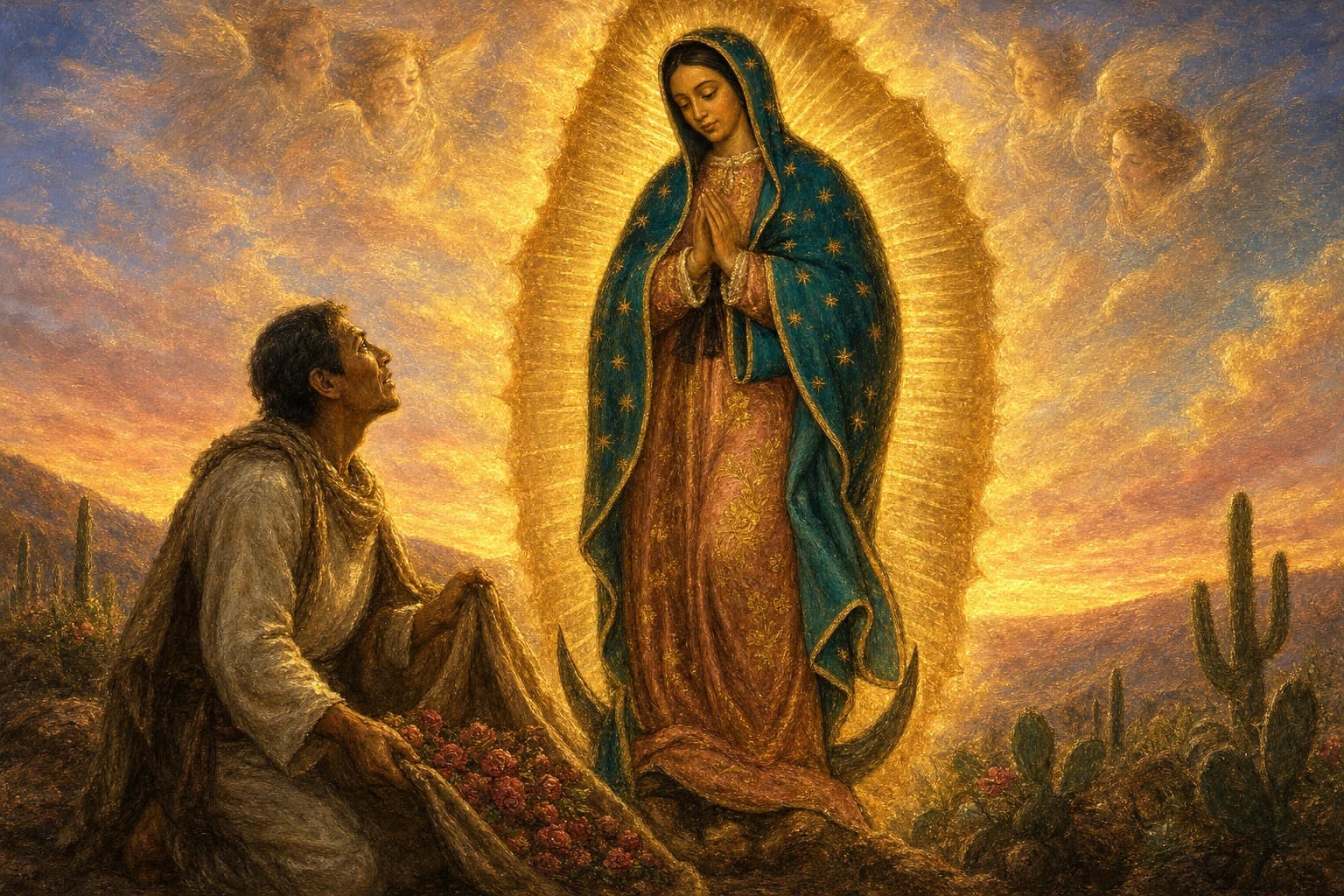
On a Saturday morning in December 1531, on his way to Mass, a poor man from a conquered people was stopped on a hill outside Mexico City by a young woman who spoke to him in his own language. She did not appear to the bishop, or to a Spanish nobleman. She went to Juan Diego. Scripture knows the pattern: “God chose the lowly things of the world, and the things that are despised” (1 Corinthians 1:28). Begin the novena by bringing your intention exactly as you are. Say the novena prayer, then:
Holy Mary, you came first to the least of your children.
Here I am, as I am, with what I carry: (name it).
Take it to your Son.
Our Lady of Guadalupe, pray for me.
Amen.
Day 2 (December 4): In his own language
She spoke to Juan Diego in Nahuatl, his own tongue, and she looked like his own people. At Pentecost the crowds in Jerusalem said the same thing in wonder: “How do we hear, everyone in our own native language?” (Acts 2:8). God does not ask us to become someone else before he will speak to us. Pray today for everyone who feels that the Church, or God, speaks a language they do not understand. Say the novena prayer, then:
Lord, you speak to each of us in our own tongue.
Speak to me today in words I can hear,
and let me speak of you to others in words they can understand.
Our Lady of Guadalupe, pray for us.
Amen.
Day 3 (December 5): “Send someone else”
After the bishop turned him away, Juan Diego went back and asked her to send someone more important, someone people would listen to. She sent him again. Mary had once said of herself that God “has looked at the humble state of his handmaid” (Luke 1:48), and she did not change her choice. Pray today for the task you feel least able to do, and for the grace to be sent anyway. Say the novena prayer, then:
Mother, like Juan Diego I would rather you sent someone else.
Give me his courage to go back and try again,
and let your Son’s strength be enough in my weakness.
Our Lady of Guadalupe, pray for me.
Amen.
Day 4 (December 6): The bishop asks for a sign
Bishop Zumárraga was not wicked; he was careful, and he asked for a sign. God gave one, as he once did through Isaiah: “Therefore the Lord himself will give you a sign. Behold, the virgin will conceive, and bear a son” (Isaiah 7:14). Pray today for the people in your life who find it hard to believe, and for patience with your own doubts. Say the novena prayer, then:
Lord, you are patient with those who ask for signs.
Be patient with me, and with (name), who finds it hard to believe.
Give us the sign that is your Son,
and the grace to recognise him.
Our Lady of Guadalupe, pray for us.
Amen.
Day 5 (December 7): “Am I not here, who am your Mother?”
His uncle Juan Bernardino fell dangerously ill, and Juan Diego, running at daybreak to fetch a priest, slipped round the other side of the hill so as not to be delayed by her. She met him on the road anyway. Her words to him, as Pope Francis has quoted them, are the heart of this devotion: “Am I not here, who am your Mother?” They echo God’s own promise through Isaiah: “As one whom his mother comforts, so I will comfort you” (Isaiah 66:13). Bring today whatever you have been trying to go around rather than through. Say the novena prayer, then:
Holy Mary, I have been taking the long way around,
hoping not to be seen.
Meet me on the road.
Tell me again that you are here,
and bring me to your Son, who heals.
Our Lady of Guadalupe, pray for (name).
Amen.
Day 6 (December 8): The Immaculate Conception
Today is the Solemnity of the Immaculate Conception, a holy day of obligation in the United States. The woman on the tilma is Mary as the Immaculate One, the “woman” of the first promise of redemption: “I will put hostility between you and the woman, and between your offspring and her offspring” (Genesis 3:15). If you can, go to Mass today; the feast is explained on the Immaculate Conception page. Say the novena prayer, then:
Father, you kept Mary free from every stain of sin
to be the mother of your Son.
By her prayers, free me from what still holds me,
and make me holy as she is holy.
Our Lady of Guadalupe, pray for us.
Amen.
Day 7 (December 9): St. Juan Diego
Today is the memorial of St. Juan Diego Cuauhtlatoatzin, on the anniversary of the first apparition. After that December he asked the bishop’s permission to live beside the little chapel on Tepeyac, and spent the rest of his life there, caring for it and for the pilgrims who came. John Paul II canonised him in 2002, the first indigenous saint of the American continent. Jesus thanked the Father for exactly this kind of saint: “you hid these things from the wise and understanding, and revealed them to infants” (Matthew 11:25). Say the novena prayer, then:
St. Juan Diego, humble messenger,
you trusted her word and carried it faithfully.
Pray for me, that I may be simple, obedient and faithful,
and that my life may carry her Son to others.
Our Lady of Guadalupe, pray for us.
Amen.
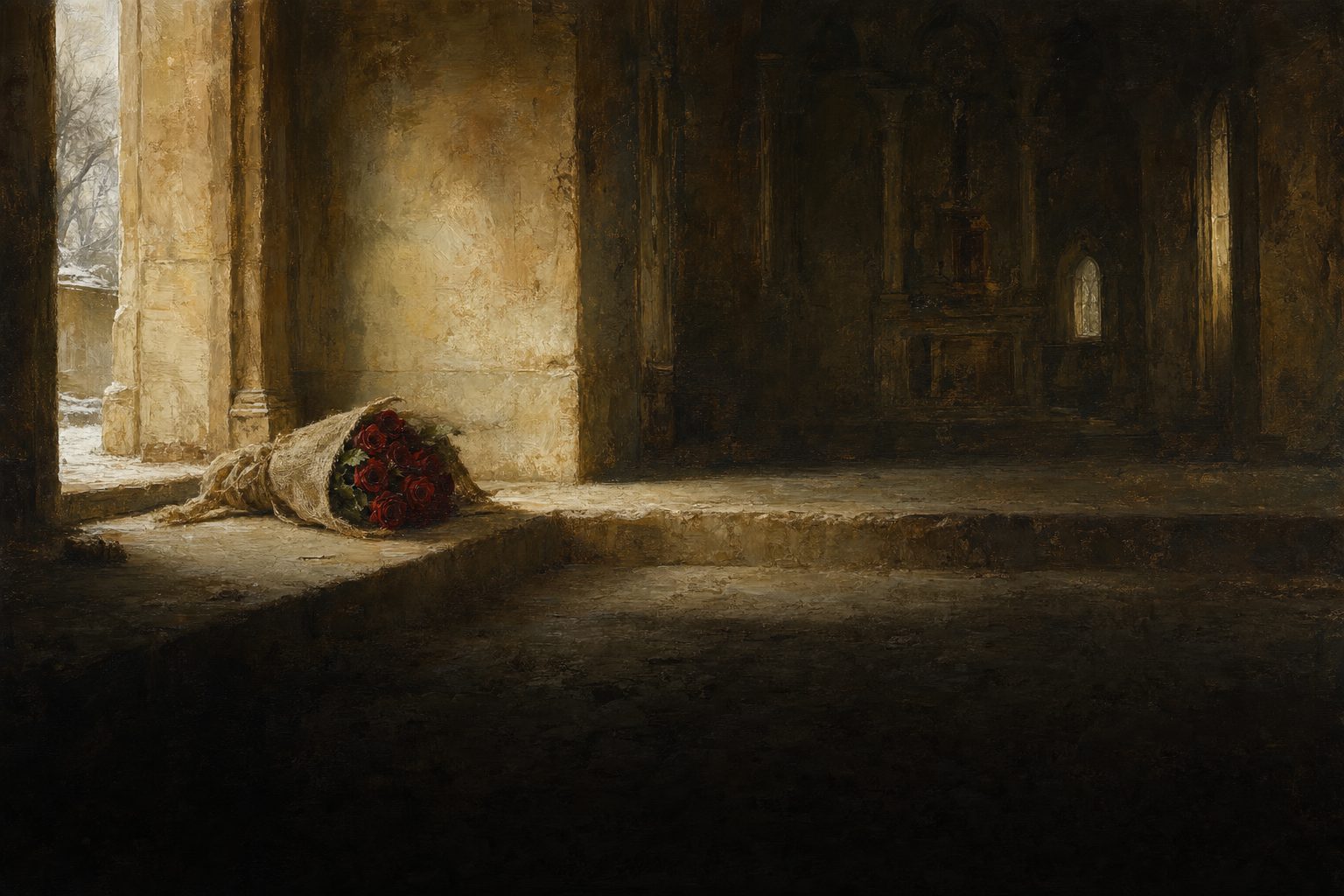
Day 8 (December 10): Roses in December
She sent him to the top of a barren hill in winter, and he found roses blooming there. Isaiah had promised it long before: “The desert will rejoice and blossom like a rose” (Isaiah 35:1). Bring today the part of your life that looks most like a winter hilltop, where nothing has grown for a long time. Say the novena prayer, then:
Lord, you make the desert bloom.
Look on this dry ground in my life: (name it).
Let something grow there again, in your time.
Our Lady of Guadalupe, Mystical Rose, pray for me.
Amen.
Day 9 (December 11, the eve of the feast): The woman clothed with the sun
When Juan Diego opened his tilma, the image of the woman who had spoken to him was on the cloth: standing before the sun, on the moon, her mantle full of stars, and, as the Vatican’s own biography of Juan Diego reads the black sash at her waist, expecting a child. It is the sign of Revelation: “a woman clothed with the sun, and the moon under her feet” (Revelation 12:1). She carries Christ to the people she has come to. Pray today for mothers, for the children they carry, and for every life at its beginning. Tomorrow is her feast; if you can, go to Mass. Say the novena prayer, then:
Holy Mary, Mother of the true God,
you carried Christ to a people who did not yet know him.
I have asked for nine days; I leave my request with you.
Carry it to your Son,
and carry him to me.
Our Lady of Guadalupe, pray for us.
Amen.
For the Advent that holds this novena, see Advent. Another Advent novena runs alongside this one: the St. Andrew Christmas novena, from November 30 to Christmas, one short prayer said fifteen times a day.
“And a great sign appeared in heaven: A woman clothed with the sun, and the moon under her feet, and on her head a crown of twelve stars…”
Go deeper
What is this novena?
The Our Lady of Guadalupe Novena is nine days of prayer that end on the eve of December 12, the day in 1531 when Juan Diego opened his cloak in front of the bishop of Mexico and the roses fell out onto the floor. It is one of the most widely prayed novenas in the Americas, and in Mexican and Mexican-American parishes it is often prayed together in church, night after night, building to the vigil of the feast. Its nine days happen to hold two other feasts that belong to the same story. December 8, the sixth day, is the Immaculate Conception, and the woman on the tilma is Mary as the Immaculate One: standing on the moon, clothed with the sun. December 9, the seventh day, is the memorial of St. Juan Diego, on the anniversary of the first apparition. The novena walks through the account almost day by day. What it asks is simple. Our Lady of Guadalupe is invoked above all as a mother: for mothers and the children they carry, for families, for the poor and for those who are far from home, and for anything a child would bring to a mother. The words she is remembered for saying to Juan Diego, when he was afraid for his dying uncle, are the heart of the devotion: “Am I not here, who am your Mother?” Like every novena, it is a way of persevering in prayer, not a formula. Mary is asked to pray; it is God who answers, and the devotion to Guadalupe, like every Marian devotion the Church approves, leads to her Son.
Keeping the nine days
Begin on December 3. Pray at the same time each day if you can, and keep one intention for all nine days. Each day: make the Sign of the Cross, read the short reflection for the day if you have time, name your intention, pray the novena prayer below, and end with a Hail Mary and the invocation “Our Lady of Guadalupe, pray for us.” The whole takes about five minutes. If you can, go to Mass on December 8, which is a holy day of obligation in the United States, and on the feast itself, December 12. Many parishes keep a vigil on the night of the 11th with Las Mañanitas sung before dawn; if yours does, it is a beautiful way to end the novena. If you miss a day, carry on and add it at the end. A novena is nine days of faithfulness, not a chain that breaks. And if you are praying for someone else, a mother expecting a child or a family member far away, tell them: knowing that someone is praying for you for nine days does its own good.
Questions people ask
When do you start the Our Lady of Guadalupe novena?
On December 3, so that the ninth day falls on December 11, the eve of her feast on December 12. If you prefer to end on the feast itself, begin on December 4; either is right.
What prayer is said for the Guadalupe novena?
There is no single official text. AngelGuard uses the short prayer to Our Lady of Guadalupe that St. Pius X approved in 1908, “Our Lady of Guadalupe, Mystical Rose”, said once a day with your intention and a Hail Mary, with a short reflection on the story of Tepeyac for each day. St. John Paul II’s longer prayer of January 1979, which begins “O Immaculate Virgin, Mother of the true God and Mother of the Church”, is published by the Vatican in Spanish, and you can pray it instead.
Is December 12 a holy day of obligation?
Not in the United States, where it is a feast. In Mexico it is a solemnity and a holy day. In the United States the holy day inside this novena is December 8, the Immaculate Conception.
What is the most powerful novena to Our Lady of Guadalupe?
No novena is more powerful than another in the sense of working better. The Church warns against treating any prayer as a mechanism that works by repetition (CCC 2111). A novena prayed with trust, for nine days, and open to God’s answer, is the whole of it.
Can I pray the Guadalupe novena at another time of year?
Yes. Many people pray it whenever they need it, especially mothers expecting a child and families in difficulty. The December dates simply let the nine days end on the eve of her feast.