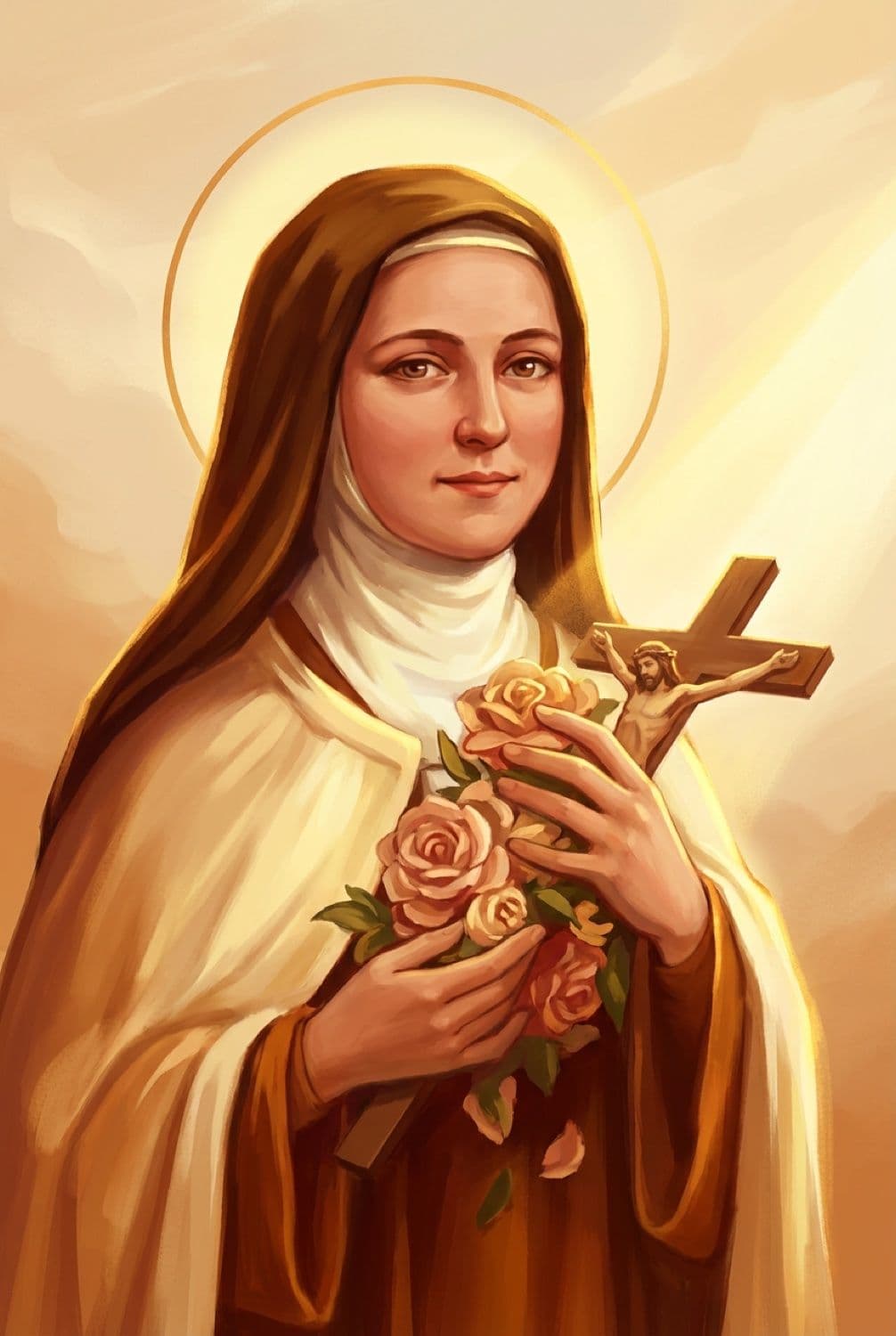
Prayer · Saints & Angels
Prayers to St. Thérèse of Lisieux
Holiness in small acts of love
A prayer to St. Thérèse: “St. Thérèse of the Child Jesus, you promised to spend your heaven doing good on earth. Pray for me. Teach me your little way: to trust God like a child, to do small things with great love, and to believe that I am loved even when I have nothing to offer. Ask Jesus for the grace I need today: (name it). Amen.” St. Thérèse of Lisieux (1873–1897) is a Carmelite nun and Doctor of the Church whose feast is October 1. Below: prayers to her for any day, the Little Flower prayer, prayers for the sick and for missionaries, and her own words on prayer as the Catechism quotes them.
In the name of the Father, and of the Son, and of the Holy Spirit.
Saint Therese of Lisieux, you were a Carmelite nun who died at twenty-four, having spent your short life behind the walls of a small French convent. You did nothing the world considered great. You wrote no theological treatises. You preached no sermons. You converted no continents.
And yet you became a Doctor of the Church, one of only four women so honored in two thousand years. You became the patroness of the missions, even though you never left France. You became, in the eyes of millions, one of the most beloved saints of the modern era.
Because you discovered the Little Way.
The Little Way is the gospel of small things. Not great heroic acts. The cup of water given for love. The smile to the difficult sister. The dish washed without complaint. The annoying noise endured in silence. The patience with the elderly nun who tried everyone's nerves. Each small act, done with great love, became a step toward sanctity.
Saint Therese, teach me the Little Way tonight.
I have been waiting for the great opportunity to be holy. The dramatic conversion. The mission to the foreign land. The spiritual experience that would change everything. I have looked past the small opportunities right in front of me. The kindness to my spouse. The patience with my child. The smile at the cashier. The prayer for the driver who cut me off in traffic.
Show me, Therese, that the path to heaven is paved with these small stones. Each one matters. Each one is real. Each one, offered to Jesus, becomes precious in His hands.
You said, I prefer the monotony of obscure sacrifice to all ecstasies. The monotony of obscure sacrifice. The unremarkable faithfulness. The doing of duty when no one is watching. The little kindness offered to the person who will never repay it.
Help me embrace this, Therese. To stop waiting for the spectacular and start receiving the ordinary as the field of holiness it is.
You also said, My vocation is love. Not works. Not knowledge. Not gifts. Love. To love within the body of Christ, however hidden the role. To be the heart of the Church, the love that animates everything else.
Let me find my vocation in love too. Whatever I am called to do, let love be the why.
You promised, after your death, to spend your heaven doing good on earth. To let fall a shower of roses. Send some roses my way tonight, Therese. Small signs of your intercession. Small graces. Small mercies.
I close with your own night prayer. O my God, I love You above all things, with my whole heart and soul, because You are all good and worthy of all love. I love my neighbor as myself for the love of You. I forgive all who have injured me, and I ask pardon of all whom I have injured. Amen.
Saint Therese of the Child Jesus, intercede for me. Teach me the Little Way.
In the name of the Father, and of the Son, and of the Holy Spirit. Amen.
Go deeper
A prayer to St. Thérèse
2 min readCatholics do not pray to saints instead of God.
Catholics do not pray to saints instead of God. They ask saints to pray with them and for them, the way you would ask a friend. St. Thérèse is one of the most asked, because she said she wanted to be asked: the Catechism quotes her, “I want to spend my heaven in doing good on earth” (CCC 956). This prayer asks her to do what she said.
St. Thérèse of the Child Jesus and of the Holy Face,
you wanted to spend your heaven doing good on earth.
I am asking you to do some good for me.
Pray to Jesus for me in this need: (name it).
If it is his will, ask him to grant it.
If it is not, ask him to give me your trust,
that I may accept what he gives
as a child accepts what its father gives.
Teach me your little way,
and help me to love Jesus as you loved him.
Amen.
If you want to pray to her over nine days, the St. Thérèse novena gives the Novena of the Twenty-four Glory Bes, its dates (September 22–30, ending on the eve of her October 1 feast) and the story behind it.
The St. Thérèse Little Flower prayer
2 min readSt. Thérèse is called the Little Flower because she called herself one.
St. Thérèse is called the Little Flower because she called herself one. On the manuscript of the first part of her autobiography she set the title “The Story of the Springtime of a little white Flower,” and in it she writes that God’s garden needs the violet and the daisy as much as the rose and the lily: the little wild flowers are loved by him as they are, and she counted herself among them. The name stuck, and prayers to “the Little Flower” are prayers to her.
St. Thérèse, Little Flower of Jesus,
you knew you were small,
and you did not mind,
because you knew you were loved.
Pray for me, who am trying so hard to be big.
Teach me to be content with being a small flower
in God’s garden,
open to the sun of his love,
and ready to be picked when he wants me.
Amen.
Jesus praised this littleness himself: “I thank you, Father, Lord of heaven and earth, that you hid these things from the wise and understanding, and revealed them to infants.” (Matthew 11:25). And: “Amen, I say to you, whoever will not receive God’s Kingdom like a little child, he will in no way enter into it.” (Mark 10:15).
A daily prayer to St. Thérèse, and the little way
1 min readHer “little way” is not a devotion to add to the day.
Her “little way” is not a devotion to add to the day. It is a way of living the day: doing ordinary things with love, accepting small humiliations quietly, and trusting God like a child trusts a parent instead of trying to earn his love. Pope St. John Paul II called it “the Gospel way of holiness for all.” A daily prayer asks her help to live it:
St. Thérèse, this morning I offer Jesus the little things of this day:
the work no one will notice,
the patience no one will thank me for,
the kind word to someone who is hard to love,
the small disappointment I will not complain about.
Let each one be a flower thrown to him.
Pray for me, that I do them with love.
Amen.
Christ’s own words on hidden goodness could be her motto: “when you do merciful deeds, don’t let your left hand know what your right hand does” (Matthew 6:3).
St. Thérèse in her own words: what the Catechism quotes
2 min readThe Catechism of the Catholic Church quotes St. Thérèse more than most of the saints, and the passages it chose are themselves prayers.
The Catechism of the Catholic Church quotes St. Thérèse more than most of the saints, and the passages it chose are themselves prayers. They are the best way to pray with her, rather than only to her.
- On what prayer is. The Catechism opens its whole teaching on prayer with her definition: “For me, prayer is a surge of the heart; it is a simple look turned toward heaven, it is a cry of recognition and of love, embracing both trial and joy” (CCC 2558).
- On praying with the Gospel. “But above all it’s the gospels that occupy my mind when I’m at prayer; my poor soul has so many needs, and yet this is the one thing needful. I’m always finding fresh lights there” (CCC 127).
- On her vocation. Searching for her place in the Church, she found it in love. The Church must have a heart, she wrote, “and I realized that this love alone was the true motive force which enabled the other members of the Church to act” (CCC 826).
- On coming before God with empty hands. From her Act of Oblation to Merciful Love: “In the evening of this life, I shall appear before you with empty hands, for I do not ask you, Lord, to count my works” (CCC 2011).
- On heaven. “I want to spend my heaven in doing good on earth” (CCC 956).
- On death. “I am not dying; I am entering life” (CCC 1011), which she wrote in a letter to Fr. Bellière, one of her spiritual brothers.
A prayer from her Act of Oblation to Merciful Love
1 min readOn June 9, 1895, the feast of the Holy Trinity, St. Thérèse offered herself to God’s merciful love in a prayer now called her Act of Oblation.
On June 9, 1895, the feast of the Holy Trinity, St. Thérèse offered herself to God’s merciful love in a prayer now called her Act of Oblation. The line the Catechism quotes (CCC 2011) goes on: “I wish, then, to be clothed in your own justice and to receive from your love the eternal possession of yourself.” It is the heart of her spirituality: not to arrive before God with a list of achievements, but with open hands, trusting him to fill them. A prayer in that spirit:
Lord, I come to you with empty hands.
I have no great works to show you,
and I do not ask you to count the ones I have.
Clothe me in your mercy instead of my own merit.
Love me as I am, and make me what you want me to be.
St. Thérèse, who trusted God with empty hands, pray for me.
Amen.
“We love him, because he first loved us.” (1 John 4:19). That verse is the whole reason her little way works: we do not earn God’s love first; we answer it.
A prayer to St. Thérèse for the sick, and for faith in the dark
1 min readSt. Thérèse knew illness.
St. Thérèse knew illness. On the night between Holy Thursday and Good Friday, 1896, she noticed the first signs of the tuberculosis that killed her eighteen months later, on September 30, 1897, at twenty-four. At the same time, as Pope St. John Paul II wrote, she underwent “a trial of faith which will last until her death”: she went on praying through it. Her last words were “My God, I love you.” Many people who are ill, and many whose faith has gone dark, ask her prayers for exactly that reason.
St. Thérèse, you suffered in body
and you walked in darkness of faith,
and you still said at the end, “My God, I love you.”
Pray for (name), who is sick.
Ask Jesus to heal them, if it is his will,
and to give them your peace whatever comes.
And pray for me, when I cannot feel God,
that I may keep loving him in the dark as you did.
Amen.
“There is no fear in love; but perfect love casts out fear” (1 John 4:18). For more prayers for a sick person, see prayers for the sick.
A prayer to St. Thérèse for missionaries and priests
1 min readThough she never left her convent after entering it at fifteen, on April 9, 1888, Pope Pius XI named her patron of the missions, together with St. Francis Xavier, on December 14, 1927, at the request of many missionary bishops.
Though she never left her convent after entering it at fifteen, on April 9, 1888, Pope Pius XI named her patron of the missions, together with St. Francis Xavier, on December 14, 1927, at the request of many missionary bishops. She prayed for missionaries and priests all her life, and wrote to young priests she regarded as her spiritual brothers, among them Fr. Bellière.
St. Thérèse, patron of the missions,
you gave your life for souls from behind a convent wall.
Pray for missionaries everywhere,
for priests who are tired or discouraged,
for those who are preparing to be priests,
and for everyone who has not yet heard that God loves them.
Teach me to be a missionary where I am,
by loving the people in front of me.
Amen.
Christ’s command is what she lived: “that you love one another. Just as I have loved you, you also love one another.” (John 13:34).
The St. Thérèse rose prayer and “miracle” prayers
2 min readMany people who pray to St. Thérèse ask her to send a rose as a sign that she has heard them.
Many people who pray to St. Thérèse ask her to send a rose as a sign that she has heard them. It is a warm, century-old popular custom, not Church teaching, and it grew up with the Novena of the Twenty-four Glory Bes after 1925. The St. Thérèse novena page tells where it comes from and what she actually said about roses. The Society of the Little Flower in the United States, which prints a rose prayer on its own prayer card, puts it plainly: “One does not pray for roses.” A rose, if one comes, is a consolation; no rose means nothing about whether you were heard.
You will also find prayers to her described as a “miracle prayer” or one that “never fails.” No prayer to any saint is guaranteed to obtain what it asks. The Catechism calls it superstition to attribute the effect of a prayer to its mere external performance (CCC 2111). St. Thérèse, who met every disappointment of her life with trust, would be the last saint to want to be treated as a guarantee. Pray to her with confidence, and leave the answer to God.
St. Thérèse, I am asking your help with (name it).
If a rose comes, I will thank God for it.
If none comes, I will still trust that you have heard me,
and that God’s answer is better than mine.
Amen.
Who St. Thérèse of Lisieux was
1 min readThérèse Martin was born at Alençon, in Normandy, on January 2, 1873.
Thérèse Martin was born at Alençon, in Normandy, on January 2, 1873. She entered the Carmelite convent at Lisieux on April 9, 1888, at fifteen, and died there on September 30, 1897, at twenty-four. Her autobiography, published a year after her death as Story of a Soul, went around the world. Pope Pius XI beatified her in 1923 and canonized her on May 17, 1925. On October 19, 1997, Pope St. John Paul II declared her a Doctor of the Church. Her feast is October 1. Her life, the little way and the history of the devotion to her are told more fully on the St. Thérèse novena page.
Questions
What is the prayer to St. Thérèse?
There is no single official one. A simple prayer: “St. Thérèse of the Child Jesus, you promised to spend your heaven doing good on earth. Pray for me. Teach me your little way, and ask Jesus for the grace I need today. Amen.” The best-known longer devotion is the Novena of the Twenty-four Glory Bes, prayed over nine days.
Why is St. Thérèse called the Little Flower?
Because she called herself one. She titled the first manuscript of her autobiography “The Story of the Springtime of a little white Flower” and compared herself to a small wildflower in God’s garden, loved as it is.
What is the St. Thérèse rose prayer?
A short prayer, printed by the Society of the Little Flower on its prayer card, that asks her: “please pick for me a rose from the heavenly gardens and send it to me as a message of love.” The custom of asking for a rose is a popular one, not Church teaching; receiving no rose says nothing about whether you were heard. The novena page explains where the custom comes from.
Is there a St. Thérèse miracle prayer that never fails?
No prayer is guaranteed to obtain what it asks, and the Church calls it superstition to attribute a prayer’s effect to its external performance (CCC 2111). Pray to St. Thérèse with confidence, as to a friend, and leave the answer to God.
What is St. Thérèse the patron saint of?
The missions: Pope Pius XI named her patron of the missions, with St. Francis Xavier, on December 14, 1927, though she never left her convent. Many also ask her prayers for the sick, since she died of tuberculosis at twenty-four.
What is the little way of St. Thérèse?
Her way of holiness: doing small, ordinary things with great love, and trusting God like a small child instead of trying to earn his love by great deeds. Pope St. John Paul II called it “the Gospel way of holiness for all.”
How did St. Thérèse of Lisieux die?
Of tuberculosis, at the Carmel of Lisieux, on the afternoon of September 30, 1897, aged twenty-four. She first noticed its symptoms on the night between Holy Thursday and Good Friday, 1896. Her last words were “My God, I love you.”
When is the feast of St. Thérèse?
October 1. The novena to her is traditionally begun on September 22 so that it ends on September 30, the anniversary of her death.
Praying toward her feast on October 1? The St. Thérèse novena begins on September 22.
Pray next
 The St. Gertrude Prayer and Prayers for the Souls in PurgatoryEternal Father, I offer You the most Precious Blood: for the holy souls in purgatory, in November and every day
 St. Monica Prayer for Wayward ChildrenFor a son or daughter who has left the faith: the mother of St. Augustine, her tears, and her prayers
 Prayers to St. JosephFoster father of Jesus, patron of fathers
 Prayer of Saint Francis — Make Me an Instrument of PeaceMake me an instrument of Your peace
 Prayer to St. Jude for Impossible CausesPatron saint of impossible cases
 Padre Pio Prayers: “Stay with Me, Lord” and a Prayer to St. PioPray, hope, and don't worry
Guided narration · How it’s made
Upcoming · Sep 29
Sts. Michael, Gabriel and RaphaelSee the full liturgical calendar — every feast this year, and an embed for your parish site.