Psalm 22
Psalm 22: My God, My God, Why Have You Forsaken Me?
The psalm Jesus prayed from the cross: a cry of abandonment that turns, line by line, into praise.
Psalm 22 begins with the words Jesus cried from the cross: “My God, my God, why have you forsaken me?” It is a psalm of David that moves from abandonment to praise; the Gospels quote it in the Passion, and the Church sings it on Palm Sunday.
Pray it now
Psalm 22 in full
1My God, my God, why have you forsaken me? Why are you so far from helping me, and from the words of my groaning?2My God, I cry in the daytime, but you don’t answer; in the night season, and am not silent.3But you are holy, you who inhabit the praises of Israel.4Our fathers trusted in you. They trusted, and you delivered them.5They cried to you, and were delivered. They trusted in you, and were not disappointed.6But I am a worm, and no man; a reproach of men, and despised by the people.7All those who see me mock me. They insult me with their lips. They shake their heads, saying,8“He trusts in the LORD. Let him deliver him. Let him rescue him, since he delights in him.”9But you brought me out of the womb. You made me trust while at my mother’s breasts.10I was thrown on you from my mother’s womb. You are my God since my mother bore me.11Don’t be far from me, for trouble is near. For there is no one to help.12Many bulls have surrounded me. Strong bulls of Bashan have encircled me.13They open their mouths wide against me, lions tearing prey and roaring.14I am poured out like water. All my bones are out of joint. My heart is like wax. It is melted within me.15My strength is dried up like a potsherd. My tongue sticks to the roof of my mouth. You have brought me into the dust of death.16For dogs have surrounded me. A company of evildoers have enclosed me. They have pierced my hands and feet.17I can count all of my bones. They look and stare at me.18They divide my garments among them. They cast lots for my clothing.19But don’t be far off, LORD. You are my help. Hurry to help me!20Deliver my soul from the sword, my precious life from the power of the dog.21Save me from the lion’s mouth! Yes, you have rescued me from the horns of the wild oxen.22I will declare your name to my brothers. Among the assembly, I will praise you.23You who fear the LORD, praise him! All you descendants of Jacob, glorify him! Stand in awe of him, all you descendants of Israel!24For he has not despised nor abhorred the affliction of the afflicted, neither has he hidden his face from him; but when he cried to him, he heard.25My praise of you comes in the great assembly. I will pay my vows before those who fear him.26The humble shall eat and be satisfied. They shall praise the LORD who seek after him. Let your hearts live forever.27All the ends of the earth shall remember and turn to the LORD. All the relatives of the nations shall worship before you.28For the kingdom is the LORD’s. He is the ruler over the nations.29All the rich ones of the earth shall eat and worship. All those who go down to the dust shall bow before him, even he who can’t keep his soul alive.30Posterity shall serve him. Future generations shall be told about the Lord.31They shall come and shall declare his righteousness to a people that shall be born, for he has done it.
Psalm 22 · WEBC
“O God my God, look upon me: why hast thou forsaken me?”
Go deeper
Why did Jesus quote Psalm 22 on the cross?
Matthew and Mark both record it, in the Aramaic Jesus spoke:
About the ninth hour Jesus cried with a loud voice, saying, “Eli, Eli, lima sabachthani?” That is, “My God, my God, why have you forsaken me?” (Matthew 27:46)
Mark 15:34 gives it as “Eloi, Eloi, lama sabachthani?” Some of the bystanders did not recognize the psalm and thought he was “calling Elijah” (Matthew 27:47).
Two things are true at once, and the Church holds both. The first is that the cry is real. Jesus is not reciting a text to make a point; he is praying from inside the abandonment the psalm describes. The Catechism says that in his redeeming love he “assumed us in the state of our waywardness of sin, to the point that he could say in our name from the cross” the first line of this psalm (CCC 603). He speaks our dereliction as his own.
The second is that it is a prayer, not despair. To quote the first line of a psalm was the ordinary way to name the whole of it, and Psalm 22 does not end in abandonment. It turns to praise and ends in victory. The Catechism places the cry among the last words from the cross “where prayer and the gift of self are but one” (CCC 2605). Even forsaken, he says “my God.”
Where the Gospels quote Psalm 22
Psalm 22 is quoted or echoed in the Passion more than any other psalm. The parallels are specific enough that the first Christians read the psalm as prophecy, and the Church has read it so ever since. Verse numbers here are the World English Bible’s.
- The mockery (verses 7–8). “They shake their heads” and “He trusts in the LORD. Let him deliver him.” Matthew: “Those who passed by blasphemed him, wagging their heads” (27:39), and the chief priests say, “He trusts in God. Let God deliver him now” (27:43).
- The garments (verse 18). “They divide my garments among them. They cast lots for my clothing.” John quotes it outright: the soldiers cast lots for the seamless tunic “that the Scripture might be fulfilled” (John 19:24).
- The thirst (verse 15). “My tongue sticks to the roof of my mouth.” John records “I am thirsty!” so “that the Scripture might be fulfilled” (John 19:28); he does not say which Scripture, and Psalm 69 is the other candidate.
- The hands and feet (verse 16). “They have pierced my hands and feet.” The Gospels do not quote this line, but Thomas later speaks of “the print of the nails” in his hands (John 20:25). See the note below on how this verse is translated.
- The praise (verse 22). “I will declare your name to my brothers.” The Letter to the Hebrews puts these words in the mouth of the risen Christ (Hebrews 2:12).
The arc of Psalm 22: from lament to praise
Stopping at the first line reverses the psalm’s meaning. Read whole, it has a clear shape.
Verses 1–11: forsaken, and still “my God.” The complaint and the trust alternate. “My God, I cry in the daytime, but you don’t answer.” Then: “But you are holy.” The mockers’ taunt. Then: “But you brought me out of the womb.” Every “but” is faith refusing to let go.
Verses 12–21: surrounded. Bulls, lions and dogs close in; the body is “poured out like water.” The plea shrinks to three words: “Hurry to help me!” Then, in the middle of verse 21, the turn: “Yes, you have rescued me from the horns of the wild oxen.” The Hebrew verb there can also mean “you have answered me.” The God who did not answer in verse 2 has answered.
Verses 22–31: praise in widening circles. First “my brothers” and the assembly; then all the descendants of Jacob; then “All the ends of the earth” and the nations; then even “All those who go down to the dust”; and finally “a people that shall be born.” The last words are “for he has done it.” Many Christian readers have heard in them an echo of Jesus’ last word in John’s Gospel, “It is finished!” (John 19:30).
A note on verse 16: “They have pierced my hands and feet”
This is the most debated line of the psalm, and it is fair to say why. In the standard Hebrew text (the Masoretic Text) the phrase reads, literally, “like a lion my hands and my feet,” which lacks a verb. The Septuagint, the Greek translation made before Christ and used by the early Church, reads “they dug my hands and feet.” Saint Jerome kept that reading in the Latin psalter the Church sang for centuries, and the Douay-Rheims follows it. A fragment of the psalm found in the Judean desert at Nahal Hever, older than any surviving Masoretic manuscript, appears to have a verb in that place, which supports the Greek.
The World English Bible, like most Christian translations, reads “They have pierced my hands and feet.” Jewish translations follow the Masoretic “like a lion.” Neither reading changes the rest of the psalm, which describes a body stretched, exposed and poured out in terms the Gospels plainly recognized.
Praying Psalm 22 when God feels far away
Psalm 22 gives a place inside faith to the feeling that God has gone silent. It lets you say “Why are you so far from helping me” to God, which is itself an act of faith: you only say it to someone you still believe is there. If the silence has become despair, or thoughts of ending your life, please tell someone you trust today.
My God, my God,
I do not understand why you feel so far away.
I cry in the daytime, and at night I am not silent.
But you are holy,
and my fathers trusted in you and were not disappointed.
You have been my God since I was born.
Do not be far from me, for trouble is near.
You are my help; hurry to help me.
Jesus, you prayed these words from the cross.
Pray them with me now,
and bring me, as you were brought, from the dust to praise.
Amen.
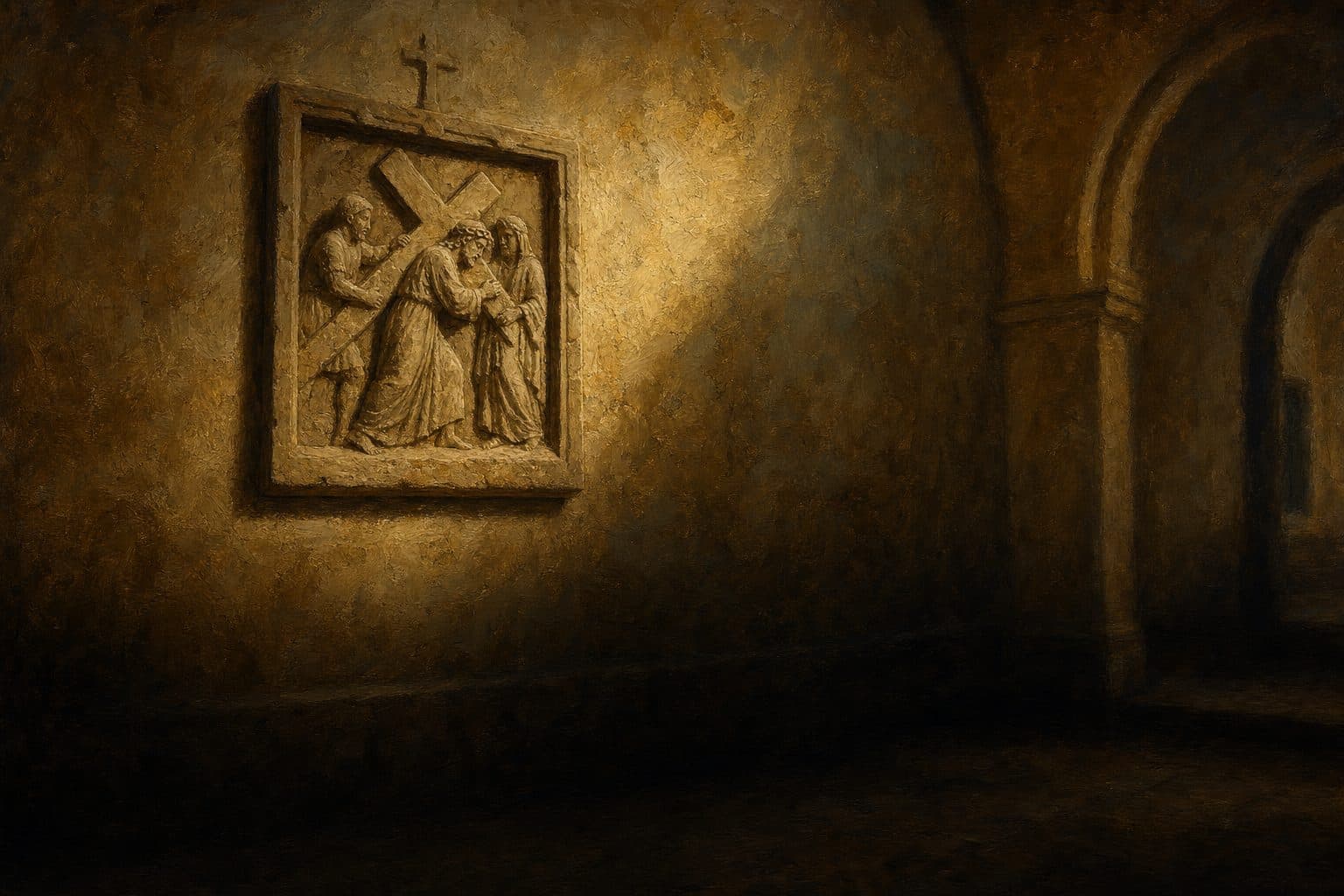
Pray it once, then read verses 22 to 31 aloud, even if you cannot yet feel them. The psalm does not ask you to skip the lament; it asks you not to stop there. For more, the Bible verses about hope and the prayer for hope carry on from here, and in Holy Week the psalm belongs with Palm Sunday and the Stations of the Cross.
What Psalm 22 Means
Psalm 22 is the psalm Jesus prayed while dying, and knowing that changes how the opening line reads.
He says the first verse aloud from the cross: my God, my God, why have you forsaken me. Heard on its own it sounds like the end of faith. But a Jewish listener in that crowd would have known what quoting a psalm's first line does. It names the whole psalm. He is not abandoning Scripture at the last moment; he is praying it, and the psalm he chose does not end where he stopped speaking.
What comes between is uncomfortably specific. The psalm describes mockery from onlookers who wag their heads, a body poured out like water, bones out of joint, a mouth dried up, hands and feet marked, and clothing divided by lot. It was written centuries before crucifixion existed as a Roman practice. The Church has read it as prophecy from the beginning, and the Gospel writers quote it directly in their accounts of the crucifixion.
Then, without warning, the psalm turns. From verse twenty-two it is praise, and it widens until it takes in all the families of the nations and generations not yet born. It ends with the declaration that he has done it.
That is what Christ was pointing at. The cry was the opening of a psalm that finishes in victory.
Liturgical Use in the Catholic Church
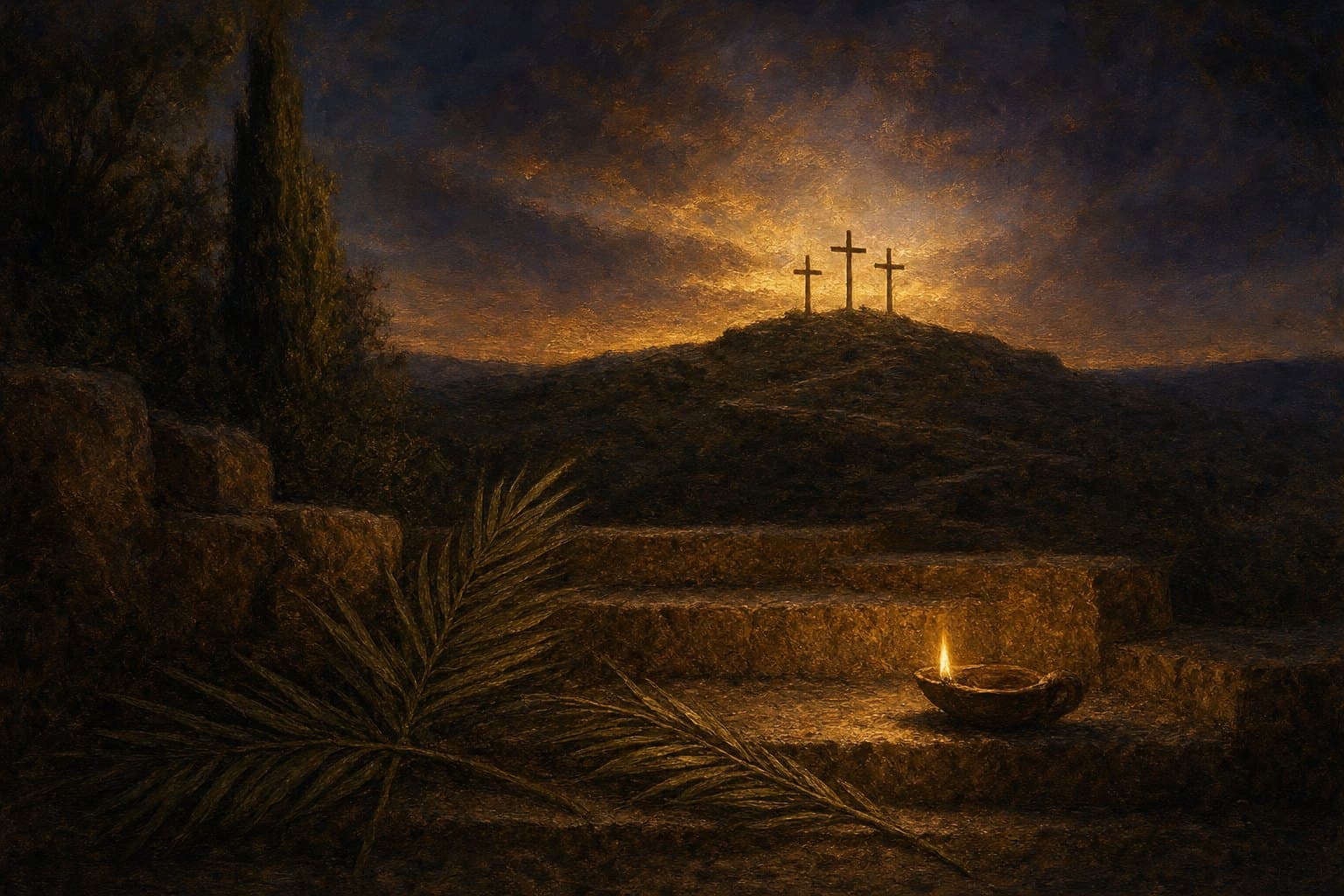
Psalm 22 is the responsorial psalm of Palm Sunday of the Passion of the Lord, sung before the Passion is read, with the refrain "My God, my God, why have you abandoned me?" On Good Friday the psalm is Psalm 31, "Father, into your hands I commend my spirit." The psalm's closing verses of praise return as the responsorial psalm of the Fifth Sunday of Easter in Year B. In the Liturgy of the Hours it is prayed at Daytime Prayer on Friday of Week III, the weekday of the Passion. It is one of the psalms most directly tied to the events of Holy Week.
Praying Psalm 22 — A Simple Practice
Read it in one sitting rather than stopping at the famous line, because stopping there reverses its meaning. If you are in a period where prayer feels like shouting at nothing, this is the psalm that gives that experience a place inside faith rather than outside it. Pray it on Good Friday if you pray no other psalm in the year.
Questions people ask
Why did Jesus say My God, my God, why have you forsaken me?
He was praying Psalm 22 aloud from the cross. Quoting a psalm's opening line named the whole psalm to any Jewish listener, and Psalm 22 turns from abandonment to praise and ends in victory. It was not a loss of faith but a prayer.
Does Psalm 22 predict the crucifixion?
It describes mockery, a body poured out, bones out of joint, pierced hands and feet, and garments divided by lot, written long before crucifixion existed as a Roman practice. The Gospel writers quote it directly in their accounts, and the Church has read it as prophetic from the earliest centuries.
When is Psalm 22 read at Mass?
It is the responsorial psalm of Palm Sunday, the day the Passion is first read in Holy Week, with the refrain "My God, my God, why have you abandoned me?" Its closing verses of praise are sung on the Fifth Sunday of Easter in Year B. It is among the psalms most closely bound to Holy Week.
Is Psalm 22 the psalm for Good Friday?
No. It is often assumed to be, but the responsorial psalm of Good Friday is Psalm 31, with the refrain "Father, into your hands I commend my spirit," the words Jesus prays in Luke 23:46. Psalm 22 belongs to Palm Sunday, five days earlier.
What does Eli, Eli, lama sabachthani mean?
"My God, my God, why have you forsaken me?" It is the first line of Psalm 22 in Aramaic, the language Jesus spoke; Matthew gives it as "Eli, Eli, lima sabachthani" and Mark as "Eloi, Eloi, lama sabachthani." Some bystanders misheard it as a call to the prophet Elijah.
What is Psalm 22 in the Douay-Rheims?
Psalm 21. Catholic Bibles following the Vulgate and Septuagint number it one lower through this part of the Psalter. The verse numbers differ too: the Lectionary and the New American Bible count the heading as verse 1, so their Psalm 22:17 is verse 16 in the World English Bible.