Psalm 46
Psalm 46: God Is Our Refuge and Strength
Be still, and know that I am God: what the famous line means when the mountains are shaking around you.
Psalm 46, “God is our refuge and strength,” is the psalm behind the line “Be still, and know that I am God.” In context that line is less an invitation to relax than a command to stop striving and let God be God.
Pray it now
Psalm 46 in full
1God is our refuge and strength, a very present help in trouble.2Therefore we won’t be afraid, though the earth changes, though the mountains are shaken into the heart of the seas;3though its waters roar and are troubled, though the mountains tremble with their swelling. Selah.4There is a river, the streams of which make the city of God glad, the holy place of the tents of the Most High.5God is within her. She shall not be moved. God will help her at dawn.6The nations raged. The kingdoms were moved. He lifted his voice and the earth melted.7The LORD of Armies is with us. The God of Jacob is our refuge. Selah.8Come, see the LORD’s works, what desolations he has made in the earth.9He makes wars cease to the end of the earth. He breaks the bow, and shatters the spear. He burns the chariots in the fire.10“Be still, and know that I am God. I will be exalted among the nations. I will be exalted in the earth.”11The LORD of Armies is with us. The God of Jacob is our refuge. Selah.
Psalm 46 · WEBC
“Be still and see that I am God; I will be exalted among the nations, and I will be exalted in the earth.”
Go deeper
What Psalm 46 Means
Psalm 46 is best known for four words that are almost always quoted out of their setting: be still, and know that I am God.
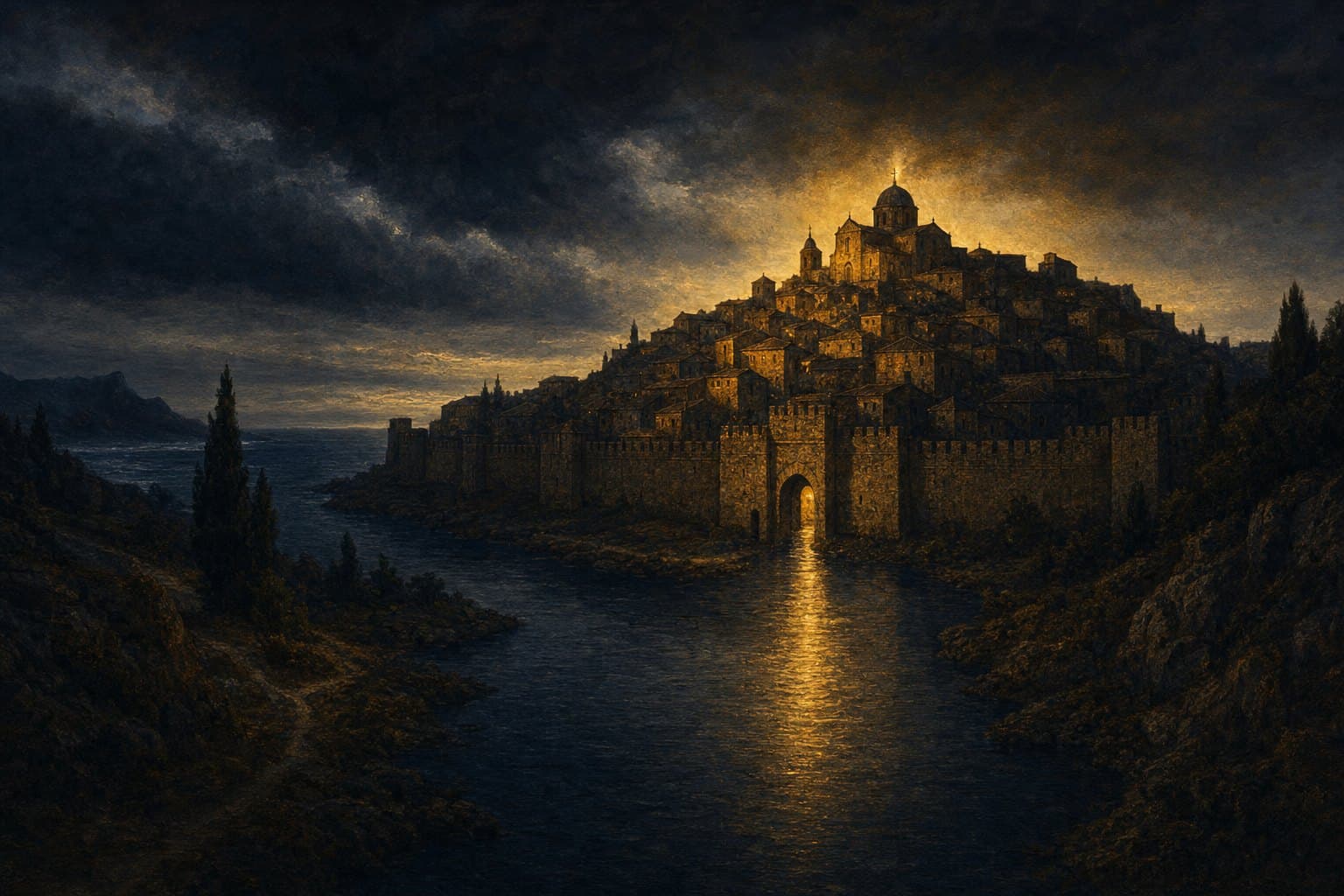
The setting is chaos. The psalm opens with the earth changing, mountains shaken into the sea, waters roaring. It is a picture of the world coming apart at the foundations, and it is deliberately cosmic rather than personal. Then, in the middle of that, a river whose streams make glad the city of God. Not a torrent. A river, running quietly through a besieged city.
The famous line is spoken into this. Read where it sits, and be still is not an invitation to relax. It is closer to a command to stop: stop struggling, stop the noise, stop trying to hold the mountains up. The verse immediately before it describes God ending wars and breaking weapons. Stillness here is what is left when the fighting is taken out of your hands.
That is why the psalm has been prayed for centuries in wartime, in illness, and by people whose situation has stopped responding to effort. It does not promise that the shaking will stop. It promises that the city with the river in it will not be moved.
Liturgical Use in the Catholic Church
Psalm 46 appears in the Liturgy of the Hours and is frequently used at times of national crisis and disaster. Its imagery of the city of God feeds directly into Catholic reflection on the Church.
Praying Psalm 46 — A Simple Practice
Read the whole psalm before using the famous line, because on its own it becomes a slogan about calm. Prayed in full, it says something harder and more useful: be still because the outcome is not yours to force. It is a good psalm for insomnia caused by a problem you cannot act on tonight.
Questions people ask
What does Be still and know that I am God mean?
In context it is not an invitation to relax. The verse before describes God ending wars and breaking weapons, so stillness here means stopping the struggle, not achieving calm. It is what is left when the fighting is taken out of your hands.
What is Psalm 46 about?
God as refuge while the world comes apart. It opens with mountains falling into the sea and answers that not with rescue from the chaos but with a river running quietly through a besieged city that will not be moved.
What number is Psalm 46 in Catholic Bibles?
Psalm 45 in the Douay-Rheims and the Vulgate, which follow the Septuagint numbering and run one lower through most of the Psalter.