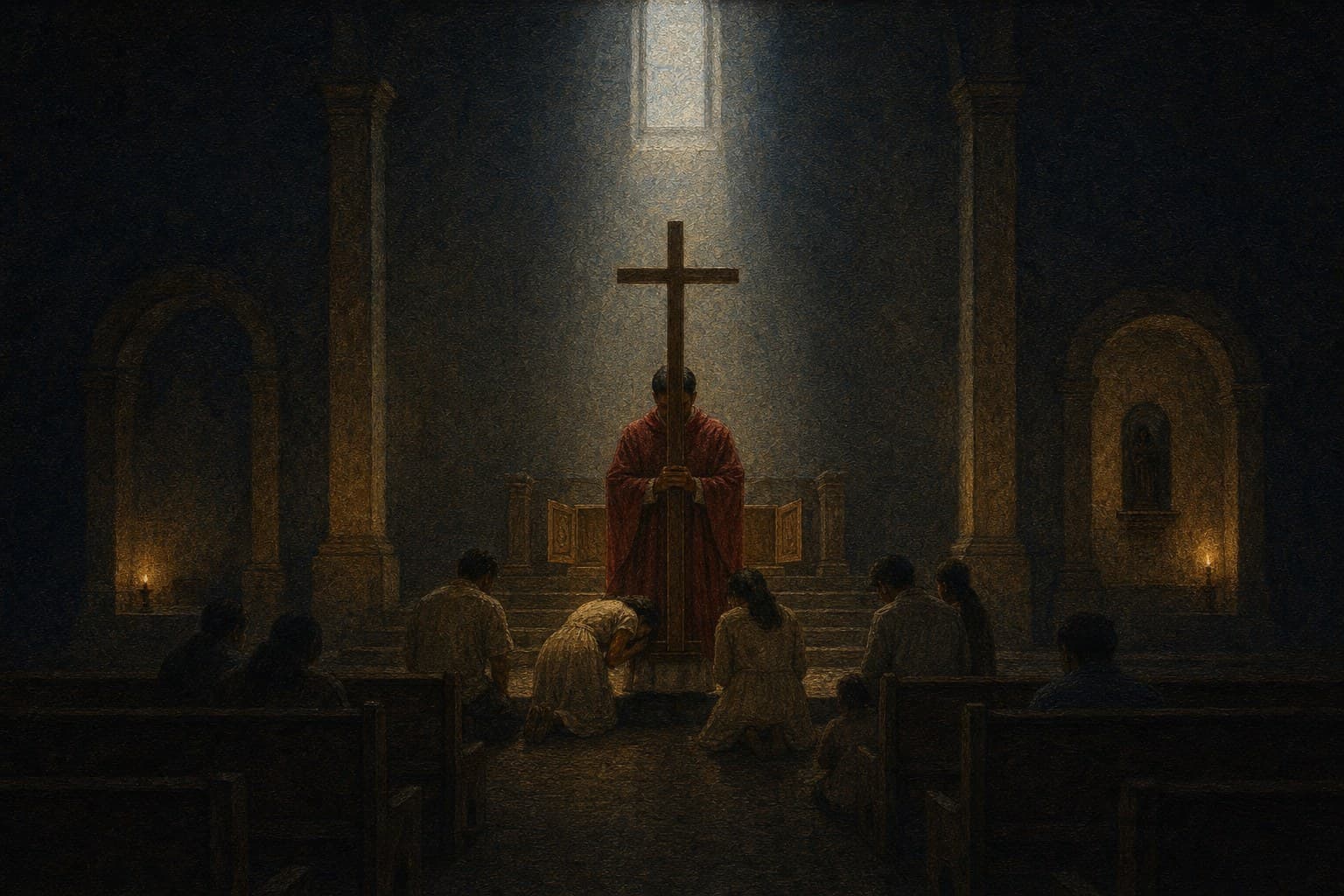
Good Friday · The Passion of the Lord
Good Friday Prayers and the Reproaches
A prayer at the foot of the Cross, the Reproaches in English and Latin, the Veneration explained, and how to keep Good Friday, March 26, 2027
On Good Friday, Catholics pray at the foot of the Cross: the Reproaches sung at the Veneration, the Stations, the Anima Christi, and a pause at three in the afternoon, the hour Christ died.
Lord Jesus Christ, crucified for us. I come this day to the foot of Your Cross.
I am sorry for every sin of mine that drove a nail.
I am sorry for every word of mine that was the gall and the vinegar.
I am sorry for every desertion of mine that was the flight of the disciples.
I am sorry for every denial of mine that was the cock crow of Peter.
I am sorry, Lord, that I have so often preferred my comfort to Your Cross.
You have led me out of Egypt, and I have led You to the Cross. You have opened the sea before me, and I have opened Your side with a spear. You have given me saving water from the rock, and I have given You gall and vinegar to drink.
Sanctus Deus, Sanctus fortis, Sanctus immortalis, miserere nobis.
Holy God. Holy Mighty One. Holy Immortal One. Have mercy on us.
I kiss the wood of Your Cross.
Ecce lignum Crucis, in quo salus mundi pependit.
Venite, adoremus.
Behold the wood of the Cross, on which hung the salvation of the world.
Come, let us adore.
Holy Mary, Mother of Sorrows, who stood at the foot — Stabat Mater dolorosa, juxta crucem lacrimosa, dum pendebat Filius — the sorrowful Mother stood weeping at the Cross while her Son hung — pray for us. Stand with us today.
Saint John the beloved, who took her into your home, pray for us.
Saint Mary Magdalene, who would come to the tomb at dawn, pray for us.
All you who watched at the foot — Saint Joseph of Arimathea, Saint Nicodemus who came by night, the holy women of Galilee — pray for us.
Soul of Christ, sanctify me. Body of Christ, save me. Blood of Christ, inebriate me. Water from the side of Christ, wash me. Passion of Christ, strengthen me. O good Jesus, hear me. Within Thy wounds hide me. Suffer me not to be separated from Thee. From the malicious enemy defend me. In the hour of my death call me, and bid me come to Thee, that with Thy saints I may praise Thee for ever and ever.
Consummatum est.
It is finished.
Through Christ our Lord. Amen.
In the name of the Father, and of the Son, and of the Holy Spirit. Amen.
(The closing prayer of the AngelGuard app’s Good Friday meditation, printed as the app prays it.)
The chapters give the Reproaches in English and Latin from a Holy Week book of 1875, what to do when you go up to the Cross, and how to keep the day at home and at church.
Go deeper
How to pray this Good Friday prayer
2 min readThe prayer that opens this page is the one the AngelGuard app’s Good Friday meditation closes with, printed word for word as the app prays it.
The prayer that opens this page is the one the AngelGuard app’s Good Friday meditation closes with, printed word for word as the app prays it. Say it slowly, before a crucifix if you have one, whenever the day allows; read aloud, it takes a few minutes. It moves through seven steps:
- Sorrow. Five short lines of contrition set each sin beside a moment of the Passion: the nails, the gall, the disciples who ran, the denial of Peter.
- The Reproaches, answered. “You have led me out of Egypt, and I have led You to the Cross”: the prayer replies, in the first person, to the chant the choir sings at the Veneration.
- Holy God. The Trisagion, the thrice-holy hymn sung between the Reproaches, first in Latin and then in English.
- The Cross unveiled. The words the priest sings as he unveils the Cross, with the people’s answer, “Come, let us adore.”
- Those who stood there. Mary, with the opening lines of the Stabat Mater; then John, Mary Magdalene, Joseph of Arimathea, Nicodemus and the women of Galilee.
- The Anima Christi. “Soul of Christ, sanctify me,” the fourteenth-century prayer to the wounded Christ, in full.
- The last word. “Consummatum est,” in Latin and in English, and then the Sign of the Cross.
If you have only a minute, the Anima Christi alone is enough, and it has its own page with the Latin. The whole meditation in the app runs about twenty-five minutes: the Reproaches read aloud, the Veneration, the three o’clock hour, and what the Church asks of you today. It is free.
How to pray on Good Friday, at home and at church
3 min readNo Mass is offered anywhere in the world on Good Friday, which falls on March 26 in 2027; the day turns on one afternoon liturgy and the hour of the Lord’s death.
No Mass is offered anywhere in the world on Good Friday, which falls on March 26 in 2027; the day turns on one afternoon liturgy and the hour of the Lord’s death. A simple plan for the day:
- Go to the liturgy. The Celebration of the Lord’s Passion is held at about three in the afternoon, and many parishes add an evening service for people who work. It is not a day of obligation, yet if you can go, no devotion at home can take its place. If illness or age keeps you home, ask your parish to bring you Holy Communion: the Church allows it to be taken to the sick at any hour of Good Friday.
- Stop at three o’clock. Saint Mark gives the hour: “And at the ninth hour, Jesus cried out with a loud voice, saying: Eloi, Eloi, lamma sabacthani?” (Mark 15:34). In the old reckoning of the day the ninth hour came at about three in the afternoon. Wherever you are, make the Sign of the Cross and pray an Our Father, the prayer that opens this page, or the Chaplet of Divine Mercy, which many Catholics pray at three. With children, hold up a crucifix at home and let each one kiss it.
- Walk the Way of the Cross. Many parishes pray the Stations of the Cross at noon or in the evening, and a family can pray them at home before a crucifix.
- Begin the Divine Mercy novena. Its nine days start on Good Friday and end on the eve of Divine Mercy Sunday: see the Divine Mercy novena.
- Keep the evening still. Leave the screens dark, read the Passion according to John, chapters 18 and 19, and let the house stay quiet until the Vigil.
Fasting and abstinence in 2027. Good Friday and Ash Wednesday are the two days of the year on which Catholics of the Latin Church both fast and abstain (canon 1251). The fast binds Catholics aged 18 to 59: you may eat a single full meal, with two lighter ones that would not add up to another. Everyone aged 14 and over keeps the abstinence from meat (canon 1252). The US bishops excuse the sick, including people with a chronic illness such as diabetes, and women who are pregnant or nursing, and they ask for common sense: no one should put their health at risk by fasting, and anyone who is excused can still keep the day with prayer. Many Catholics keep the fast through Holy Saturday until the Easter Vigil. The rules and the date for each year are on the Good Friday page.
The Reproaches (Improperia) in English
4 min readThe Reproaches, in Latin the Improperia, are the chant of the Veneration of the Cross: while the faithful come forward one by one, Christ speaks from the Cross to the people he saved.
The Reproaches, in Latin the Improperia, are the chant of the Veneration of the Cross: while the faithful come forward one by one, Christ speaks from the Cross to the people he saved. Each verse sets a gift of God in the Exodus beside a wound of the Passion, and the refrain takes its words from the prophet Micah: “O my people, what have I done to thee” (Micah 6:3).
The English here is from The Complete Office of Holy Week, in Latin and English, a book entered for copyright in New York in 1875 and printed by Benziger Brothers. In that book the choir answers the first three verses with the Trisagion, printed once here, and each of the last nine with the refrain, “My people! what have I done to thee?” To pray them at home, one voice reads each verse and everyone gives the answer: the three lines of “Holy God” after each of the first three verses, and the refrain after each of the last nine. A few of the book’s words have aged: buffets are blows of the fist, a gibbet is a gallows, and Pharao and the Chanaanites are Pharaoh and the Canaanites. Today’s Missal uses a newer translation, so the words sung in your parish will sound different.
My people! what have I done to thee? Or in what have I grieved thee? Answer me.
Because I brought thee out of the land of Egypt: thou hast prepared a cross for thy Saviour.
Holy God.
Holy and strong God.
Holy and immortal God! have mercy on us.
Because I led thee through the desert forty years and fed thee with manna and brought thee into an excellent land; thou hast prepared a cross for thy Saviour.
What more should I have done to thee, and have not done? I have planted thee for my most beautiful vineyard: and thou hast proved very bitter to me: for in my thirst thou gavest me vinegar to drink; and with a spear thou hast pierced the side of thy Saviour.
For thy sake I scourged Egypt with her first-born; and thou hast delivered me to be scourged.
I brought thee out of Egypt, having drowned Pharao in the Red Sea; and thou hast delivered me over to the chief priests.
I opened the sea before thee; and thou with a spear hast opened my side.
I went before thee in a pillar of the cloud; and thou hast brought me to the palace of Pilate.
I fed thee with manna in the desert; and thou hast beaten me with buffets and scourges.
I gave thee wholesome water to drink out of the rock; and thou hast given me gall and vinegar.
For thy sake I struck the kings of the Chanaanites; and thou hast struck my head with a reed.
I gave thee a royal sceptre; and thou hast given me a crown of thorns.
I have exalted thee with great strength; and thou hast hanged me on the gibbet of the cross.
We adore thy cross, O Lord! and we praise and glorify thy holy resurrection: for by the wood of the cross the whole earth is filled with joy.
Who are “my people”? The verses remember Israel in the desert, but the Church sings them to her own children, and those who walk up to kiss the Cross hear them spoken to themselves. The Catechism is plain about it: the Church lays the heaviest share of guilt for the sufferings of Christ on Christians, whose sins caused them, and rejects the old habit of blaming the Jews alone (CCC 598). The Second Vatican Council taught that his Passion “cannot be charged against all the Jews” then alive, “nor against the Jews of today” (Nostra Aetate 4). So pray them as Christ’s words to you, never as a charge against the Jewish people.
The Reproaches in Latin: Popule meus
2 min readThe Latin of the Reproaches is the text the Roman Missal printed for centuries, given here as the same 1875 book prints it beside its English.
The Latin of the Reproaches is the text the Roman Missal printed for centuries, given here as the same 1875 book prints it beside its English. The Trisagion keeps its Greek: one side of the choir sings “Agios o Theos,” and the other answers “Sanctus Deus.”
Popule meus, quid feci tibi? aut in quo contristavi te? responde mihi.
Quia eduxi te de terra Ægypti, parasti crucem Salvatori tuo.
Agios o Theos.
Sanctus Deus.
Agios ischyros.
Sanctus fortis.
Agios athanatos, eleison imas.
Sanctus immortalis, miserere nobis.
Quia eduxi te per desertum quadraginta annis, et manna cibavi te, et introduxi te in terram satis bonam, parasti crucem Salvatori tuo.
Quid ultra debui facere tibi, et non feci? Ego quidem plantavi te vineam meam speciosissimam; et tu facta es mihi nimis amara: aceto namque sitim meam potasti, et lancea perforasti latus Salvatori tuo.
Ego propter te flagellavi Ægyptum cum primogenitis suis; et tu me flagellatum tradidisti.
Ego eduxi te de Ægypto, demerso Pharaone in Mare Rubrum; et tu me tradidisti principibus sacerdotum.
Ego ante te aperui mare; et tu aperuisti lancea latus meum.
Ego ante te præivi in columna nubis; et tu me duxisti ad prætorium Pilati.
Ego te pavi manna per desertum; et tu me cecidisti alapis et flagellis.
Ego te potavi aqua salutis de petra; et tu me potasti felle et aceto.
Ego propter te Chananæorum reges percussi; et tu percussisti arundine caput meum.
Ego dedi tibi sceptrum regale; et tu dedisti capiti meo spineam coronam.
Ego te exaltavi magna virtute; et tu me suspendisti in patibulo crucis.
Crucem tuam adoramus Domine, et sanctam resurrectionem tuam laudamus, et glorificamus: ecce enim propter lignum venit gaudium in universo mundo.
How old are they? Older in Gaul than in Rome. The Catholic Encyclopedia of 1909 notes that the Reproaches are missing from the early Roman ordines, the books that set out the order of the rites; one scholar, Duchesne, heard in them a Gallican ring, the sound of the old liturgy of Gaul, and another, Martène, found some of the verses, alternating with the Trisagion, in Gallican documents of the ninth century. A Roman ordo first gives them in the fourteenth century, while the Greek of the Trisagion shows an older borrowing from the East, made before the Photian schism of the ninth century.
The Good Friday liturgy explained: the Celebration of the Lord’s Passion
2 min readThe Good Friday liturgy is not a Mass: by a tradition older than any rubric, the Church offers no Mass on this day, nor on Holy Saturday until the Vigil.
The Good Friday liturgy is not a Mass: by a tradition older than any rubric, the Church offers no Mass on this day, nor on Holy Saturday until the Vigil. Holy Communion is given at this afternoon service, and taken to the sick, from hosts consecrated at the Mass of the Lord’s Supper the night before. The Holy See’s letter on the Easter feasts (1988) asks that it begin at about three o’clock, or at another hour when people can come, though never after nine at night.
Its three parts come down from ancient tradition and may not be rearranged:
- The Liturgy of the Word. The priest and ministers enter in silence and lie prostrate before the bare altar while the people kneel. Then come Isaiah’s song of the suffering servant, the Letter to the Hebrews on the high priest who learned obedience, and the Passion according to John, read in full; every year these are Isaiah 52:13–53:12 and Hebrews 4:14–16 with 5:7–9, then John 18:1–19:42. Ten solemn intercessions follow, from the Church and the Pope to unbelievers, rulers and everyone who suffers, because Christ died for the whole world.
- The Adoration of the Cross. The Cross is shown to the people, and each person comes forward to venerate it while the Reproaches are sung.
- Holy Communion. The Our Father is sung, Communion is given, and after a prayer over the people everyone genuflects to the Cross and leaves in silence.
The altar is left bare afterward, yet the Cross remains, with a few candles, so that people can still kneel before it. The order itself is very old: the Catholic Encyclopedia found the same sequence of readings, sung psalms and prayers in the earliest Roman ordines, from about the year 800, and called it the shape of the first Christian services held without Mass.
The Veneration of the Cross: what to do when you come forward
2 min readThe Veneration of the Cross is the part of Good Friday most people remember: a crucifix is carried in or slowly uncovered while the priest sings three times “Ecce lignum Crucis,” and each time the people answer “Venite, adoremus.”
The Veneration of the Cross is the part of Good Friday most people remember: a crucifix is carried in or slowly uncovered while the priest sings three times “Ecce lignum Crucis,” and each time the people answer “Venite, adoremus.” In the 1875 English: “Behold the wood of the cross, on which the Salvation of the world was hanged. Come, let us adore.”
What to do. When your row goes up, walk to the Cross and make one simple act of reverence, as your parish does it: a genuflection, a deep bow, a kiss on the feet of the figure of Christ, or a touch of the hand. Then go back to your place and kneel for a while as the Reproaches go on. Anyone present may come up to venerate the Cross, including those who will not receive Communion afterward. The Church wants each person to come up in turn, since this personal act is the heart of the rite; only when the crowd is very large are the people invited to venerate all at once from their places.
Why kneel before wood? The custom comes from Jerusalem. Egeria, a pilgrim late in the fourth century, saw the bishop hold the relic of the True Cross on a table at Golgotha while the faithful and the catechumens came one at a time, bowed, and kissed it. The honor passes through the wood to Christ. A medieval writer, long taken for Alcuin, put it this way (in the Catholic Encyclopedia’s translation): “While we bend down in body before the cross we bend down in spirit before God.” Saint Paul had said it first: “But God forbid that I should glory, save in the cross of our Lord Jesus Christ” (Galatians 6:14).
A short meditation for Good Friday
2 min readThe prophet Isaiah described this day centuries before it came: “But he was wounded for our iniquities, he was bruised for our sins: the chastisement of our peace was upon him, and by his bruises we are healed” (Isaiah 53:5).
The prophet Isaiah described this day centuries before it came: “But he was wounded for our iniquities, he was bruised for our sins: the chastisement of our peace was upon him, and by his bruises we are healed” (Isaiah 53:5). The Church reads those words before the Passion on Good Friday, and they hold the whole day in one verse: the wounds are his, and the healing is ours.
Saint John adds that a soldier opened the side of Jesus, “and immediately there came out blood and water” (John 19:34). On this day the Church remembers that she herself was born from that wound. What looks like an ending is an opening. Before he bowed his head, Jesus said: “It is consummated” (John 19:30). In the Greek of the Gospel that is a single word, and it means finished in the sense of complete: nothing was lacking in what he gave for your salvation, and it is yours to receive, not to earn.
So you do not need to feel anything in particular today. Stand where Mary stood, with John and the women. Look at the Cross for a while without saying much. Name someone you love who is suffering, or someone you have lost, and leave that person there with him. Then let the rest of the day be quiet, as the tomb was quiet. Easter will come; today, stay.
Questions
What prayers do you say on Good Friday?
At church Catholics pray the Good Friday liturgy, where the choir sings the Reproaches during the Veneration of the Cross; at home they pray the Stations of the Cross, an Our Father at three o’clock and the Anima Christi. This page opens with a prayer at the foot of the Cross from the AngelGuard app, and gives the Reproaches in English and Latin.
What should Catholics do at 3 pm on Good Friday?
Stop and pray, because three in the afternoon is the hour Jesus died, the ninth hour of the Gospels (Mark 15:34). If you can, be at the Celebration of the Lord’s Passion, which the Church sets for about that time. If you cannot, make the Sign of the Cross wherever you are and pray an Our Father, the Anima Christi or the Chaplet of Divine Mercy, which many pray at this hour; the Divine Mercy novena also begins that day.
What must Catholics do on Good Friday?
Fast and abstain from meat. On March 26, 2027, Catholics aged 18 to 59 fast, eating one full meal and two lighter ones that would not make a second, and everyone aged 14 and older abstains from meat. The sick and women who are pregnant or nursing are excused. The afternoon liturgy is not an obligation, but it is the heart of the day.
What is a good prayer to pray on Good Friday?
A short one you can say slowly before a crucifix. The Anima Christi, “Soul of Christ, sanctify me,” has been prayed for seven centuries; the acclamation of the Veneration, “We adore thy cross, O Lord,” fits any moment of the day. The prayer that opens this page includes the Anima Christi, along with acts of sorrow, the words of the Veneration and the saints who stood at the Cross.
What are the Reproaches on Good Friday?
The Reproaches, or Improperia, are verses sung during the Veneration of the Cross in which Christ recalls what God did for his people in the Exodus and what he received in return in his Passion, with the refrain “My people, what have I done to thee?” from Micah 6:3. The Church sings them as words addressed to every Christian.
What happens at the Veneration of the Cross?
A crucifix is unveiled or carried in while the priest sings “Behold the wood of the Cross” and the people answer “Come, let us adore.” Then each person goes up in turn and shows reverence with a genuflection, a bow or a kiss, while the Reproaches and other chants are sung. The custom goes back to Jerusalem in the fourth century.
What color should be worn on Good Friday?
There is no rule for what the faithful wear, though many Catholics dress soberly for a day of mourning. At the altar the color is red: the priest and deacon wear red vestments on Good Friday, as the US bishops’ calendar lists, and again on Palm Sunday.
Keep praying
- Stations of the CrossAll fourteen in order, with the prayers at each.
- The Anima Christi Prayer (Soul of Christ), Line by LineSoul of Christ, sanctify me: the prayer in full, what each line means, the Latin, who really wrote it, and how to pray it after Communion
- Divine Mercy ChapletComplete Chaplet with meditations
A prayer from AngelGuard · the app’s closing prayer for Good Friday
Feast
Sts. Simon and Jude
See the full liturgical calendar — every feast this year, and an embed for your parish site.