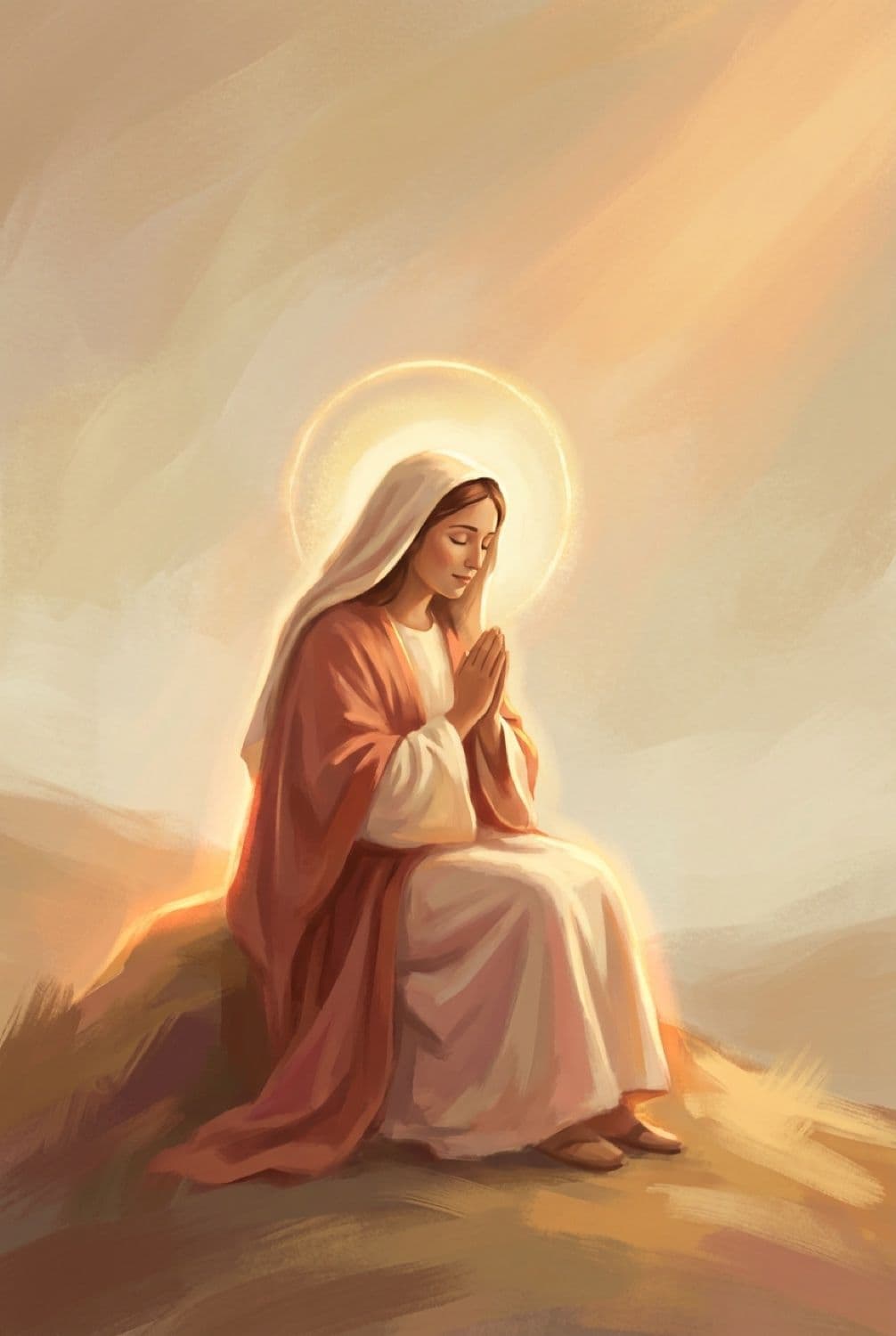
Prayer · Daily
Lectio Divina: How to Pray It, with Psalm 23
Guided Scripture meditation
Lectio divina, Latin for “divine reading,” is the Church’s ancient way of praying with Scripture: you read a short passage slowly, not to study it but to listen for God speaking through it, and you answer him in prayer. It has four steps. Lectio (reading): what does the text say in itself? Meditatio (meditation): what does it say to me? Oratio (prayer): what do I say to the Lord in response? Contemplatio (contemplation): resting in God and asking what conversion he wants of me. Pope Benedict XVI set out the steps with exactly those questions in Verbum Domini (2010), adding that it is not finished until it arrives at actio, action, a life given for others. The practice goes back to the early Church and the monks; a twelfth-century Carthusian, Guigo II, first named the four steps as the rungs of a ladder. Below: the four steps explained, a complete lectio divina on Psalm 23, how to begin, and whether it is Catholic.
LECTIO DIVINA: THE GOOD SHEPHERD
A Guided Scripture Meditation on Psalm 23
Lectio Divina — "divine reading" — is an ancient monastic practice of praying with Scripture. Instead of reading the Bible for information, you read it for encounter. You let God speak directly to your heart through His Word.
There are four movements: Lectio (Read), Meditatio (Reflect), Oratio (Respond), and Contemplatio (Rest). We will move through each one together.
Find a quiet, comfortable place. Close your eyes. Take a deep breath. Ask the Holy Spirit to open your heart.
"Holy Spirit, open the eyes of my heart. Speak to me through Your Word. Let me hear what You want to say to me — not just my head, but deep in my soul. Amen."
[Pause. Three slow breaths.]
═══════════════════════════════════════
LECTIO — READ
═══════════════════════════════════════
Listen to these words as if you are hearing them for the very first time. As if God wrote them this morning, specifically for you.
"The Lord is my shepherd, I lack nothing."
[Pause.]
"He makes me lie down in green pastures, He leads me beside quiet waters, He refreshes my soul."
[Pause.]
"He guides me along the right paths for His name's sake."
[Pause.]
"Even though I walk through the darkest valley, I will fear no evil, for You are with me; Your rod and Your staff, they comfort me."
[Pause.]
"You prepare a table before me in the presence of my enemies. You anoint my head with oil; my cup overflows."
[Pause.]
"Surely goodness and love will follow me all the days of my life, and I will dwell in the house of the Lord forever."
[Long pause. Let the words settle.]
═══════════════════════════════════════
MEDITATIO — REFLECT
═══════════════════════════════════════
Now we will go back through the psalm slowly. This time, pay attention to which word or phrase catches your attention. Which line tugs at your heart? That is the Holy Spirit highlighting something for you.
"The Lord is MY shepherd."
MY. Not someone else's. Not in general. Yours. The Creator of the universe, the God who flung the stars into space, is YOUR personal shepherd. He knows your name. He knows what you need today. He is not a distant God watching from afar — He is a shepherd who walks beside you, who reaches down to pick you up when you stumble.
Is there a part of your life right now where you have forgotten that God is YOUR shepherd? Where you have been trying to navigate on your own?
[Pause. Reflect.]
"I lack nothing."
This does not mean you will always have everything you want. It means you will always have everything you need. God's provision is not about abundance of stuff — it is about sufficiency of grace. In every season, in every trial, in every moment of scarcity — you lack nothing, because you have Him.
Where in your life do you feel lack right now? Financial? Relational? Emotional? Spiritual? Bring that feeling of lack before God. Let Him redefine what "enough" means.
[Pause. Reflect.]
"He makes me LIE DOWN."
Notice: He makes you. Sometimes we are so busy, so driven, so anxious that we refuse to rest. God, the Good Shepherd, sometimes has to make us lie down. An illness. A forced pause. A season of waiting. It feels like punishment, but it is protection. He knows you need rest before you even know it yourself.
Are you resisting rest right now? Are you pushing through when God is asking you to stop?
[Pause. Reflect.]
"Even though I walk through the DARKEST VALLEY..."
Through. Not around. Not over. Through. God does not always remove the valley. Sometimes He walks you through it. And the promise is not that the valley won't be dark — it will be. The promise is that you won't walk it alone.
"I will fear no evil, for YOU ARE WITH ME."
Not "for the valley is not dangerous." It may be very dangerous. Not "for nothing bad will happen." Something bad may happen. But "for You are with me." That is the anchor. That is the promise. You. Are. With. Me.
Are you in a dark valley right now? Can you feel His presence, or does He feel distant? Speak to Him honestly.
[Long pause. Reflect deeply.]
"You prepare a table before me IN THE PRESENCE OF MY ENEMIES."
God does not always remove your enemies. Sometimes He sets up a feast right in front of them. While they watch. While they rage. While they scheme. God's blessing on your life is not dependent on the absence of opposition. He blesses you in the middle of the battle.
Who or what feels like an enemy right now? Illness? A person? A spiritual attack? God is preparing a table for you. Right there. Right now.
[Pause. Reflect.]
"Surely GOODNESS and LOVE will FOLLOW me ALL the days of my life."
Not some days. All days. Even the bad days. Even the days you cannot feel it. Goodness and love are hunting you down. You cannot outrun them. You cannot sin your way out of them. They are relentless, because He is relentless.
[Pause.]
═══════════════════════════════════════
ORATIO — RESPOND
═══════════════════════════════════════
Now it is your turn to speak to God. Based on what stood out to you, respond with your own prayer. You can use the words below, or speak from your heart.
Lord, You are my Shepherd. I confess that I have been trying to shepherd myself — and I have done a terrible job. I have worried when You told me to trust. I have run when You told me to rest. I have feared the valley when You promised to walk through it with me.
Forgive me for forgetting who You are. You are the Good Shepherd. You laid down Your life for me. You know me by name. You leave the ninety-nine to come find me when I wander.
Lord, I need You to be my Shepherd today. In [name your specific situation]. I cannot navigate this alone. Lead me. Guide me. Make me lie down if I need to lie down. Walk me through the valley if that is the path. But do not let me go.
I trust You. I may not feel it, but I choose it. You are good. You are faithful. And You are with me.
[Pause. Add your own words. Speak freely to God.]
═══════════════════════════════════════
CONTEMPLATIO — REST
═══════════════════════════════════════
Now, the hardest part for most of us: silence. No more words. No more reading. No more reflecting. Just being. Being with God.
In contemplation, you simply rest in God's presence. You don't need to say anything. You don't need to think anything. Just be.
Imagine yourself lying in those green pastures. The sun is warm on your face. You can hear quiet water flowing nearby. The Shepherd is sitting beside you. He is not going anywhere. You are safe.
[Two minutes of silence.]
Rest.
[One more minute of silence.]
When you are ready, slowly return to awareness of your surroundings. But carry this peace with you. The pasture is not a place — it is a Person. And He goes with you wherever you go.
"The Lord is my shepherd. I lack nothing."
In the name of the Father, and of the Son, and of the Holy Spirit. Amen.
Go deeper
What is lectio divina?
2 min readLectio divina is reading the Bible as a letter from someone who loves you, rather than as a textbook.
Lectio divina is reading the Bible as a letter from someone who loves you, rather than as a textbook. You take a short passage, read it slowly, often aloud, more than once, and let a word or phrase stop you. You turn it over. You speak to God about it. And then you are quiet with him.
It is as old as Christian prayer. Pope Benedict XVI traces it to the Fathers of the Church, quoting St. Augustine: “Your prayer is the word you speak to God. When you read the Bible, God speaks to you; when you pray, you speak to God,” and Origen, who told a student to devote himself to “the lectio of the divine Scriptures” and, when he met a closed door in the text, to knock (Verbum Domini 86). St. Benedict built it into the monastic day, setting hours for it in chapter 48 of his Rule. In the twelfth century a Carthusian monk, Guigo II, prior of the Grande Chartreuse from 1174 to 1180, described its four steps in a short letter known as the Scala Claustralium, the “Ladder of Monks,” picturing them as the rungs of Jacob’s ladder between earth and heaven.
The Second Vatican Council asked every Catholic to go “gladly to the sacred text itself,” and to remember that “prayer should accompany the reading of sacred Scripture” (Dei Verbum 25, quoted in Verbum Domini 86). The Catechism quotes St. Jerome’s warning, “Ignorance of the Scriptures is ignorance of Christ” (CCC 133), and gives lectio divina, with the Rosary, as its example of Christian meditation on the mysteries of Christ (CCC 2708).
The four steps of lectio divina
2 min readIn Verbum Domini 87, Pope Benedict XVI describes the steps, each with a question: Lectio (reading).
In Verbum Domini 87, Pope Benedict XVI describes the steps, each with a question:
- Lectio (reading). Read the text, with “a desire to understand its true content: what does the biblical text say in itself?” Without this, he warns, “there is always a risk that the text will become a pretext for never moving beyond our own ideas.”
- Meditatio (meditation). “What does the biblical text say to us?” Here each person “must let himself or herself be moved and challenged.”
- Oratio (prayer). “What do we say to the Lord in response to his word?” Prayer, “as petition, intercession, thanksgiving and praise, is the primary way by which the word transforms us.”
- Contemplatio (contemplation). We “take up, as a gift from God, his own way of seeing and judging reality, and ask ourselves what conversion of mind, heart and life is the Lord asking of us?”
He then adds a fifth word the monks always assumed: lectio divina “is not concluded until it arrives at action (actio), which moves the believer to make his or her life a gift for others in charity.” And he gives Mary as its model, who “kept all these sayings, pondering them in her heart” (Luke 2:19).
An old way of remembering the ladder: seek in reading, and you will find in meditating; knock in praying, and it will be opened to you in contemplating.
Lectio divina on Psalm 23, step by step
3 min readThe guided meditation above is a lectio divina on Psalm 23, in a free paraphrase for praying slowly.
The guided meditation above is a lectio divina on Psalm 23, in a free paraphrase for praying slowly. Here is the same practice on the psalm in the World English Bible, Catholic Edition, for praying on your own. Allow about twenty minutes.
Before you begin. Sit somewhere quiet. Make the Sign of the Cross and ask the Holy Spirit to open your heart (a short prayer for this is below).
1. Lectio: read. Read the psalm slowly, aloud if you can, twice:
1 The LORD is my shepherd; I shall lack nothing. 2 He makes me lie down in green pastures. He leads me beside still waters. 3 He restores my soul. He guides me in the paths of righteousness for his name’s sake. 4 Even though I walk through the valley of the shadow of death, I will fear no evil, for you are with me. Your rod and your staff, they comfort me. 5 You prepare a table before me in the presence of my enemies. You anoint my head with oil. My cup runs over. 6 Surely goodness and loving kindness shall follow me all the days of my life, and I will dwell in the LORD’s house forever.
Ask what the text says in itself. It is a psalm of trust, in two pictures: a shepherd with his sheep (verses 1–4), and a host with his guest (verses 5–6). Notice that halfway through, in the dark valley, the psalmist stops talking about God and starts talking to him: “for you are with me.”
2. Meditatio: reflect. Read it a third time and notice which word or line catches you. Stay with it. If it is “I shall lack nothing,” ask what you feel you lack. If it is “the valley of the shadow of death,” ask where your valley is. If it is “in the presence of my enemies,” ask what God is setting before you in the middle of a conflict. Do not force it; one phrase is enough.
3. Oratio: respond. Speak to God about that phrase, in your own words. Thank him, ask him, argue with him, tell him what you are afraid of. The psalm itself shows you how: it turns from “he” to “you.”
4. Contemplatio: rest. Stop talking. Stay with the Shepherd for a few minutes in silence, as a sheep simply lies down in the pasture. Then ask one question: what is he asking of me today?
5. Actio: act. Choose one small thing to do before the day is out because of what you heard: make the call, forgive the debt, rest instead of working late, bring someone a meal.
For the psalm itself, its background and how the Church prays it, see Psalm 23.
How to start lectio divina
1 min readChoose the text before you sit down.
- Choose the text before you sit down. The easiest choice is the Gospel of the next Sunday, or of the day’s Mass. Keep it short: a psalm, a parable, eight or ten verses.
- Give it fifteen to thirty minutes, ideally at the same time each day.
- Read slowly and more than once. Reading aloud, even under your breath, slows you down.
- Stop when something stops you. Lectio divina is not about finishing the passage.
- Keep a notebook if it helps: the word that struck you, and what you said to God.
- Do not judge it by how you feel. Some days nothing seems to happen. God’s word, he promises, “will not return to me void, but it will accomplish that which I please” (Isaiah 55:11).
- Try it with others. In group lectio, the passage is read aloud several times; after each reading, anyone who wishes says the word that struck them, then what it says to them, then a short prayer. Benedict XVI stresses that Scripture is best read “in the communion of the Church” (Verbum Domini 86).
Is lectio divina Catholic? Is it a good or bad practice?
2 min readYes, it is Catholic, and one of the oldest Catholic ways of praying.
Yes, it is Catholic, and one of the oldest Catholic ways of praying. It comes from the Fathers and the monasteries, was formalized by a Carthusian monk, and has been recommended by the Second Vatican Council and by Pope Benedict XVI, who said the Synod on the Word of God gave it “the greatest attention” among all ways of reading Scripture, since it can bring about “an encounter with Christ, the living word of God” (Verbum Domini 87). He even notes that the prayerful reading of Scripture can, under the Church’s usual conditions, gain an indulgence.
Can other Christians do it? Yes. Many Protestant churches teach it today, and Christians of every tradition can pray it. It is simply prayer with the Bible.
Is it a good or bad practice? The usual worry is that it turns Scripture into a mirror for whatever we already feel, or into an Eastern-style emptying of the mind. Both are real risks of doing it badly, and the Church’s description guards against both. The first step asks what the text says in itself, before asking what it says to me; it is read “in the communion of the Church,” not alone against her; and its goal is not an empty mind but a person, Christ. The Catechism says Christian meditation “should go further: to the knowledge of the love of the Lord Jesus, to union with him” (CCC 2708), and calls contemplative prayer “a close sharing between friends,” in St. Teresa’s words (CCC 2709).
Heard this way, Scripture is, in the words of the Letter to the Hebrews, “living and active, and sharper than any two-edged sword… able to discern the thoughts and intentions of the heart” (Hebrews 4:12), which is why Benedict XVI calls it a criterion for discernment. For the indulgence and its conditions, see plenary indulgences.
A prayer before and after lectio divina
1 min readMany people begin with a prayer to the Holy Spirit, who inspired the Scriptures and is, the Catechism says, their interpreter, and end with thanks.
Many people begin with a prayer to the Holy Spirit, who inspired the Scriptures and is, the Catechism says, their interpreter, and end with thanks. These two are short enough to keep in the front of your Bible.
Before:
Come, Holy Spirit.
You inspired these words; open them to me.
Quiet my mind, open my heart,
and let me hear what the Father wants to say to me today.
Mary, who kept God’s word and pondered it in your heart,
pray for me.
Amen.
After:
Thank you, Lord, for speaking to me.
Let the word I have heard take root in me,
and bear fruit in what I do today.
Amen.
The gift of the Spirit most at work in this kind of prayer is understanding, one of the seven gifts of the Holy Spirit. For verses to begin with, see Bible verses about prayer.
Questions
What is lectio divina?
Lectio divina (“divine reading”) is a traditional Catholic way of praying with Scripture: reading a short passage slowly, reflecting on what God is saying through it, responding in prayer, and resting in his presence. It goes back to the Fathers of the Church and the monasteries, and the Church still recommends it to every Catholic.
What are the 4 steps of lectio divina?
Lectio (reading: what does the text say in itself?), meditatio (meditation: what does it say to me?), oratio (prayer: what do I say to the Lord in response?), and contemplatio (contemplation: resting in God and asking what conversion he asks of me). Pope Benedict XVI adds that it is completed in actio, action for others (Verbum Domini 87).
What does lectio divina mean?
It is Latin for “divine reading” or “sacred reading”: reading the Bible as God’s word addressed to you, in order to pray, rather than to study.
Is lectio divina Catholic?
Yes. It comes from the early Church and the monastic tradition, was set out in four steps by the Carthusian Guigo II in the twelfth century, and is recommended by the Second Vatican Council (Dei Verbum 25) and by Pope Benedict XVI in Verbum Domini (2010). The Catechism gives it, with the Rosary, as an example of Christian meditation (CCC 2708).
Is lectio divina a good or bad practice?
Done as the Church describes it, it is one of the best ways to pray with the Bible. The risks people worry about, reading your own ideas into the text or emptying the mind, are guarded against by its first step (what does the text say in itself?), by reading in communion with the Church, and by its goal: union with Christ, not an empty mind (CCC 2708).
Can Christians do lectio divina?
Yes. It is a Christian practice from the start, and Christians of every tradition pray it today. It is simply prayer with Scripture.
How long should lectio divina take?
Fifteen to thirty minutes is typical. A short passage and a few minutes of silence at the end matter more than the length.
Who created lectio divina?
No one person. It grew from the way the Fathers, such as Origen and St. Augustine, prayed with Scripture, and St. Benedict set hours for it in his Rule. The four named steps come from Guigo II, a Carthusian prior of the twelfth century, in his Scala Claustralium, the “Ladder of Monks.”
What is the difference between lectio divina and Bible study?
Bible study asks what a passage means; lectio divina asks what God is saying to me through it, and answers him. They belong together: the first step of lectio divina is to understand what the text says in itself, but it goes on to prayer and conversion.
For what Scripture itself says about how to pray: Bible verses about prayer — including the Lord’s Prayer.
Pray next
 The Morning Offering PrayerStart your day with God
 The Angelus Prayer: Full Text, When to Pray It, and the LatinTraditional midday prayer
 Examination of ConscienceEvening reflection
 Prayer for Salvation: A Catholic Salvation PrayerAccept Christ as your Lord
 Identity in ChristDeclare who you are in God
 Guided Night PrayerSleep meditation & protection
Upcoming · Sep 29
Sts. Michael, Gabriel and RaphaelSee the full liturgical calendar — every feast this year, and an embed for your parish site.