Prayer · Daily
The Angelus Prayer: Full Text, When to Pray It, and the Latin
Traditional midday prayer
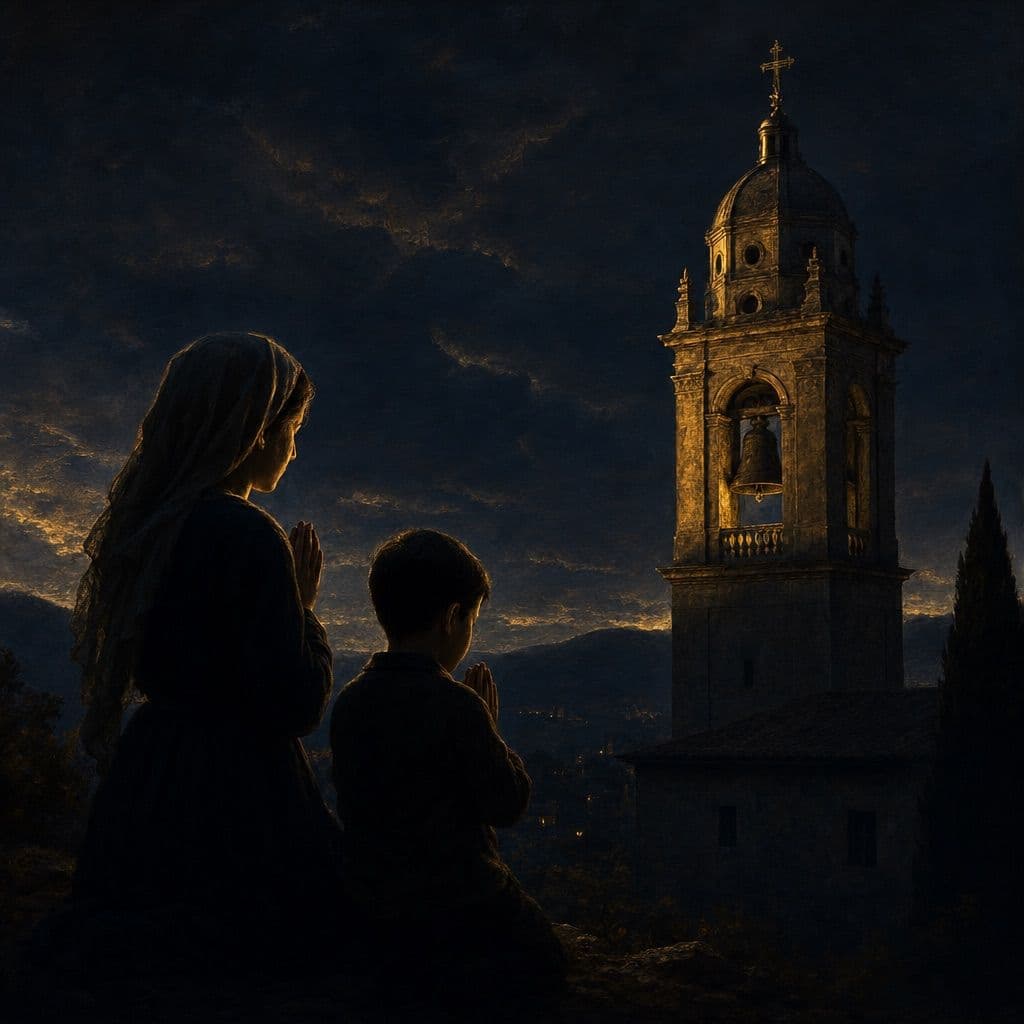
The Angelus is a short Catholic prayer honoring the Incarnation, traditionally prayed three times a day, at 6 a.m., noon and 6 p.m., when church bells ring. It has three versicles and responses, each followed by a Hail Mary: “The Angel of the Lord declared unto Mary” (the Annunciation), “Behold the handmaid of the Lord” (Mary’s yes), and “And the Word was made flesh” (the Incarnation). A closing versicle and a prayer, “Pour forth, we beseech thee, O Lord, thy grace into our hearts”, end it, often followed by the Glory Be. It takes a minute or two. From Easter to Pentecost the Regina Caeli is said instead.
THE ANGELUS
V. The Angel of the Lord declared unto Mary,
R. And she conceived of the Holy Spirit.
Hail Mary, full of grace, the Lord is with thee.
Blessed art thou among women,
and blessed is the fruit of thy womb, Jesus.
Holy Mary, Mother of God, pray for us sinners,
now and at the hour of our death. Amen.
V. Behold the handmaid of the Lord,
R. Be it done unto me according to Thy Word.
Hail Mary...
V. And the Word was made flesh,
R. And dwelt among us.
Hail Mary...
V. Pray for us, O holy Mother of God,
R. That we may be made worthy of the promises of Christ.
Let us pray:
Pour forth, we beseech Thee, O Lord, Thy grace into our hearts;
that we, to whom the Incarnation of Christ Thy Son was made known
by the message of an Angel, may by His Passion and Cross
be brought to the glory of His Resurrection.
Through the same Christ Our Lord.
Amen.
WHEN TO PRAY THE ANGELUS:
Traditionally prayed three times daily — at 6:00 AM, 12:00 PM (noon), and 6:00 PM — when church bells ring. This ancient prayer reminds us of the Incarnation and invites Mary's intercession throughout the day.
Go deeper
How to pray the Angelus, step by step
2 min readThe full text is above.
The full text is above. It is written for two voices, a leader (V.) and everyone else (R.), but it can just as well be prayed alone, saying both parts.
- First versicle. V. The Angel of the Lord declared unto Mary. R. And she conceived of the Holy Spirit. Then one Hail Mary, the leader saying the first half and everyone the second (“Holy Mary, Mother of God…”).
- Second versicle. V. Behold the handmaid of the Lord. R. Be it done unto me according to thy word. Hail Mary.
- Third versicle. V. And the Word was made flesh. R. And dwelt among us. Hail Mary. Many bow or genuflect at these words.
- Closing versicle. V. Pray for us, O holy Mother of God. R. That we may be made worthy of the promises of Christ.
- The prayer. “Let us pray. Pour forth, we beseech thee, O Lord…”, ending “Through the same Christ our Lord. Amen.”
- Glory Be. The Compendium of the Catechism ends the Angelus with a Glory Be; in many places it is said three times.
The whole prayer takes one to two minutes. The Rosary uses the same Hail Mary, and the Annunciation is its first Joyful Mystery; the full set is on the mysteries of the Rosary.
The Gospel inside the Angelus
1 min readEvery line of the Angelus is Scripture or close to it.
Every line of the Angelus is Scripture or close to it. The first two versicles follow the Annunciation in Luke 1:26–38, where the angel Gabriel greets Mary, “Hail, full of grace! The Lord is with you” (Luke 1:28), and she answers, “Behold, the handmaid of the Lord; let it be done to me according to your word” (Luke 1:38). The third is the heart of the prologue of John’s Gospel: “The Word was made flesh and dwelt among us” (John 1:14).
So in three sentences the prayer tells the whole mystery: God’s message, Mary’s consent, and God becoming man. The closing prayer then does something the Christmas story alone does not: it asks that we who know the Incarnation be brought “by his Passion and Cross” to “the glory of his Resurrection”. Paul VI pointed to exactly this when he explained why the Angelus needs no revision: it reminds us of the Paschal Mystery even as it recalls the Incarnation (Marialis Cultus 41). Its greatest day is the feast of the Annunciation, March 25, nine months before Christmas.
When is the Angelus prayed? 6 a.m., noon and 6 p.m.
1 min readThree times a day: “at dawn, mid-day and at dusk”, in the words of the Church’s Directory on Popular Piety and the Liturgy (n.
Three times a day: “at dawn, mid-day and at dusk”, in the words of the Church’s Directory on Popular Piety and the Liturgy (n. 195). In practice that is usually 6 a.m., 12 noon and 6 p.m., the hours at which many church bells still ring for it. In places where the bells no longer ring, set an alarm, or pray it with the first thing you do in the morning, at lunch and at the end of the working day.
If you miss the hour, pray it when you remember. It is a devotion, not an obligation, and no sin is committed by missing it. The Directory asks that where life makes the full prayer hard, the faithful keep “at least the recitation of three Aves”, three Hail Marys at the time of the bell (n. 195). The Pope prays the Angelus with pilgrims in St. Peter’s Square every Sunday at noon, with a short reflection on the day’s Gospel, and many people pray it with him that way each week. Morning and evening the Angelus pairs naturally with the Morning Offering and the night prayer of the Church.
In Eastertide: the Regina Caeli replaces the Angelus
2 min readFrom Easter Sunday until Pentecost, the Angelus gives way to the Regina Caeli, “Queen of Heaven”.
From Easter Sunday until Pentecost, the Angelus gives way to the Regina Caeli, “Queen of Heaven”. This goes back to a disposition of Pope Benedict XIV on April 2, 1742 (Directory on Popular Piety, n. 196). The antiphon itself is older, probably from the tenth or eleventh century, and joins the Incarnation (“he whom you merited to bear”) to the Resurrection (“has risen as he said”). This is the text in the Compendium of the Catechism, U.S. version:
Queen of heaven, rejoice, alleluia.
The Son whom you merited to bear, alleluia,
has risen as he said, alleluia.
Rejoice and be glad, O Virgin Mary, alleluia!
For the Lord has truly risen, alleluia.
Let us pray.
O God, who through the resurrection of your Son, our Lord Jesus Christ,
did vouchsafe to give joy to the world;
grant, we beseech you, that through his Mother, the Virgin Mary,
we may obtain the joys of everlasting life.
Through the same Christ our Lord. Amen.
In Latin: Regína cæli lætáre, allelúia. Quia quem meruísti portáre, allelúia. Resurréxit, sicut dixit, allelúia. Ora pro nobis Deum, allelúia. Gaude et lætáre, Virgo María, allelúia. Quia surréxit Dóminus vere, allelúia. The version used in Britain has “Pray for us to God, alleluia!” in place of the fourth line, as the Latin does. Like the Angelus, it can be sung, and it is one of the four seasonal Marian antiphons, along with the Salve Regina. For the season itself, see Easter.
Where the Angelus comes from: the bells
2 min readThe Angelus grew out of church bells, one hour at a time, and its history is better documented than most devotions’.
The Angelus grew out of church bells, one hour at a time, and its history is better documented than most devotions’.
- Evening first. The oldest custom is saying Hail Marys at the evening bell. A provincial synod at Gran (Esztergom, in Hungary) ordered three Hail Marys at the bell in 1307, and Pope John XXII attached an indulgence to the practice in 1318 and 1327. By the first half of the fourteenth century it was general across Europe.
- Then morning. A chronicle of Parma mentions a morning bell in 1318, and in England Bishop John Stratford of Winchester enjoined it as early as 1324.
- Noon last. A midday bell was rung, on Fridays only, in Prague (1386) and Mainz (1423). On June 29, 1456, Pope Callixtus III, in the bull Cum his superioribus annis, ordered bells rung at midday in every church, with the Our Father and the Hail Mary, to pray for the Christian army defending Belgrade against the Ottoman siege. It is often said that the noon bell celebrates the victory at Belgrade on July 22, 1456; in fact the bull came first, as a call to prayer, and the victory three weeks later. King Louis XI of France commended the noon prayer in 1475.
- The words. The three versicles in their present form are found in a catechism printed at Venice in 1560, and the fuller form, with the closing prayer, is traced to the early seventeenth century.
In 1974 Paul VI urged Catholics to keep it “wherever and whenever possible”, and explained why it needed no revision: its simple structure, its biblical character, “its historical origin which links it to the prayer for peace and safety”, and its “quasi-liturgical rhythm which sanctifies different moments during the day” (Marialis Cultus 41).
The Angelus in Latin (Angelus Domini)
1 min readAs the Holy See prints it in the appendix of the Compendium of the Catechism.
As the Holy See prints it in the appendix of the Compendium of the Catechism. The Hail Mary is said in full at each “Ave, María…”: Ave, María, grátia plena, Dóminus tecum. Benedícta tu in muliéribus, et benedíctus fructus ventris tui, Iesus. Sancta María, Mater Dei, ora pro nobis peccatóribus, nunc et in hora mortis nostræ. Amen.
V. Ángelus Dómini nuntiávit Maríæ.
R. Et concépit de Spíritu Sancto.
Ave, María…
V. Ecce ancílla Dómini.
R. Fiat mihi secúndum verbum tuum.
Ave, María…
V. Et Verbum caro factum est.
R. Et habitávit in nobis.
Ave, María…
V. Ora pro nobis, sancta Dei génetrix.
R. Ut digni efficiámur promissiónibus Christi.
Orémus.
Grátiam tuam, quæsumus, Dómine, méntibus nostris infúnde;
ut qui, Ángelo nuntiánte, Christi Fílii tui incarnatiónem cognóvimus,
per passiónem eius et crucem, ad resurrectiónis glóriam perducámur.
Per eúndem Christum Dóminum nostrum. Amen.
The prayer takes its name from its first word, Angelus, “angel”. Fiat, “let it be done”, is Mary’s own word, and has become the Church’s name for her consent.
Why do Catholics pray the Angelus?
1 min readBecause it stops the day three times to remember the one event on which all the others depend: that God became man.
Because it stops the day three times to remember the one event on which all the others depend: that God became man. The Directory on Popular Piety calls it the traditional way the faithful commemorate the Annunciation, and a recollection of the moment “the Word became flesh in the womb of the Virgin Mary” (n. 195). Praying it at morning, noon and evening does for an ordinary day what the Liturgy of the Hours does for a monastery: it gives the hours a shape, and hands each part of the day to God.
It is also a prayer with Mary rather than only to her. It retells her yes, and asks her prayers that we may say ours. And because it began as prayer at the bells for peace and safety, it has always been a prayer people say for the world, not only for themselves. For the prayer Mary’s yes made possible, the Our Father is the one her Son taught.
Questions
What is the full text of the Angelus prayer?
V. The Angel of the Lord declared unto Mary. R. And she conceived of the Holy Spirit. Hail Mary. V. Behold the handmaid of the Lord. R. Be it done unto me according to thy word. Hail Mary. V. And the Word was made flesh. R. And dwelt among us. Hail Mary. V. Pray for us, O holy Mother of God. R. That we may be made worthy of the promises of Christ. Let us pray: Pour forth, we beseech thee, O Lord, thy grace into our hearts; that we, to whom the Incarnation of Christ, thy Son, was made known by the message of an angel, may by his Passion and Cross be brought to the glory of his Resurrection. Through the same Christ, our Lord. Amen.
How do you pray the Angelus?
A leader says each versicle and everyone answers, with a Hail Mary after each of the first three; then the closing versicle, the prayer “Pour forth, we beseech thee, O Lord”, and a Glory Be. Alone, you say both parts. It takes a minute or two.
What time is the Angelus prayed?
Traditionally at 6 a.m., noon and 6 p.m., at dawn, midday and dusk, when church bells ring for it. If you miss the hour, pray it when you remember.
Why do Catholics say the Angelus?
To remember the Incarnation, God becoming man in Mary’s womb, three times a day, and to ask Mary’s prayers. Paul VI said it “sanctifies different moments during the day” and reminds us of the Paschal Mystery (Marialis Cultus 41).
What prayer replaces the Angelus during Easter?
The Regina Caeli (“Queen of Heaven, rejoice, alleluia”), from Easter Sunday to Pentecost, by a disposition of Pope Benedict XIV in 1742.
Why do church bells ring for the Angelus?
The Angelus grew out of the bells: first the evening bell (indulgenced by Pope John XXII in 1318 and 1327), then the morning bell, then the noon bell, which Pope Callixtus III ordered in every church in 1456 to pray for the defenders of Belgrade.
Do you have to kneel for the Angelus?
No posture is required for a private devotion. Many kneel, and many bow or genuflect at “And the Word was made flesh”; others simply stop where they are.
What is the Angelus in Latin?
It begins “Ángelus Dómini nuntiávit Maríæ. Et concépit de Spíritu Sancto.” The full Latin text, as the Compendium of the Catechism prints it, is on this page.
Is the Angelus in the Bible?
Its words are. The first two versicles follow the Annunciation in Luke 1:26–38, and the third is John 1:14, “The Word was made flesh and dwelt among us.”
Pray next
 The Morning Offering PrayerStart your day with God
 Examination of ConscienceEvening reflection
 Prayer for Salvation: A Catholic Salvation PrayerAccept Christ as your Lord
 Identity in ChristDeclare who you are in God
 Guided Night PrayerSleep meditation & protection
 Complete Holy RosaryGuided Rosary with meditations
Guided narration · How it’s made
Upcoming · Sep 29
Sts. Michael, Gabriel and RaphaelSee the full liturgical calendar — every feast this year, and an embed for your parish site.