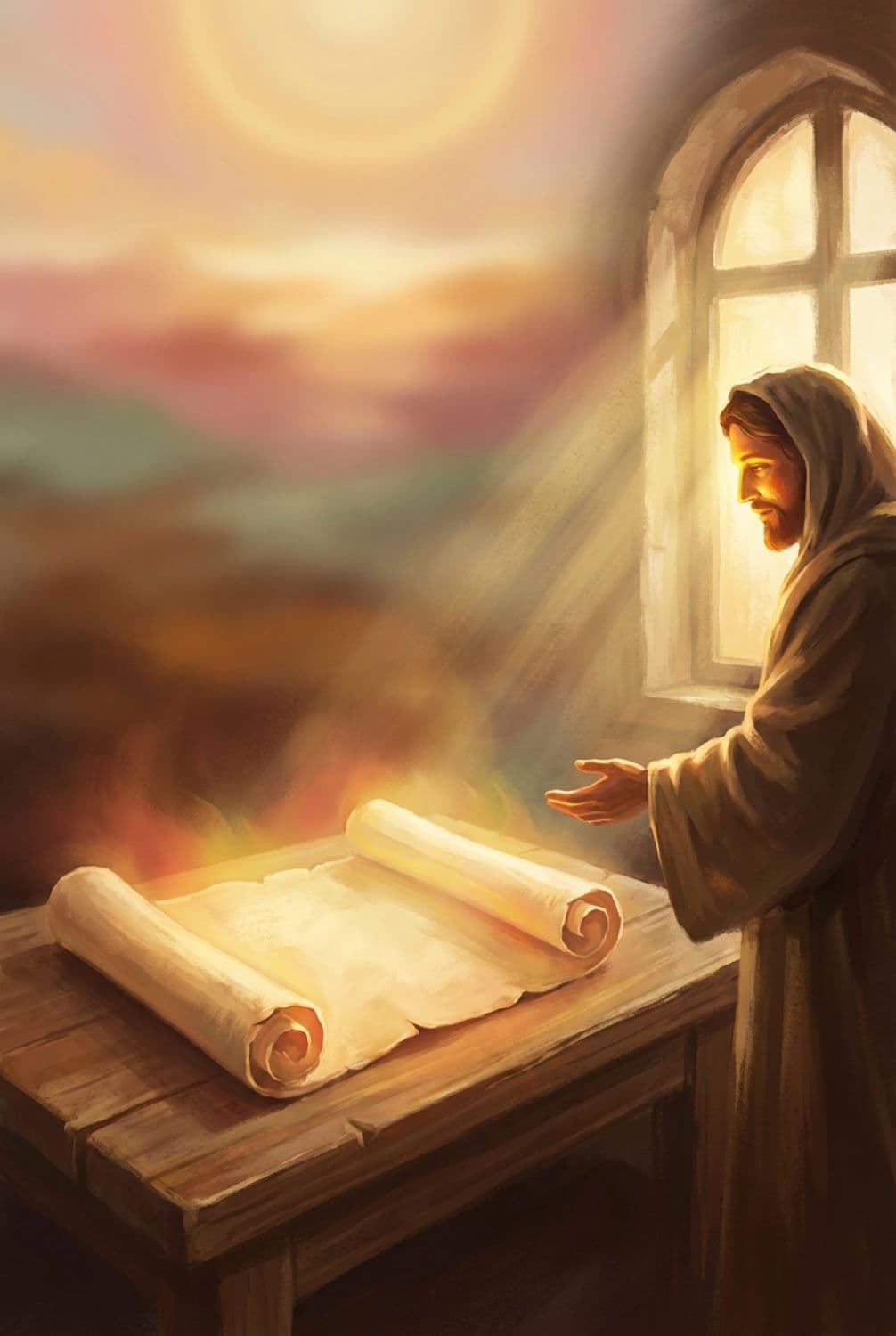
Prayer · Scripture
Revelation 21: A New Heaven and a New Earth
Revelation 21 is the Bible’s vision of the end of the story: after the last judgment, St. John sees “a new heaven and a new earth,” the holy city, New Jerusalem, coming down from God, and hears that God will dwell with his people. Its best-known verse is 21:4: “He will wipe away every tear from their eyes. Death will be no more; neither will there be mourning, nor crying, nor pain any more. The first things have passed away.” And its center is 21:5: “Behold, I am making all things new.” The chapter’s main point is that God does not throw creation away but renews it, and that the goal of history is God living with us for ever. The Catholic Church reads it at funerals and in the Easter season, and the Catechism teaches it as the Christian hope of the new heaven and the new earth (CCC 1042–1050). Below: the text, verse 4 and verse 8 explained, its use at funerals, and a prayer of hope.
In the name of the Father, and of the Son, and of the Holy Spirit.
Then I saw a new heaven and a new earth, for the first heaven and the first earth had passed away, and the sea was no more. And I saw the holy city, new Jerusalem, coming down out of heaven from God, prepared as a bride adorned for her husband. And I heard a loud voice from the throne saying, Behold, the dwelling place of God is with man. He will dwell with them, and they will be His people, and God Himself will be with them as their God.
He will wipe away every tear from their eyes, and death shall be no more, neither shall there be mourning, nor crying, nor pain anymore, for the former things have passed away.
And He who was seated on the throne said, Behold, I am making all things new.
This is the Book of Revelation, chapter twenty-one. The end of the Bible. The end of the story. The end that is also a new beginning.
Tonight, after a long day in this present age, I let my mind rise to that age that is coming.
A new heaven and a new earth. Not just heaven. Not the disembodied existence we sometimes imagine. A new earth too. The physical creation made new. The world we love, healed of all that has gone wrong with it.
The first heaven and the first earth had passed away. What is broken is broken. The sin. The decay. The death. All of it gone in the new creation. Not patched. Not improved. Made new.
The sea was no more. In the ancient world, the sea was the symbol of chaos, of unpredictability, of separation. In the new creation, no more chaos. No more separation. Even the sea is healed.
The holy city, new Jerusalem, coming down out of heaven. The new home for the new humanity. Coming down. Not us going up to it. It comes to us. Heaven and earth meet in the city of God.
Behold, the dwelling place of God is with man. Eden restored. The intimate presence of God walking with His people, as it was in the garden before the fall, as it will be in the city after the consummation.
He will dwell with them. With us. Tents pitched together. The God who became flesh and dwelt among us in Christ will dwell among us forever in the new creation.
They will be His people, and God Himself will be with them as their God. The covenant, fulfilled. The relationship that the entire Old Testament longed for. We will be His. He will be ours.
He will wipe away every tear from their eyes. Read it slowly, Lord. Every tear. Mine. The ones I have cried. The ones I have not yet cried. The ones I am crying right now over things You have not yet healed. He Himself will wipe them away. With His own hand.
Death shall be no more. The last enemy. Defeated. Forever. The thing that has shaped every human story, ended.
Neither shall there be mourning, nor crying, nor pain anymore. Read each word. Mourning. Gone. Crying. Gone. Pain. Gone. Anymore. No more.
For the former things have passed away. The past, with all its sorrow, gone. The present age, with all its struggle, gone. A new age. New everything.
Behold, I am making all things new. Not making all new things, though that too. Making all things new. The very things we love. Made new. The relationships. The places. The people. New.
Lord, this is my hope. This is the horizon I walk toward. Tonight, I sleep with this picture in my mind. The city coming down. The tears wiped away. The God who is with us forever.
Whatever I am facing tomorrow is real. But it is not final. Whatever I have lost is real. But it is not lost forever. Whatever I am hoping for, the deepest desire of my heart, will be answered in the new creation, beyond what I could ask or imagine.
He who testifies to these things says, Surely I am coming soon.
Amen. Come, Lord Jesus.
In the name of the Father, and of the Son, and of the Holy Spirit. Amen.
Go deeper
Revelation 21:1–7: the text
2 min readIn the World English Bible, Catholic Edition: I saw a new heaven and a new earth, for the first heaven and the first earth have passed away, and the sea is no more.
In the World English Bible, Catholic Edition:
1 I saw a new heaven and a new earth, for the first heaven and the first earth have passed away, and the sea is no more. 2 I saw the holy city, New Jerusalem, coming down out of heaven from God, prepared like a bride adorned for her husband. 3 I heard a loud voice out of heaven saying, “Behold, God’s dwelling is with people; and he will dwell with them, and they will be his people, and God himself will be with them as their God. 4 He will wipe away every tear from their eyes. Death will be no more; neither will there be mourning, nor crying, nor pain any more. The first things have passed away.”
5 He who sits on the throne said, “Behold, I am making all things new.” He said, “Write, for these words of God are faithful and true.” 6 He said to me, “I am the Alpha and the Omega, the Beginning and the End. I will give freely to him who is thirsty from the spring of the water of life. 7 He who overcomes, I will give him these things. I will be his God, and he will be my son.
The rest of the chapter (verses 9–27) is an angel showing John the city itself: its twelve gates named for the twelve tribes of Israel, its twelve foundations named for the twelve apostles, its walls of jasper and gates of pearl. And then the surprise: “I saw no temple in it, for the Lord God the Almighty and the Lamb are its temple. The city has no need for the sun or moon to shine, for the very glory of God illuminated it and its lamp is the Lamb” (Revelation 21:22–23).
What is the main point of Revelation 21?
2 min readRevelation 21 comes straight after the last judgment in chapter 20, and it answers the question the whole Bible has been asking since Eden: will God and his people ever live together again?
Revelation 21 comes straight after the last judgment in chapter 20, and it answers the question the whole Bible has been asking since Eden: will God and his people ever live together again? The answer is yes, and on earth. The holy city does not wait for us to climb up to it; it comes “down out of heaven from God.” The loud voice announces the fulfillment of the covenant promised all through the Old Testament: “they will be his people, and God himself will be with them as their God.”
Three details carry the meaning:
- “A new heaven and a new earth.” This is Isaiah’s promise fulfilled: “For, behold, I create new heavens and a new earth; and the former things will not be remembered” (Isaiah 65:17). St. Peter repeats it: “according to his promise, we look for new heavens and a new earth, in which righteousness dwells” (2 Peter 3:13).
- “The sea is no more.” In the Bible the sea is the image of chaos and threat, the place the beast rose from in Revelation 13. Its disappearance means there is nothing left to fear.
- “I am making all things new.” Not “all new things.” God does not scrap the first creation and start again; he heals and transforms it. St. Paul says the creation itself “will be delivered from the bondage of decay into the liberty of the glory of the children of God” (Romans 8:21).
For Jesus’ own promise of the place he goes to prepare, see John 14: “In my Father’s house”.
What does Revelation 21:4 teach us?
1 min readRevelation 21:4 is one of the most searched verses in the Bible, and for an obvious reason: it is a promise about grief.
Revelation 21:4 is one of the most searched verses in the Bible, and for an obvious reason: it is a promise about grief. “He will wipe away every tear from their eyes” is itself a quotation of Isaiah: “He has swallowed up death forever! The Lord GOD will wipe away tears from off all faces” (Isaiah 25:8). The picture is not of tears forbidden, but of tears wiped away, one by one, by God himself.
It teaches three things. First, that death is an enemy, not a natural friend: “The last enemy that will be abolished is death” (1 Corinthians 15:26). Second, that the sorrows of this life are real, and God does not pretend otherwise; they are listed one by one, mourning, crying, pain, before they are ended. Third, that they are not final: “The first things have passed away.” The Catechism quotes this verse whole when it describes the heavenly Jerusalem where “God will have his dwelling among men” (CCC 1044).
For more of what the Bible says to the bereaved, see our Bible verses for grief and Bible verses about death.
What does Revelation 21:8 mean?
2 min readVerse 8 is the hard verse, and the second most searched: “But for the cowardly, unbelieving, sinners, abominable, murderers, sexually immoral, sorcerers, idolaters, and all liars, their part is in the lake that burns with fire and sulfur, which is the second death.”
Verse 8 is the hard verse, and the second most searched: “But for the cowardly, unbelieving, sinners, abominable, murderers, sexually immoral, sorcerers, idolaters, and all liars, their part is in the lake that burns with fire and sulfur, which is the second death.”
It has to be read with the verses before it. Verse 6 has just said that God gives the water of life “freely to him who is thirsty,” and verse 7 promises everything to “he who overcomes.” Verse 8 is a warning about those who refuse to the end, not a list of everyone who has ever sinned; the apostles who fled at the Cross were cowards for a night, and Peter was a liar three times over. What shuts a person out of the city is not having sinned but refusing mercy.
The Catechism teaches exactly that. Hell is “definitive self-exclusion from communion with God and the blessed” (CCC 1033), and its chief punishment is “eternal separation from God” (CCC 1035). But “God predestines no one to go to hell”: it takes “a willful turning away from God (a mortal sin)… and persistence in it until the end” (CCC 1037). The same paragraph adds that in every Mass the Church asks God to “save us from final damnation.”
If this verse frightens you, the answer is the one the chapter gives: come thirsty, and receive freely. The door back is the sacrament of Confession; see how to go to Confession.
Revelation 21 at Catholic funerals
2 min readRevelation 21:1–5a, 6b–7 is one of the readings the Church provides for funerals, under the heading “There shall be no more death.”
Revelation 21:1–5a, 6b–7 is one of the readings the Church provides for funerals, under the heading “There shall be no more death.” It is among the New Testament readings a family can choose for a funeral Mass, and during the Easter season, when the first reading at a funeral is taken from the New Testament, it is one of four that may be read (Lectionary for Mass, no. 1012, as the USCCB lists them). It is also read on Sundays: in Year C of the Sunday cycle, Revelation 21:1–5a is the second reading on the Fifth Sunday of Easter, and 21:10–14, 22–23 on the Sixth.
It fits the funeral liturgy because the funeral is not a eulogy. The Catechism asks that the homily “avoid the literary genre of funeral eulogy” and instead “illumine the mystery of Christian death in the light of the risen Christ” (CCC 1688). And every Christian funeral looks toward what Revelation 21 describes: what the believer confessed in the Creed, “I look for the resurrection of the dead, and the life of the world to come,” fulfilled (CCC 1680).
A prayer for someone who has died, from Revelation 21:
Lord God, you who sit on the throne and make all things new,
we commend to you (name).
Wipe away every tear from their eyes.
Let death be no more for them,
nor mourning, nor crying, nor pain.
Give them to drink freely from the spring of the water of life,
and bring them into the city whose lamp is the Lamb.
And when our own time comes,
gather us all there together,
where you will be our God, and we will be your people.
Through Christ our Lord.
Amen.
For the prayers the Church offers for the dead, including the Eternal Rest, see our prayers for the dead.
The Catechism on the new heaven and the new earth
2 min readThe Catechism’s section “Hope of the New Heaven and the New Earth” (CCC 1042–1050) is essentially a commentary on Revelation 21.
The Catechism’s section “Hope of the New Heaven and the New Earth” (CCC 1042–1050) is essentially a commentary on Revelation 21. In outline:
- The Kingdom in its fullness. “At the end of time, the Kingdom of God will come in its fullness. After the universal judgment, the righteous will reign for ever with Christ, glorified in body and soul” (CCC 1042).
- A renewal of everything. “Sacred Scripture calls this mysterious renewal, which will transform humanity and the world, ‘new heavens and a new earth’” (CCC 1043).
- God’s dwelling with us. In the heavenly Jerusalem “God will have his dwelling among men,” and the Catechism quotes Revelation 21:4 in full (CCC 1044). The redeemed form “the holy city” of God, “the Bride, the wife of the Lamb” (CCC 1045).
- The world transformed, not discarded. “The visible universe, then, is itself destined to be transformed” (CCC 1047). “We know neither the moment of the consummation of the earth and of man, nor the way in which the universe will be transformed” (CCC 1048).
- So this life matters. “Far from diminishing our concern to develop this earth, the expectancy of a new earth should spur us on” (CCC 1049). What is good in our work and our love we “will find… once again, cleansed this time from the stain of sin, illuminated and transfigured” (CCC 1050).
Heaven itself the Catechism calls “the ultimate end and fulfillment of the deepest human longings” (CCC 1024), and admits it is “beyond all understanding and description”: Scripture can only speak of it in images, among them “the heavenly Jerusalem” (CCC 1027).
A prayer of hope with Revelation 21
2 min readHope, the Catechism says, is the virtue by which “we desire the kingdom of heaven and eternal life as our happiness, placing our trust in Christ’s promises” (CCC 1817).
Hope, the Catechism says, is the virtue by which “we desire the kingdom of heaven and eternal life as our happiness, placing our trust in Christ’s promises” (CCC 1817). This prayer is for anyone who needs to hold on to that promise tonight: after a loss, in a long illness, or simply tired of a world that is not yet made new.
Lord Jesus, you are the Alpha and the Omega,
the Beginning and the End.
You have not forgotten the world you made,
and you have not forgotten me.
I believe that you are making all things new.
I believe that every tear will be wiped away,
that death will be no more,
and that I will see again the ones I love who died in you.
Until that day, give me hope that does not give up,
and let me work for your Kingdom here,
so that something of the city to come
can be seen in the way I live.
Amen. Come, Lord Jesus.
The last words of the Bible, two chapters later, are this prayer’s ending: “He who testifies these things says, ‘Yes, I am coming soon.’ Amen! Yes, come, Lord Jesus!” (Revelation 22:20). For more Scripture on the hope of eternal life, see Bible verses about hope.
Questions
What is the main point of Revelation 21?
That God will make all things new and live with his people for ever. After the last judgment, John sees a new heaven and a new earth, the New Jerusalem coming down from God, and hears that God’s dwelling is with people, that he will wipe away every tear, and that death will be no more.
What does Revelation 21 say?
It describes a new heaven and a new earth, the holy city New Jerusalem “coming down out of heaven from God, prepared like a bride adorned for her husband,” God dwelling with his people, the end of death, mourning, crying and pain, and God’s words “Behold, I am making all things new.” The rest of the chapter describes the city, which has no temple because “the Lord God the Almighty and the Lamb are its temple.”
What does Revelation 21:4 teach us?
That grief and death are real but not final. “He will wipe away every tear from their eyes. Death will be no more; neither will there be mourning, nor crying, nor pain any more. The first things have passed away.” It repeats Isaiah 25:8, and the Catechism quotes it to describe heaven (CCC 1044).
What does Revelation 21:5 mean?
“Behold, I am making all things new” means that God renews his creation rather than replacing it: not all new things, but all things made new. The Catechism teaches that “the visible universe, then, is itself destined to be transformed” (CCC 1047).
What does Revelation 21:8 mean?
It warns that those who persist to the end in refusing God, the cowardly, the unbelieving, murderers, idolaters and liars, exclude themselves from the city. Read with verses 6 and 7, it is not a list of everyone who has sinned but of those who refuse mercy. “God predestines no one to go to hell” (CCC 1037).
What does “the sea is no more” mean in Revelation 21:1?
In the Bible the sea stands for chaos, danger and the powers opposed to God; in Revelation the beast rises out of the sea. “The sea is no more” means that in the new creation nothing threatening remains.
Is Revelation 21 read at Catholic funerals?
Yes. Revelation 21:1–5a, 6b–7, “There shall be no more death,” is one of the New Testament readings for funerals, and during the Easter season it may be the first reading (Lectionary for Mass, no. 1012).
What is the New Jerusalem in Revelation 21?
The holy city that comes down from God at the end of time: an image of God’s people made perfect and living with him. The Catechism says those united with Christ “will form the community of the redeemed, ‘the holy city’ of God, ‘the Bride, the wife of the Lamb’” (CCC 1045).
Pray next
- Psalm 23 — The Lord Is My ShepherdThe best-loved psalm — “The Lord is my shepherd” — a song of trust the Church prays at funerals and on Good Shepherd Sunday, rich with sacramental meaning.
- Psalm 121 — I Lift Up My Eyes to the Hills“I will lift up my eyes to the hills.” A pilgrim’s Song of Ascents and a prayer of protection for travel, for sleep, and for every going out and coming in.
- Psalm 51 — Have Mercy on Me, O GodThe Miserere — “Have mercy on me, O God.” The Church’s greatest prayer of repentance, prayed every Friday and on Ash Wednesday, and made for the confessional.
 The Beatitudes: Matthew 5:3–12, What Each One Means, and a Prayer for EachA Scripture meditation
 Romans 8 — Nothing Can Separate UsNothing Can Separate Us
 1 Corinthians 13 — The Way of LoveThe Way of Love
Guided narration · How it’s made
Upcoming · Sep 29
Sts. Michael, Gabriel and RaphaelSee the full liturgical calendar — every feast this year, and an embed for your parish site.