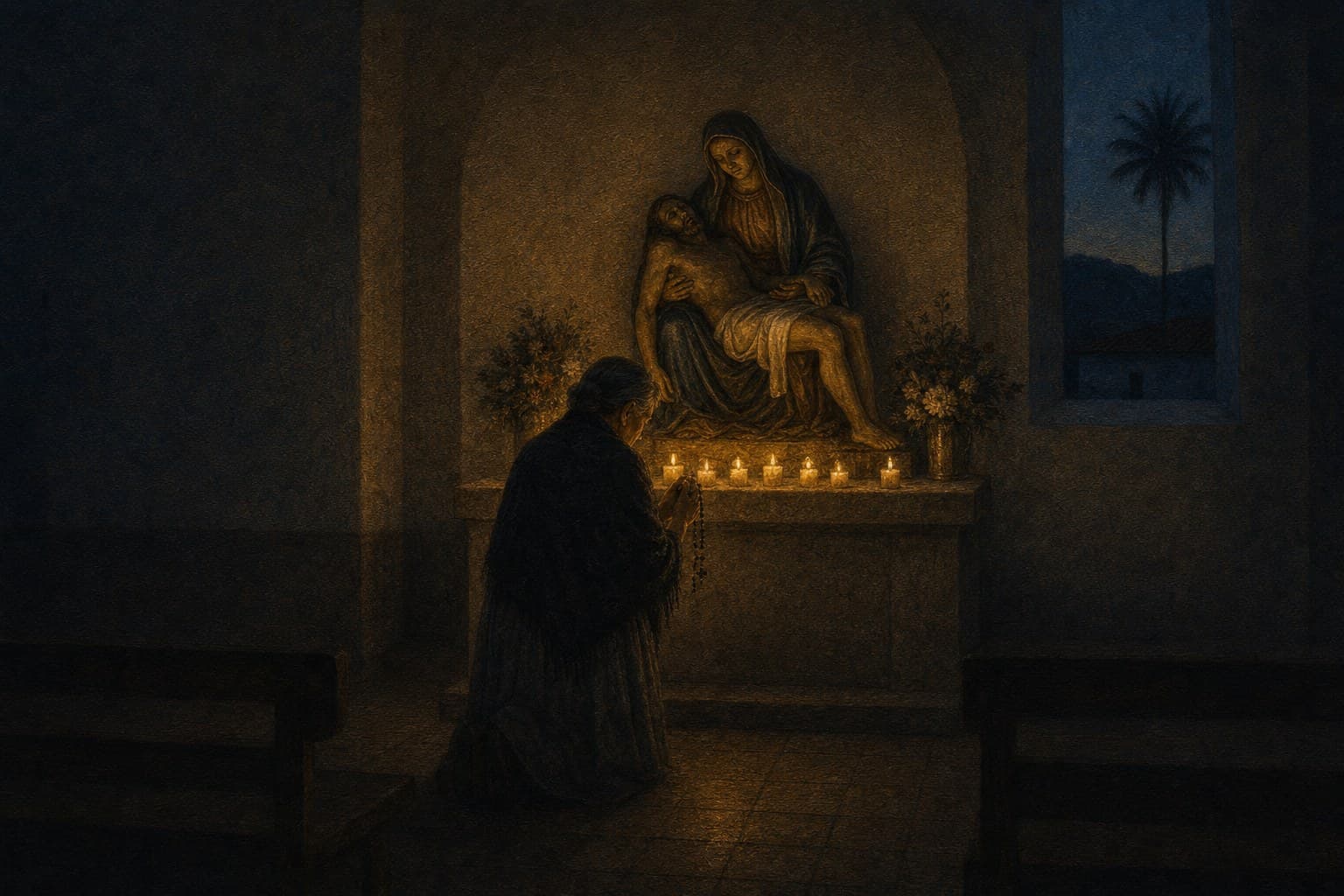
The Servite chaplet of Our Lady of Sorrows
The Seven Sorrows Rosary (Chaplet of the Seven Sorrows)
The whole Servite chaplet, each of Mary’s seven sorrows with its Scripture, how to pray it on the beads, and when
The Seven Sorrows Rosary, or Chaplet of the Seven Sorrows, is a Catholic prayer that follows Mary through seven griefs, with one Our Father and seven Hail Marys for each.
(Begin with the Sign of the Cross.)
Act of contrition
O my Lord, Thou who alone art most worthy of my love, behold me standing before thy Divine Presence utterly overwhelmed by the thought of the many grievous injuries I have done Thee.
I ask thy pardon for them with my whole heart, repenting of them purely for love of Thee, and at the thought of thy great goodness hating and loathing them above every evil of this life.
As I would rather have died a thousand times than have offended Thee, so now I am most firmly resolved to die a thousand deaths rather than offend Thee again.
My crucified Jesus, I firmly purpose to cleanse my soul as soon as possible by thy most Precious Blood in the Sacrament of Penance.
And thou, most tender Virgin, Mother of mercy and Refuge of sinners, do thou obtain for me by virtue of thy bitter pains, the pardon of sin which I desire.
The first sorrow: the prophecy of Simeon
With this confidence in my heart, I meditate on the First Sorrow, when Mary, Virgin Mother of my God, presented Jesus her only Son in the Temple, laid Him in the arms of holy and aged Simeon, and heard his prophetic word, “The sword of grief shall pierce thy soul,” foretelling thereby the Passion and Death of her Son Jesus.
(Our Father once, Hail Mary seven times.)
The second sorrow: the flight into Egypt
The Second Sorrow of the Blessed Virgin was when she was obliged to fly into Egypt by reason of the persecution of cruel Herod, who impiously sought to slay her well beloved Son.
(Our Father once, Hail Mary seven times.)
The third sorrow: the Child Jesus lost in Jerusalem
The Third Sorrow of the Blessed Virgin was when, after having gone up to Jerusalem at the Paschal Feast with Joseph her spouse and Jesus her beloved Son, she lost Him on the way back to her poor house, and for three days bewailed the loss of her only Love.
(Our Father once, Hail Mary seven times.)
The fourth sorrow: Mary meets Jesus on the way to Calvary
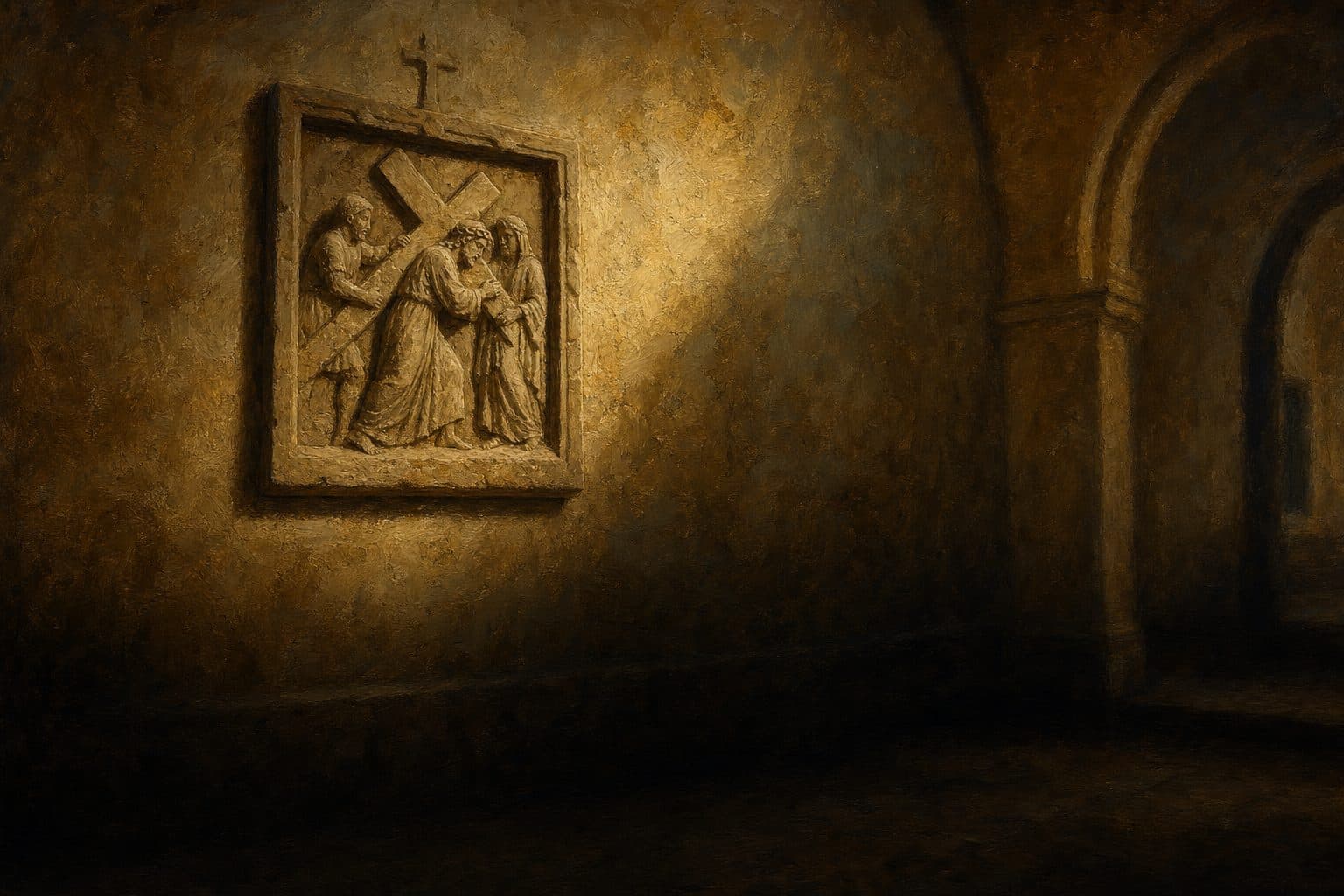
The Fourth Sorrow of the Blessed Virgin was when she met her dear Son Jesus carrying to Mount Calvary on his tender shoulders the heavy Cross whereon He was to be crucified for our salvation.
(Our Father once, Hail Mary seven times.)
The fifth sorrow: Jesus dies on the Cross
The Fifth Sorrow of the Blessed Virgin was when she saw her Son Jesus raised upon the hard tree of the Cross, and blood flowing from every part of his sacred Body, and then beheld Him die after three hours’ agony.
(Our Father once, Hail Mary seven times.)
The sixth sorrow: Jesus is taken down from the Cross
The Sixth Sorrow of the Blessed Virgin was when she saw the lance pierce the sacred Side of Jesus, her beloved Son, the nails withdrawn, and his holy Body laid in her purest bosom.
(Our Father once, Hail Mary seven times.)
The seventh sorrow: the burial of Jesus
The Seventh and last Sorrow of the Blessed Virgin, Queen and Advocate of us, her servants, miserable sinners, was when she saw the holy Body of her Son buried in the grave.
(Our Father once, Hail Mary seven times.)
(Then the Hail Mary three times, in honor of the tears Mary shed in her sorrows.)
V. Pray for us, Virgin most sorrowful.
R. That we may be made worthy of the promises of Christ.
Let us pray.
Grant, we beseech Thee, O Lord Jesus Christ, that the most blessed Virgin Mary, thy Mother, may intercede for us before the throne of thy mercy, now and at the hour of our death, whose most holy soul was transfixed with the sword of sorrow in the hour of thine own Passion.
Through Thee, Jesus Christ, Saviour of the world, who livest and reignest world without end.
Amen.
(The prayers are from the Raccolta of 1910, pp. 218–220. The last clause of its act of contrition, about the indulgences of that time, is left out.)
Also called the Servite Rosary, it comes from the Servites, the Order of the Servants of Mary, and ends with three Hail Marys for her tears. This page gives the whole chaplet in the words of the Raccolta, a Catholic prayer book of 1910, with the Scripture for each sorrow and when to pray it.
Go deeper
How to pray the Seven Sorrows Rosary, step by step
3 min readThe Seven Sorrows Rosary is prayed on a chaplet whose forty-nine beads fall into seven sets, one set for each sorrow, with three more beads for Mary’s tears.
The Seven Sorrows Rosary is prayed on a chaplet whose forty-nine beads fall into seven sets, one set for each sorrow, with three more beads for Mary’s tears. Many booklets, among them those from Kibeho, pray those three Hail Marys first, on the beads by the medal; the 1910 words on this page keep them for the end. The beads are often black, and some chaplets mark each set with a small medal. If you have none, an ordinary rosary or your fingers will do: what matters is the count of seven.
- Begin. Make the Sign of the Cross and pray the act of contrition.
- Announce the first sorrow, the prophecy of Simeon. If there is time, read its verse from the Gospel below and keep the scene in front of you.
- Pray one Our Father and seven Hail Marys while you stay with that sorrow.
- Go on through the other six in the same way, from the flight into Egypt to the burial of Jesus.
- Pray three more Hail Marys in honor of Mary’s tears.
- Close with the lines marked V. and R. and the prayer to Christ.
In all, that makes seven Our Fathers and fifty-two Hail Marys, so it takes about as long as a five-decade Rosary.
With others. One person reads the act of contrition and announces each sorrow. Everyone prays the Our Father and the Hail Marys, or, as at the Rosary, the leader says the first half of each and the rest answer with the second. To finish, the leader says the line marked V., everyone answers with the line marked R., and the leader prays the last prayer alone.
Alone. Read each announcement slowly, once, and let the seven Hail Marys keep you at that scene. On a day when praying all seven is too much, pray one sorrow and take up the next tomorrow; in a week you will have prayed the whole chaplet.
Where these words come from. The prayers are printed word for word from the Raccolta, the English collection of indulgenced prayers made by Father Ambrose St. John of the Birmingham Oratory, in its 1910 edition, where they appear as “The Rosary of the Seven Dolours” (pp. 217–220). Two small changes: the last clause of its act of contrition, which asks for the indulgences then attached to the chaplet, is left out, and the book’s “etc.” after “who livest and reignest” is written out in the form the same book prints elsewhere. The labels and the lines in parentheses are ours. The words of the Our Father and the Hail Mary have pages of their own.
Each of the seven sorrows, with its Scripture and a meditation
4 min readThe seven sorrows of Mary run from the Temple, while her Son was still a baby in her arms, to a new tomb in a garden close to Calvary.
The seven sorrows of Mary run from the Temple, while her Son was still a baby in her arms, to a new tomb in a garden close to Calvary. The Gospels tell the events of six of them, though not always with Mary in view; the fourth, her meeting with him on the road, comes to us from tradition and the fourth Station of the Cross. The verses below are from the Douay-Rheims Bible, and each short meditation is our own.
- The prophecy of Simeon (Luke 2:34–35). Simeon, who has waited all his life for this child, turns to the young mother: “And thy own soul a sword shall pierce, that, out of many hearts, thoughts may be revealed” (Luke 2:35). She is told the cost before any of it has come. Pray this sorrow for anyone living under news they dread.
- The flight into Egypt (Matthew 2:13–14). Warned in a dream, Joseph “arose, and took the child and his mother by night, and retired into Egypt” (Matthew 2:14). They leave in the dark with what they can carry, for a country that is not theirs. Pray it for refugees and for every family driven from home.
- The Child Jesus lost in Jerusalem (Luke 2:43–51). On the third day the search ends in the Temple, and his mother says: “Son, why hast thou done so to us? behold thy father and I have sought thee sorrowing” (Luke 2:48). Of all seven, this is the sorrow where the Gospel lets us hear her voice, and the word it gives her is sorrowing. Pray it for parents whose child is missing, or has drifted far from home or from faith.
- Mary meets Jesus on the way to Calvary. The Gospels do not tell this meeting. Luke says only: “And there followed him a great multitude of people, and of women, who bewailed and lamented him” (Luke 23:27). Christian tradition puts his mother in that crowd, near enough to see him fall and unable to lift the beam. Pray it for those at a bedside who would gladly take the pain if they could.
- Jesus dies on the Cross (John 19:25–27). “Now there stood by the cross of Jesus, his mother” (John 19:25). She stays to the end, and in his last hour he gives her the beloved disciple as a son: “Woman, behold thy son” (John 19:26). Pray it for the dying, and for everyone who keeps watch with them through the night.
- Jesus is taken down from the Cross (John 19:34–40). John tells how “one of the soldiers with a spear opened his side, and immediately there came out blood and water” (John 19:34), and how Joseph of Arimathea came “and took the body of Jesus” (John 19:38). The Gospels do not say that he was laid in her arms; the Church’s tradition says so, as the prayer above does, and the Pietà, the mother with her dead Son across her knees, is how Christian art has kept that moment. Pray it for anyone who has held someone they loved after death.
- The burial of Jesus (John 19:41–42). “Now there was in the place where he was crucified, a garden; and in the garden a new sepulchre, wherein no man yet had been laid” (John 19:41), and Joseph “rolled a stone to the door of the sepulchre” (Mark 15:46). Then comes the long quiet of Holy Saturday, when she waits and believes. Pray it for the bereaved in the empty days after a funeral.
The seven sorrows are not the five Sorrowful Mysteries of the Rosary, whose decades go with Christ from Gethsemane to Golgotha. Four of the seven sorrows fall on that same Good Friday, but the devotion begins some thirty years earlier, in the Temple, and it watches every scene from where his mother stood.
Close: Each of the seven sorrows, with its Scripture and a meditation
Where the Seven Sorrows Rosary comes from: the Servites
3 min readThe Seven Sorrows Rosary is the prayer of the Servites, the Order of the Servants of Mary.
The Seven Sorrows Rosary is the prayer of the Servites, the Order of the Servants of Mary. The Catholic Encyclopedia tells how they began: seven young men of Florence, from leading families of the city and members of a lay confraternity devoted to the praise of Mary, were at prayer on the feast of the Assumption in 1233 when, by the order’s tradition, the Virgin appeared and asked them to give their lives wholly to God. They left the city for Monte Senario, a mountain north of Florence, took a black habit and the Rule of St. Augustine, and became the order of her servants.
Sorrow was at the heart of the order from the start. In 1239, by the Catholic Encyclopedia’s account, the founders chose Mary at the foot of the Cross as the chief devotion of their community. The count of seven came later: the seven sorrows from Simeon in the Temple to the grave are the ones their own feast kept from 1668. The Catholic Encyclopedia of 1912 still names “the Rosary of the Seven Dolours” (dolours being the old word for sorrows) among the Servites’ own devotions. Popes encouraged it for centuries: the Raccolta of 1910 lists indulgences granted for this chaplet from Benedict XIII in 1724 to Leo XIII in 1898.
The feast. In 1668 the Servites were allowed a feast of the seven sorrows, and in 1814 Pius VII, home again from his exile in France, made it a feast of the entire Latin Church. Today the General Roman Calendar keeps Our Lady of Sorrows as a memorial on September 15, right after the Exaltation of the Holy Cross; its Gospel is either the mother at the Cross or Simeon’s prophecy. The feast, the Stabat Mater and what the devotion means for the grieving are told on Our Lady of Sorrows.
Kibeho. Since the 1980s the chaplet has reached a great many new people through Kibeho, in Rwanda, where schoolgirls reported apparitions of the Virgin beginning on November 28, 1981. One of them, Marie Claire Mukangango, said that Mary had asked her to spread the Rosary of the Seven Sorrows. On June 29, 2001, Bishop Augustin Misago of Gikongoro judged that the Virgin had truly appeared to the first three visionaries, adding that no Catholic is bound to believe it, and the shrine at Kibeho bears the name of Our Lady of Sorrows. The booklets that come from Kibeho add prayers of their own; this page keeps to the older Servite form, and anyone who prays the Kibeho booklet is praying the same seven sorrows.
Close: Where the Seven Sorrows Rosary comes from: the Servites
When to pray it: Fridays, Lent and September 15
3 min readThe Seven Sorrows Rosary suits every day of the year, yet some days have long been its own.
The Seven Sorrows Rosary suits every day of the year, yet some days have long been its own. The Raccolta of 1910 singles out Fridays, the days of Lent, and the feast of the Seven Dolours with the week after it as times to say this chaplet (p. 218).
Fridays. Friday is the day of the Crucifixion, and four of the seven sorrows happened on that one Friday: the road, the Cross, the taking down and the burial. Praying the chaplet once a week, on Friday, keeps Good Friday in view all year.
Lent and Holy Week. The Directory on Popular Piety says that the Via Matris, which walks through the same seven sorrows as seven stations, suits the themes of Lent (n. 137), and it asks that Our Lady of Sorrows be remembered in Holy Week, on Good Friday (n. 145). From 1727 the Friday before Palm Sunday was a feast of her sorrows for the whole Latin Church, and it is still a fitting day for the chaplet.
September 15. The memorial of Our Lady of Sorrows is the chaplet’s own day. The Servites once kept their feast for eight days, and a September week of the chaplet is an easy way to begin.
In grief. If you come to this prayer after a death, nothing in it asks you to feel better than you do. Mary does not explain her sorrows in any of the seven; she stays with her Son. The chaplet stops at the tomb; her faith did not, and the third day came. If you need words for your own loss, there is also a prayer for grief.
Indulgences. The Raccolta of 1910 lists many indulgences for this chaplet, counted in days and years. Pope Paul VI’s reform of 1967 ended that way of counting, and the current Enchiridion of Indulgences (1999) does not name the Seven Sorrows Rosary; its grant for the Rosary (grant 17) is for the Marian Rosary of decades. Its appendix of short invocations does give Mater dolorosa, ora pro nobis, “Sorrowful Mother, pray for us,” as one example: said while you lift your heart to God in the middle of work or trouble, it belongs to the first general grant, a partial indulgence. The same book also gives a partial indulgence for any approved prayer to Mary (under the same grant 17) and for the devout use of a rosary or chaplet blessed by a priest or deacon (grant 14). So the chaplet has no indulgence of its own today, and this page promises only what all prayer receives: the grace God gives to those who stay with Mary beside the Cross.
The Stabat Mater, to close the chaplet
3 min readThe Stabat Mater, the medieval Latin sequence whose first words set Mary beside the Cross, makes a fitting close to the Seven Sorrows Rosary.
The Stabat Mater, the medieval Latin sequence whose first words set Mary beside the Cross, makes a fitting close to the Seven Sorrows Rosary. Nobody knows who wrote it; the Catholic Encyclopedia judged Pope Innocent III and the Franciscan poet Jacopone da Todi the only likely authors. It entered the Roman Missal and Breviary in 1727 for the feast of the Seven Dolours. The English below is Father Edward Caswall’s, as he printed it in his Lyra Catholica in 1849, where its three parts are sung at Vespers, Matins and Lauds.
At the Cross her station keeping,
Stood the mournful Mother weeping,
Close to Jesus to the last:
Through her heart, his sorrow sharing,
All his bitter anguish bearing,
Now at length the sword had pass’d.
Oh, how sad and sore distress’d
Was that Mother highly blest
Of the sole-begotten One!
Christ above in torment hangs;
She beneath beholds the pangs
Of her dying glorious Son.
Is there one who would not weep,
Whelm’d in miseries so deep
Christ’s dear Mother to behold?
Can the human heart refrain
From partaking in her pain,
In that Mother’s pain untold?
Bruis’d, derided, curs’d, defil’d,
She beheld her tender Child
All with bloody scourges rent;
For the sins of his own nation,
Saw Him hang in desolation,
Till his Spirit forth He sent.
O thou Mother! fount of love!
Touch my spirit from above,
Make my heart with thine accord:
Make me feel as thou hast felt;
Make my soul to glow and melt
With the love of Christ my Lord.
Holy Mother! pierce me through;
In my heart each wound renew
Of my Saviour crucified:
Let me share with thee His pain,
Who for all my sins was slain,
Who for me in torments died.
Let me mingle tears with thee,
Mourning Him who mourn’d for me,
All the days that I may live:
By the Cross with thee to stay;
There with thee to weep and pray;
Is all I ask of thee to give.
Virgin of all virgins best!
Listen to my fond request:
Let me share thy grief divine;
Let me, to my latest breath,
In my body bear the death
Of that dying Son of thine.
Wounded with his every wound,
Steep my soul till it hath swoon’d
In his very blood away;
Be to me, O Virgin, nigh,
Lest in flames I burn and die,
In his awful Judgment day.
Christ, when Thou shalt call me hence,
Be thy Mother my defence,
Be thy Cross my victory;
While my body here decays,
May my soul thy goodness praise,
Safe in Paradise with Thee.
On a night when the whole hymn is too long, the first stanza and the one that begins “Let me mingle tears with thee” are enough.
Questions
What is the Seven Sorrows Rosary?
The Seven Sorrows Rosary, also called the Chaplet of the Seven Sorrows or the Servite Rosary, is a Catholic prayer on seven griefs in the life of the Virgin Mary, beginning with Simeon’s warning and ending at the tomb. Each sorrow is announced and prayed with one Our Father and seven Hail Marys, and three more Hail Marys honor her tears. It comes from the Servites, an order begun by seven Florentines in 1233.
How do you pray the Seven Sorrows Rosary?
Make the Sign of the Cross and pray an act of contrition. Then announce the sorrows one after another, praying one Our Father and seven Hail Marys for each while you think of that scene. After the seventh, pray three Hail Marys in honor of Mary’s tears, and close with “Pray for us, Virgin most sorrowful” and the prayer to Christ. The full prayers come first on this page.
When should I say the Seven Sorrows Rosary?
You can pray it on any day. The traditional times are Fridays, Lent and mid-September, around the memorial of Our Lady of Sorrows on the 15th; the 1910 Raccolta names all three. Some spread the seven across the days of a week instead of praying all of them at once.
Is there a special Rosary for the seven sorrows of Mary?
Yes. The Servite chaplet has forty-nine beads in seven sets, one set for each sorrow, and three extra beads for Mary’s tears; the beads are often black. You do not need one to pray it: an ordinary rosary or your fingers will keep count.
What happens when you pray the Seven Sorrows Rosary?
Nothing automatic, yet much can happen. You spend some time beside Mary in seven hard moments of her life, and through her you come to the Passion of her Son. It can teach you to carry your own griefs without despair, and to be sorry for your sins. Kibeho’s message, for example, ties the chaplet to repentance. The fruit is whatever God gives through that prayer, not a guaranteed result.
What are the promises of praying the Seven Sorrows Rosary?
Lists of seven graces circulate under the name of St. Bridget of Sweden, and further graces are linked to Kibeho, in Rwanda. They are private revelations. The Catechism teaches that such revelations, even approved ones, are not part of the deposit of faith: they do not improve on or complete what Christ revealed, though they may help believers live that Revelation more deeply (CCC 67). A promise may encourage you, but it is not the reason to pray: the chaplet leads you to Christ with his mother.
What is the difference between the Seven Sorrows Rosary and the Rosary?
The Rosary prays five decades of ten Hail Marys on mysteries from the lives of Jesus and Mary. The Seven Sorrows Rosary prays seven groups of seven Hail Marys on Mary’s seven sorrows, plus three for her tears, and it has no Glory Be in the 1910 form. Four of its sorrows fall on Good Friday, close to the Sorrowful Mysteries, but seen from where his mother stood.
Is there an indulgence for the Seven Sorrows Rosary?
Not by name today. The Raccolta of 1910 lists many indulgences for it, but Paul VI’s reform of 1967 replaced that system, and the current Enchiridion of Indulgences (1999) does not mention the chaplet. Its grant for praying the Rosary (grant 17) concerns the Marian Rosary of decades. The short invocation “Sorrowful Mother, pray for us” (in Latin, Mater dolorosa, ora pro nobis) is among the examples it gives for the first general grant, a partial indulgence for lifting your heart to God in daily life. The same book also gives a partial indulgence for any approved prayer to Mary and for the devout use of a rosary or chaplet blessed by a priest or deacon.
Keep praying
- Stations of the CrossAll fourteen in order, with the prayers at each.
- Hail, Holy Queen (Salve Regina): The Prayer in English and LatinThe Salve Regina: the prayer that ends the Rosary and the Church’s night prayer
- The Litany of Loreto (Litany of the Blessed Virgin Mary)The whole litany with the three titles added in 2020, how to pray it alone or with others, what Mary’s titles mean and the Latin

A traditional Catholic prayer · The Raccolta (1910), the Servite chaplet
Upcoming · Oct 28
Sts. Simon and Jude
See the full liturgical calendar — every feast this year, and an embed for your parish site.