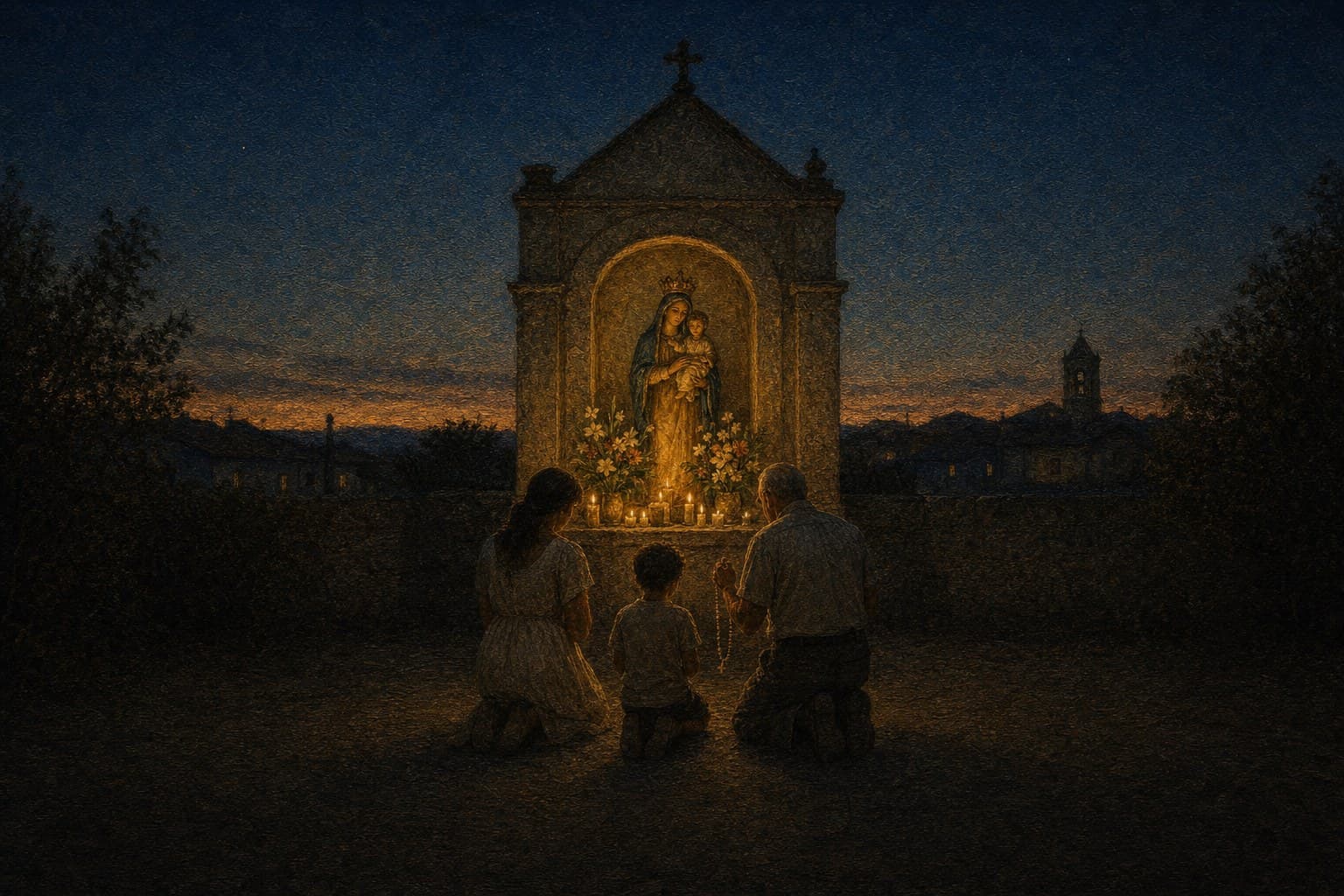
After the Rosary, in May and October
The Litany of Loreto (Litany of the Blessed Virgin Mary)
The whole litany with the three titles added in 2020, how to pray it alone or with others, what Mary’s titles mean and the Latin
The Litany of Loreto, also called the Litany of the Blessed Virgin Mary, is a Catholic prayer that calls on Mary by a long chain of her titles, each answered with “pray for us.”
(With others, one person leads each line and everyone answers with its last words: “have mercy on us” or “pray for us.”)
Lord, have mercy.
Christ, have mercy.
Lord, have mercy.
Christ, hear us.
Christ, graciously hear us.
God the Father of heaven, have mercy on us.
God the Son, Redeemer of the world, have mercy on us.
God the Holy Ghost, have mercy on us.
Holy Trinity, one God, have mercy on us.
Holy Mary, pray for us.
Holy Mother of God, pray for us.
Holy Virgin of virgins, pray for us.
Mother of Christ, pray for us.
Mother of the Church, pray for us.
Mother of mercy, pray for us.
Mother of divine grace, pray for us.
Mother of hope, pray for us.
Mother most pure, pray for us.
Mother most chaste, pray for us.
Mother inviolate, pray for us.
Mother undefiled, pray for us.
Mother most amiable, pray for us.
Mother most admirable, pray for us.
Mother of good counsel, pray for us.
Mother of our Creator, pray for us.
Mother of our Saviour, pray for us.
Virgin most prudent, pray for us.
Virgin most venerable, pray for us.
Virgin most renowned, pray for us.
Virgin most powerful, pray for us.
Virgin most merciful, pray for us.
Virgin most faithful, pray for us.
Mirror of justice, pray for us.
Seat of wisdom, pray for us.
Cause of our joy, pray for us.
Spiritual vessel, pray for us.
Vessel of honor, pray for us.
Singular vessel of devotion, pray for us.
Mystical Rose, pray for us.
Tower of David, pray for us.
Tower of ivory, pray for us.
House of gold, pray for us.
Ark of the covenant, pray for us.
Gate of heaven, pray for us.
Morning star, pray for us.
Health of the sick, pray for us.
Refuge of sinners, pray for us.
Solace of migrants, pray for us.
Comforter of the afflicted, pray for us.
Help of Christians, pray for us.
Queen of angels, pray for us.
Queen of patriarchs, pray for us.
Queen of prophets, pray for us.
Queen of apostles, pray for us.
Queen of martyrs, pray for us.
Queen of confessors, pray for us.
Queen of virgins, pray for us.
Queen of all saints, pray for us.
Queen conceived without original sin, pray for us.
Queen assumed into heaven, pray for us.
Queen of the most holy Rosary, pray for us.
Queen of the family, pray for us.
Queen of peace, pray for us.
Lamb of God, Who takest away the sins of the world, spare us, O Lord.
Lamb of God, Who takest away the sins of the world, graciously hear us, O Lord.
Lamb of God, Who takest away the sins of the world, have mercy on us.
V. Pray for us, O holy Mother of God.
R. That we may be made worthy of the promises of Christ.
Let us pray.
Grant, we beseech Thee, O Lord God,
that we, Thy servants, may enjoy perpetual health of mind and body;
and, by the glorious intercession of the Blessed Mary, ever Virgin,
be delivered from present sorrow
and possess eternal joy.
Through Christ our Lord.
R. Amen.
(Seven titles were added after 1904: Queen of peace in 1917, Queen assumed into heaven in 1950, Mother of the Church in 1980, Queen of the family in 1995, and Mother of mercy, Mother of hope and Solace of migrants in 2020. Their English is AngelGuard’s translation from the Latin.)
Pope Sixtus V approved it in 1587, and Catholics pray it most often after the Rosary, in May and in October. This page gives the whole litany with all 54 of its present titles, including the three added in 2020, along with what they mean and the Latin.
Go deeper
How to pray the Litany of Loreto, alone or with others
3 min readThe Litany of Loreto is a prayer of call and answer: one voice names Mary by one of her titles, and everyone replies with a short plea.
The Litany of Loreto is a prayer of call and answer: one voice names Mary by one of her titles, and everyone replies with a short plea. It takes about five minutes, at home before an image of Our Lady or in church.
With others. One person leads. The litany opens by asking God’s mercy, and in those first lines everyone repeats each plea after the leader. For the Father, the Son, the Holy Ghost and the Trinity, the leader names God and all answer “have mercy on us.” Then come Mary’s titles: the leader says “Holy Mary,” “Mother of Christ,” “Tower of ivory” and the rest, and after each one all answer “pray for us.” Three lines to the Lamb of God turn the prayer back to Christ, and all answer “spare us, O Lord,” “graciously hear us, O Lord” and “have mercy on us.” The leader reads the versicle (V.), everyone answers with the response (R.), and the leader says the closing prayer, to which all say Amen.
Alone. Say both halves yourself, slowly. Because the answer never changes, the mind is free to stay with each name, and it is fine to stop at a title that catches you before going on.
With children. A child needs only three words, “pray for us,” so the litany is often the first prayer a small child can say with the family. Let an older child take the leader’s part, and pause at “Health of the sick” or “Queen of the family” to name someone at home or far away who needs prayer.
After the Rosary. The best-known place for the litany is the end of the Rosary, after the Hail, Holy Queen. St. John Paul II wrote that when the Rosary is over, the soul feels the need to break out in praise of Mary, in the Salve Regina or the Litany of Loreto (Rosarium Virginis Mariae, 37). Yet the litany does not belong to the Rosary alone. The Holy See’s Directory on Popular Piety calls the litanies “independent acts of worship” (n. 203), so you can pray it on its own on any day.
About the text on this page. The English comes word for word from a Catholic prayer book approved in New York in 1904, Father F. X. Lasance’s Prayer-Book for Religious, with its “Holy Ghost” and “Who takest,” leaving out only the Sub tuum praesidium that it sets between the litany and the versicle. Seven titles were added after the book was printed, from Queen of peace in 1917 to the three of 2020; a note under the litany names them, and their English is our own translation from the official Latin. The 1904 book ends the litany with the prayer of the Angelus, “Pour forth, we beseech Thee, O Lord, Thy grace into our hearts.” Here it ends with the prayer that the same book gives to the Little Office of Our Lady for most of the year, which asks for health of mind and body that lasts, and for eternal joy. Both are traditional; if your parish uses another closing prayer, pray that one.
Close: How to pray the Litany of Loreto, alone or with others
Where the Litany of Loreto comes from
2 min readThe Litany of Loreto is named after the Holy House of Loreto, a shrine a short way south of Ancona, near the Adriatic, honored by tradition as the Nazareth home in which the Word was made flesh.
The Litany of Loreto is named after the Holy House of Loreto, a shrine a short way south of Ancona, near the Adriatic, honored by tradition as the Nazareth home in which the Word was made flesh. Litanies to Mary are older than the shrine’s fame. The oldest one the Catholic Encyclopedia knew in 1910 is in a twelfth-century manuscript at Mainz, and the centuries after it produced many more, long and varied; in Venice they were sung in processions in times of plague.
The Loreto text took shape among those litanies, and the Catholic Encyclopedia thinks it probable that it became the custom of the Holy House toward the end of the fifteenth century. Records show litanies sung there in 1531, 1547 and 1554. The oldest printed copy known, from Dillingen in Germany around 1558, presents itself as the litany of Our Lady “as said every Saturday at Loreto,” and handbooks for pilgrims spread it far beyond Italy.
Then it was nearly lost. In 1571 St. Pius V reformed the Little Office of Our Lady and left its litanies out, and the clergy of Loreto, afraid their own text was now forbidden, drew up a new litany made of phrases from Scripture, set to music in 1575. Rome declined to impose it, and the old text returned. On July 11, 1587, Pope Sixtus V, deeply devoted to Loreto, approved the litany in the bull Reddituri and urged preachers everywhere to spread it. In 1601, when Clement VIII forbade the publication of new litanies, the Litany of Loreto was expressly kept.
The Holy House. The shrine’s tradition says that angels carried the house from Nazareth to Italy in the last years of the thirteenth century. Popes have honored the shrine for centuries, and in 2019 Pope Francis added the memorial of Our Lady of Loreto, December 10, to the General Roman Calendar. The Catholic Encyclopedia of 1910 also set out the grave historical difficulties of the account, and Catholics are free to weigh them. The litany does not stand or fall with it. What the Church honors at Loreto is the mystery the house keeps before every pilgrim, as the 2019 decree says: God’s Son, born of a woman, living in a family home at Nazareth.
The titles added to the litany since 1587
3 min readThe litany that Sixtus V approved has kept growing, and most of its newer titles answer something the Church was living through at the time.
The litany that Sixtus V approved has kept growing, and most of its newer titles answer something the Church was living through at the time.
Queen of the most holy Rosary. The Dominicans had added it by 1614. The Congregation of Rites allowed it to the Confraternity of the Rosary in 1675, and Leo XIII prescribed it for the whole Church on December 24, 1883.
Queen conceived without original sin. Pius IX granted it to the diocese of Mechlin, in Belgium, in 1846. After he defined the Immaculate Conception in 1854, Rome allowed one diocese after another to add it, until it was prayed everywhere.
Mother of good counsel. Leo XIII added it by a decree of April 22, 1903. The old Marian litany of St. Mark’s in Venice had long called Mary Mater veri consilii, Mother of true counsel.
Queen of peace (1917). On May 5, 1917, in the middle of the First World War, Benedict XV wrote to his Secretary of State, Cardinal Pietro Gasparri, asking that the bishops of the whole world add “Queen of peace, pray for us.”
Queen assumed into heaven (1950). Pius XII had it added after “Queen conceived without original sin” by a Congregation of Rites decree of October 31, 1950; the next day, November 1, he defined the dogma of the Assumption.
Mother of the Church (1980). St. Paul VI declared Mary Mother of the Church on November 21, 1964, at the close of the third session of the Second Vatican Council. In 1980 the Holy See permitted its use in the litany, and since 2018 the Church has kept the memorial of Mary, Mother of the Church, on the Monday after Pentecost.
Queen of the family (1995). St. John Paul II added it in 1995, his second title for the litany after Mother of the Church.
Mother of mercy, Mother of hope and Solace of migrants (2020). On June 20, 2020, the memorial of the Immaculate Heart of Mary, Cardinal Robert Sarah, prefect of the Congregation for Divine Worship, informed the presidents of the bishops’ conferences that Pope Francis wished these three titles to be inserted. The letter gives the reason: in a time with so many causes of uncertainty and fear, God’s people feel all the more their need to turn to Mary with love and trust. The first comes after “Mother of the Church,” the second after “Mother of divine grace,” and the third after “Refuge of sinners.”
Why your booklet may read differently. A card printed before 2020 lacks the three newest titles, and an older one may lack more. English versions also vary: “Holy Ghost” or “Holy Spirit,” “Vessel of honor” or “honour,” “Comforter” or “Comfort of the afflicted,” “Queen of families” or “Queen of the family.” It is the same prayer. For the seven newer titles we kept close to the Latin: Regina familiae is singular, so “Queen of the family,” and Solacium migrantium becomes “Solace of migrants.”
What the titles of the Litany of Loreto mean
3 min readThe titles of the Litany of Loreto come in groups: Mary as Mother, then as Virgin, then a run of images, then her care for us in our needs, and last her titles as Queen.
The titles of the Litany of Loreto come in groups: Mary as Mother, then as Virgin, then a run of images, then her care for us in our needs, and last her titles as Queen. Some images come from Scripture and many from the Latin poetry of the Middle Ages, as the Catholic Encyclopedia notes. You do not need to understand every one to pray them, but a few are worth knowing.
Holy Mother of God. The first title after her name, and the root of all the others. Elizabeth greeted her as “the mother of my Lord” (Luke 1:43).
Mother of the Church. From the cross, Jesus entrusted his mother to the beloved disciple: “Behold thy mother. And from that hour, the disciple took her to his own” (John 19:27).
Tower of David, Tower of ivory. Both come from the love song of the bridegroom and the bride: “Thy neck, is as the tower of David” (Canticle of Canticles 4:4) and “Thy neck as a tower of ivory” (Canticle of Canticles 7:4). Strength and beauty, both of them gifts of God.
Ark of the covenant. The ark kept the tablets of the Law; Mary carried the Lord himself. In the Apocalypse, as soon as “the ark of his testament was seen in his temple” (Apocalypse 11:19), the next sign appears: “A woman clothed with the sun” (Apocalypse 12:1).
Gate of heaven. Jacob woke from his dream of the ladder and said of the place: “this is no other but the house of God, and the gate of heaven” (Genesis 28:17). Through Mary, the King of heaven came to us.
Health of the sick, Refuge of sinners, Solace of migrants, Comforter of the afflicted, Help of Christians. Here the litany turns to our needs. The newest of these titles remembers that the Holy Family knew exile: Joseph “arose, and took the child and his mother by night, and retired into Egypt” (Matthew 2:14).
The titles of Queen. Mary is Queen of angels, patriarchs, prophets, apostles, martyrs, confessors and virgins, and of all saints. The confessors are the saints who bore witness to Christ without dying for him, first under persecution and later by heroic holiness. Her own song gives the measure of her greatness: “he hath regarded the humility of his handmaid; for behold from henceforth all generations shall call me blessed” (Luke 1:48).
Every line asks the same thing of her: not to take God’s place, but to pray for us. The litany begins with God’s mercy and ends with the Lamb of God, and Mary stands between them, turned toward her Son.
When to pray the litany: after the Rosary, in May and October, on Saturdays
2 min readThe Litany of Loreto can be prayed on any day of the year, but three times belong to it in a special way.
The Litany of Loreto can be prayed on any day of the year, but three times belong to it in a special way.
October. On September 1, 1883, in the encyclical Supremi apostolatus officio, Leo XIII ordered that from October 1 to November 2 of that year every parish pray five decades of the Rosary “with the addition of the Litany of Loreto.” The October Rosary, and the litany at its close, grew from that order. For the mysteries to meditate on each day of the week, see the mysteries of the Rosary.
May. In the West, May is kept as Mary’s month (Directory on Popular Piety, n. 191). It falls mostly within the fifty days of Easter, and the Directory suggests that its devotions show Mary with the first disciples waiting for the Holy Spirit, when “all these were persevering with one mind in prayer with the women, and Mary the mother of Jesus” (Acts 1:14). A family can pray the litany each evening of May before a statue of Our Lady with a few flowers, and many parishes pray or sing it at their May crowning.
Saturdays. Of all the days of the week, Saturday is the one dedicated to Mary (Directory, n. 188), and Saturday was the day the litany was sung at Loreto.
The indulgence. Whoever devoutly prays an approved litany, the Litany of the Blessed Virgin Mary among them, can gain a partial indulgence (Enchiridion of Indulgences, 1999, grant 22, 2°). The Enchiridion asks that the text be approved by the competent Church authority, so for the indulgence use the version your bishops’ conference or your parish prints, or the Latin below.
The Litany of Loreto in Latin
3 min readThe Latin below is the official list of the Litaniae Lauretanae, with the three invocations of 2020, as the Italian bishops’ conference published it in its bulletin of August 31, 2021, after the Holy See’s letter.
The Latin below is the official list of the Litaniae Lauretanae, with the three invocations of 2020, as the Italian bishops’ conference published it in its bulletin of August 31, 2021, after the Holy See’s letter. The versicle and the closing prayer, Concede nos famulos tuos, are the Latin printed beside the English in the 1904 prayer book, with its æ written as ae.
Kyrie, eleison.
Christe, eleison.
Kyrie, eleison.
Christe, audi nos.
Christe, exaudi nos.
Pater de caelis, Deus, miserere nobis.
Fili, Redemptor mundi, Deus, miserere nobis.
Spiritus Sancte, Deus, miserere nobis.
Sancta Trinitas, unus Deus, miserere nobis.
Sancta Maria, ora pro nobis.
Sancta Dei Genitrix, ora pro nobis.
Sancta Virgo virginum, ora pro nobis.
Mater Christi, ora pro nobis.
Mater Ecclesiae, ora pro nobis.
Mater misericordiae, ora pro nobis.
Mater divinae gratiae, ora pro nobis.
Mater spei, ora pro nobis.
Mater purissima, ora pro nobis.
Mater castissima, ora pro nobis.
Mater inviolata, ora pro nobis.
Mater intemerata, ora pro nobis.
Mater amabilis, ora pro nobis.
Mater admirabilis, ora pro nobis.
Mater boni consilii, ora pro nobis.
Mater Creatoris, ora pro nobis.
Mater Salvatoris, ora pro nobis.
Virgo prudentissima, ora pro nobis.
Virgo veneranda, ora pro nobis.
Virgo praedicanda, ora pro nobis.
Virgo potens, ora pro nobis.
Virgo clemens, ora pro nobis.
Virgo fidelis, ora pro nobis.
Speculum iustitiae, ora pro nobis.
Sedes sapientiae, ora pro nobis.
Causa nostrae laetitiae, ora pro nobis.
Vas spirituale, ora pro nobis.
Vas honorabile, ora pro nobis.
Vas insigne devotionis, ora pro nobis.
Rosa mystica, ora pro nobis.
Turris davidica, ora pro nobis.
Turris eburnea, ora pro nobis.
Domus aurea, ora pro nobis.
Foederis arca, ora pro nobis.
Ianua coeli, ora pro nobis.
Stella matutina, ora pro nobis.
Salus infirmorum, ora pro nobis.
Refugium peccatorum, ora pro nobis.
Solacium migrantium, ora pro nobis.
Consolatrix afflictorum, ora pro nobis.
Auxilium Christianorum, ora pro nobis.
Regina Angelorum, ora pro nobis.
Regina Patriarcharum, ora pro nobis.
Regina Prophetarum, ora pro nobis.
Regina Apostolorum, ora pro nobis.
Regina Martyrum, ora pro nobis.
Regina Confessorum, ora pro nobis.
Regina Virginum, ora pro nobis.
Regina Sanctorum omnium, ora pro nobis.
Regina sine labe originali concepta, ora pro nobis.
Regina in caelum assumpta, ora pro nobis.
Regina sacratissimi Rosarii, ora pro nobis.
Regina familiae, ora pro nobis.
Regina pacis, ora pro nobis.
Agnus Dei, qui tollis peccata mundi, parce nobis, Domine.
Agnus Dei, qui tollis peccata mundi, exaudi nos, Domine.
Agnus Dei, qui tollis peccata mundi, miserere nobis.
V. Ora pro nobis, sancta Dei Genitrix.
R. Ut digni efficiamur promissionibus Christi.
Oremus.
Concede nos famulos tuos, quaesumus, Domine Deus,
perpetua mentis et corporis sanitate gaudere:
et gloriosa beatae Mariae semper Virginis intercessione
a praesenti liberari tristitia, et aeterna perfrui laetitia.
Per Christum Dominum nostrum.
R. Amen.
Older books spell some titles differently, Janua cæli for Ianua coeli or Speculum justitiæ for Speculum iustitiae; the words are the same.
Questions
What is the Litany of Loreto prayer?
The Litany of Loreto is the Church’s best-known litany to Mary. After asking God’s mercy, it names Mary by 54 titles, from “Holy Mary” to “Queen of peace,” answering each with “pray for us,” and it closes with the Lamb of God, a versicle and a prayer. It takes its name from Loreto, the Italian shrine where it was sung on Saturdays, and Pope Sixtus V approved it in 1587.
What is the purpose of the Litany of Loreto?
Its purpose is to praise Mary and to ask for her prayers. Each line has two halves, a title that praises her and a plea for her prayer, as the Directory on Popular Piety describes it (n. 203). The praise honors what God did in her, and the plea asks her to pray for us to her Son; nothing in it asks of her what belongs to God alone.
How many titles are in the Litany of Loreto?
Today there are 54 titles of Mary, from “Holy Mary” to “Queen of peace.” The text Sixtus V approved in 1587 was shorter. Popes added titles over the centuries, among them Queen of the most holy Rosary (1883), Mother of good counsel (1903), Queen of peace (1917), Queen assumed into heaven (1950), Mother of the Church (1980), Queen of the family (1995) and three titles in 2020.
What are the new invocations of the Litany of Loreto?
The three newest are Mother of mercy, Mother of hope and Solace of migrants, added at the wish of Pope Francis on June 20, 2020. The first comes after “Mother of the Church,” the second after “Mother of divine grace,” and the third after “Refuge of sinners.” Many cards and booklets printed earlier do not have them.
When should you pray a litany?
On any day. The Litany of Loreto is prayed most often to close the Rosary, through May, Mary’s month, and October, the Rosary’s month, and on Saturdays. The Church calls the litanies independent acts of worship, so it can also be prayed alone, in a procession or at a family altar.
Is Loreto Catholic or Protestant?
Catholic. Loreto is a pilgrimage town in central Italy, near Ancona, whose basilica houses the Holy House, a shrine closely tied to the popes for centuries. The litany named after it is a Catholic prayer to Mary, which Pope Sixtus V approved in 1587.
What is the miracle of Loreto?
The shrine’s tradition holds that angels carried the house of the Holy Family from Nazareth, first to Tersatto, above present-day Rijeka in Croatia, in 1291 and three years later to the woods near Recanati, before it came to rest on the hill of Loreto. Popes have honored the shrine for centuries, while the Catholic Encyclopedia of 1910 also recorded grave historical difficulties with the account. It is a tradition of the shrine, not an article of faith, and the litany’s titles do not depend on it.
Is there an indulgence for praying the Litany of Loreto?
Yes, a partial indulgence, for devoutly praying an approved litany, including the Litany of the Blessed Virgin Mary (Enchiridion of Indulgences, 1999, grant 22, 2°). For the indulgence, use a text approved by the Church for your country, or the Latin.
Keep praying
- Hail, Holy Queen (Salve Regina): The Prayer in English and LatinThe Salve Regina: the prayer that ends the Rosary and the Church’s night prayer
- The Magnificat: Mary’s Song in Full, Verse by VerseMary’s song of praise from Luke 1:46–55 in the Douay-Rheims Bible: what each verse means, its roots in Hannah’s song, the Latin, and how the Church prays it every evening
- How to pray the RosaryA bead diagram, every prayer in full, and today’s mysteries.

A traditional Catholic prayer · Approved 1587; newer titles translated by AngelGuard
Upcoming · Oct 28
Sts. Simon and Jude
See the full liturgical calendar — every feast this year, and an embed for your parish site.