Easter Vigil · The Easter Proclamation
The Exsultet in English and Latin
The Easter Proclamation in full, in an English translation of 1875 beside the Latin, with its meaning, its history and a guide to Holy Saturday night
The Exsultet, or Easter Proclamation, is the great hymn a deacon sings beside the lighted paschal candle at the start of the Easter Vigil, announcing that Christ is risen.
(Sung by the deacon beside the lighted paschal candle at the Easter Vigil.)
Let now the heavenly troop of angels rejoice; let the divine mysteries be joyfully celebrated; and let a sacred trumpet proclaim the victory of so great a king. Let the earth also be filled with joy, being illuminated with such resplendent rays; and let it see the darkness, which overspread the whole world, chased away by the splendor of our eternal king. Let our mother the Church also rejoice, being adorned by the rays of so great a light; and let this temple resound with the joyful acclamations of the people.
Wherefore, beloved brethren, you who are now present at the admirable brightness of this holy light, I beseech you to invoke with me the name of the Almighty God. That he, who hath been pleased above my desert to admit me into the number of the Levites, will, by an effusion of his light upon me, enable me to celebrate the praises of this emblematic taper: through our Lord Jesus Christ, his Son: who with him and the Holy Ghost liveth and reigneth one God for ever and ever.
R. Amen.
V. The Lord be with you.
R. And with thy spirit.
V. Lift up your hearts.
R. We have them lifted up to the Lord.
V. Let us give thanks to the Lord our God.
R. It is meet and just.
It is truly meet and just to proclaim with all the affection of our heart and soul, and with the sound of our voice, the invisible God, the Father Almighty, and his only Son, our Lord Jesus Christ. Who paid for us to his eternal Father the debt of Adam; and by his sacred blood cancelled the guilt contracted by original sin. For this is the Paschal solemnity, in which the true Lamb was slain, by whose blood the doors of the faithful are consecrated.
This is the night in which thou formerly broughtest forth our forefathers the children of Israel out of Egypt, leading them dry-foot through the Red Sea. This then is the night which dissipated the darkness of sin, by the light of the pillar. This is the night which now delivers all over the world those that believe in Christ from the vices of the world and darkness of sin, restores them to grace, and clothes with sanctity.
This is the night in which Christ broke the chains of death, and ascended conqueror from hell. O how admirable is thy goodness towards us! O how inestimable is thy love! Thou hast delivered up thy Son to redeem a slave. O truly necessary sin of Adam, which the death of Christ has blotted out! O happy fault that merited such and so great a Redeemer! O truly blessed night! which alone deserved to know the time and hour when Christ rose again from hell.
This is the night of which it is written: And the night shall be as light as day; and the night shineth upon me in my pleasures. Therefore the sanctification of this night blots out crimes, washes away sins, and restores innocence to the fallen, and joy to the sorrowful. It banishes enmities, produces concord, and humbles empires.
Therefore, on this sacred night, receive, O holy Father! the evening sacrifice of this incense, which thy holy Church, by the hands of her ministers, presents to thee in this solemn oblation of this wax candle, made out of the labor of bees. And now we know the excellence of this pillar, which the sparkling fire lights for the honor of God. Which fire, though now divided, suffers no loss from the communication of its light. Because it is fed by the melted wax, produced by the bee, to make this taper.
O truly blessed night! which plundered the Egyptians, and enriched the Hebrews. A night in which heaven is united to earth, and God to man. We beseech thee, therefore, O Lord! that this candle, consecrated to the honor of thy name, may continue burning to dissipate the darkness of this night; and being accepted as a sweet odor, may be united with the celestial lights. Let the morning-star find it burning. That morning-star, I mean, which never sets. Which, being returned from hell, shone with brightness on mankind.
We beseech thee, therefore, O Lord! to grant us peace during this paschal solemnity, and with thy constant protection to rule, govern, and preserve us, thy servants, all the Clergy, and the devout Laity, together with our Holy Father, Pope N.; and our Bishop, N.; through the same Lord Jesus Christ, thy Son, who with thee and the Holy Ghost liveth and reigneth one God, for ever and ever.
R. Amen.
(The English of The Complete Office of Holy Week, New York, 1875, pp. 424–430, as printed.)
The English is a translation of 1875; the chapters add the Latin of the old Roman Missal, what “O happy fault” means, how to keep Holy Saturday, and a prayer for the night from the AngelGuard app.
Go deeper
What the Exsultet is, and when it is sung
2 min readThe Exsultet is the Easter Proclamation, in Latin the Praeconium paschale, named like many Latin prayers after its first word: “Exsultet,” let it exult.
The Exsultet is the Easter Proclamation, in Latin the Praeconium paschale, named like many Latin prayers after its first word: “Exsultet,” let it exult. It is sung once a year, at the Easter Vigil, which in 2027 begins after nightfall on Holy Saturday, March 27.
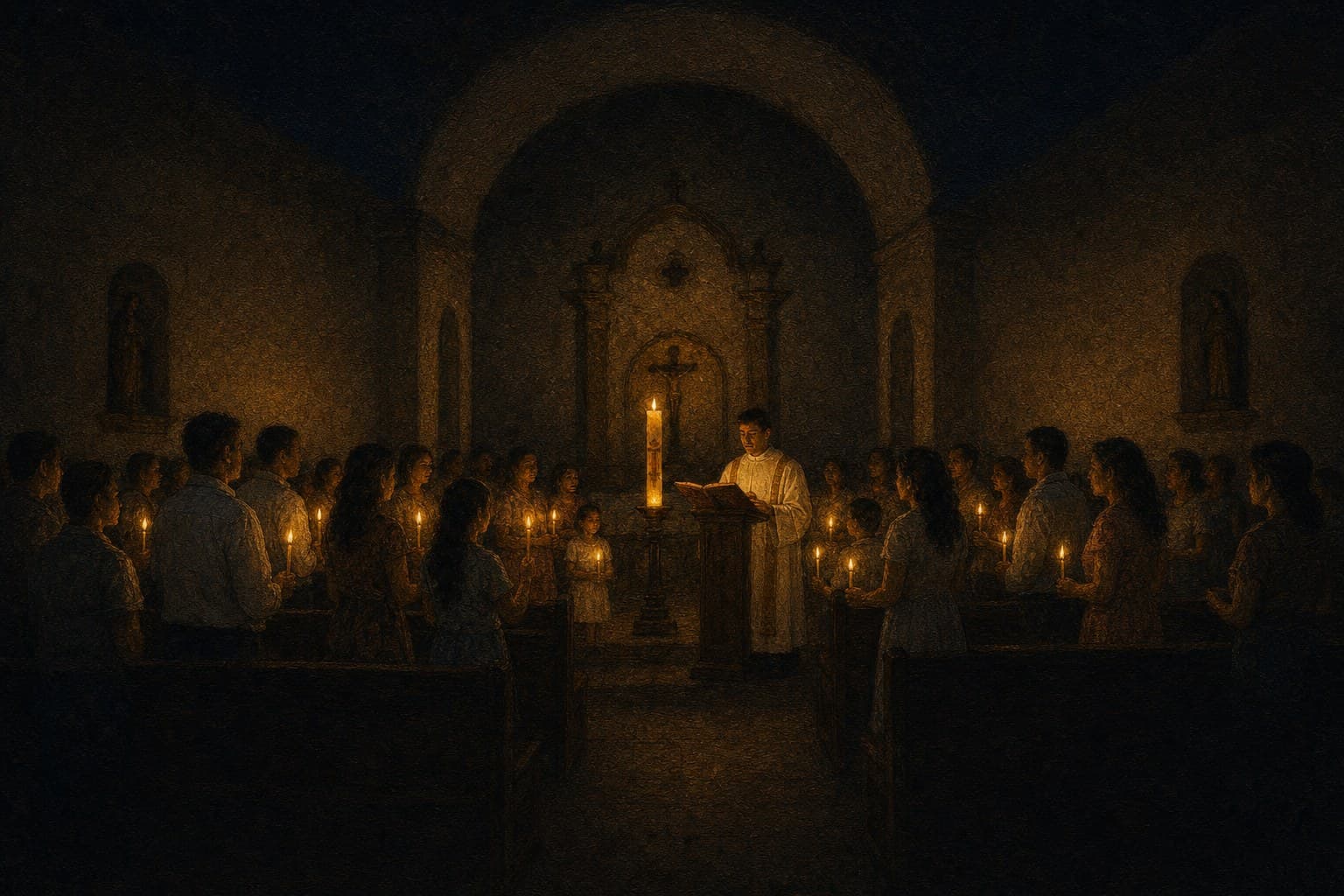
The Vigil opens in the dark. A fire is blessed outside the church and the paschal candle is lit from it; the deacon carries the candle in, singing three times “The Light of Christ,” while its flame is passed from hand to hand until the whole church holds small lights. Then, beside the candle on its stand, he sings the Exsultet. Without a deacon, the priest sings it, and if he cannot, a cantor. It is a song of praise built like the preface of the Mass: it calls heaven, earth and the Church to rejoice, tells the story of the Passover from Egypt to the empty tomb, and offers the candle to God as a pillar of fire for the night.
Exsultet or Exultet? Both. Editions of the Roman Missal before about 1920 spell it Exultet, as the 1875 book on this page does, and today’s Missal has Exsultet. The English printed here is one of the older translations, which is what many people mean when they look for the old version of the Exsultet; the Missal used in parishes today has its own newer English. In the old English, “the Levites” are the deacons, the “emblematic taper” is the paschal candle, and “meet” means right and fitting.
What the Exsultet says, part by part
2 min readThe Exsultet moves in four steps, and knowing them makes the long chant easy to follow by candlelight.
The Exsultet moves in four steps, and knowing them makes the long chant easy to follow by candlelight.
- The call to rejoice. Angels, the earth and the Church are told to exult because their King has won. The deacon then asks the people to pray that he may sing the candle’s praise worthily.
- The thanksgiving. After the dialogue of the preface, “Lift up your hearts,” the song thanks the Father and the Son, who paid Adam’s debt with his blood and is the true Passover Lamb.
- This is the night. Five times the hymn says it: the night of the Red Sea, of the pillar that drove away the dark, of the baptized set free from sin, of Christ breaking the chains of death, and the night foretold in the psalm, “night shall be light as day” (Psalm 138:12). Between them stand the felix culpa and the blessed night that alone knew the hour of the Resurrection.
- The candle offered. The candle is offered as an evening sacrifice made by the work of bees, a flame that loses nothing when it is shared. The hymn prays that it may burn all night until the morning star finds it, the star that never sets, Christ risen; then it prays for the Church and her pastors.
“O happy fault”: the felix culpa explained
2 min read“O happy fault that merited such and so great a Redeemer!” is the most famous line of the Exsultet.
“O happy fault that merited such and so great a Redeemer!” is the most famous line of the Exsultet. In Latin it is O felix culpa, and the line just before it is bolder still: “O truly necessary sin of Adam, which the death of Christ has blotted out!”
The Church is not calling sin good. Adam’s sin was a real loss, and a few lines earlier the hymn calls it a debt that Christ paid and a guilt his blood cancelled. The joy is in what God made of it. Saint Paul gives the rule: “And where sin abounded, grace did more abound” (Romans 5:20). When the Catechism asks why God did not prevent the first sin, it answers with Saint Leo the Great and Saint Thomas Aquinas, and Thomas cites this very line of the Exsultet: God allows evil only to bring a greater good out of it, and here the greater good is the Redeemer himself (CCC 412).
“Rose again from hell.” Three times the 1875 English says that Christ came back “from hell,” where newer translations say the underworld. The Latin ab inferis means the realm of the dead, the hell of the Creed’s “he descended into hell”: the Catechism explains that Scripture gives this name to the abode of the dead, where the just who died before Christ waited for him (CCC 633). He went there, the Catechism adds, not to set the damned free but “to free the just who had gone before him” (CCC 633), and the night proclaims that he has come back from there as victor.
The Exsultet in Latin
4 min readThe Latin given here is the text of the Roman Missal before Pope Pius XII reformed Holy Week in the 1950s, printed as the 1875 book has it beside its English.
The Latin given here is the text of the Roman Missal before Pope Pius XII reformed Holy Week in the 1950s, printed as the 1875 book has it beside its English. Today’s Missal keeps the hymn with some changes; among them, the five grains of incense are no longer fixed in the candle during the song, and the old prayer for the Emperor, which the 1875 book already leaves out, gave way to a prayer for those who govern.
Exultet jam angelica turba cœlorum: exultent divina mysteria; et pro tanti regis victoria, tuba insonet salutaris. Gaudeat et tellus tantis irradiata fulgoribus; et æterni regis splendore illustrata, totius orbis se sentiat amisisse caliginem. Lætetur et mater Ecclesia tanti luminis adornata fulgoribus: et magnis populorum vocibus hæc aula resultet.
Quapropter adstantes vos, fratres clarissimi, ad tam miram hujus sancti luminis claritatem, una mecum, quæso, Dei omnipotentis misericordiam invocate. Ut qui me non meis meritis intra Levitarum numerum dignatus est aggregare, luminis sui claritatem infundens, cerei hujus laudem implere perficiat. Per Dominum nostrum Jesum Christum Filium suum: qui cum eo vivit et regnat in unitate Spiritus sancti Deus, per omnia sæcula sæculorum.
R. Amen.
V. Dominus vobiscum.
R. Et cum spiritu tuo.
V. Sursum corda.
R. Habemus ad Dominum.
V. Gratias agamus Domino Deo nostro.
R. Dignum et justum est.
Vere dignum et justum est, invisibilem Deum Patrem omnipotentem, Filiumque ejus unigenitum, Dominum nostrum Jesum Christum, toto cordis ac mentis affectu, et vocis ministerio personare. Qui pro nobis æterno Patri, Adæ debitum solvit; et veteris piaculi cautionem pio cruore detersit. Hæc sunt enim festa Paschalia, in quibus verus ille Agnus occiditur, cujus sanguine postes fidelium consecrantur.
Hæc nox est, in qua primum patres nostros filios Israel eductos de Ægypto, Mare Rubrum sicco vestigio transire fecisti. Hæc igitur nox est, quæ peccatorum tenebras, columnæ illuminatione purgavit. Hæc nox est, quæ hodie per universum mundum, in Christo credentes, a vitiis sæculi, et caligine peccatorum segregatos reddit gratiæ, sociat sanctitati.
Hæc nox est, in qua destructis vinculis mortis, Christus ab inferis victor ascendit. Nihil enim nobis nasci profuit, nisi redimi profuisset. O mira circa nos tuæ pietatis dignatio! O inæstimabilis dilectio charitatis! ut servum redimeres, filium tradidisti. O certe necessarium Adæ peccatum, quod Christi morte deletum est! O felix culpa, quæ talem ac tantum meruit habere Redemptorem! O vere beata nox, quæ sola meruit scire tempus et horam, in qua Christus ab inferis resurrexit! Hæc nox est, de qua scriptum est: Et nox sicut dies illuminabitur; et nox illuminatio mea in deliciis meis. Hujus igitur sanctificatio noctis fugat scelera culpas lavat, et reddit innocentiam lapsis, et mœstis lætitiam. Fugat odia, concordiam parat, et curvat imperia.
In hujus igitur noctis gratia, suscipe, sancte Pater, incensi hujus sacrificium vespertinum, quod tibi in hac cerei oblatione solemni, per ministrorum manus, de operibus apum, sacrosancta reddit Ecclesia. Sed jam columnæ hujus præconia novimus, quam in honorem Dei rutilans ignis accendit. Qui licet sit divisus in partes, mutuati tamen luminis detrimenta non novit. Alitur enim liquantibus ceris, quas in substantiam pretiosæ hujus lampadis, apis mater eduxit.
O vere beata nox, quæ expoliavit Ægyptios, ditavit Hebræos! Nox in qua terrenis cœlestia, humanis divina junguntur. Oramus ergo te, Domine, ut cereus iste in honorem tui nominis consecratus, ad noctis hujus caliginem destruendam, indeficiens perseveret; et in odorem suavitatis acceptus, supernis luminaribus misceatur. Flammas ejus lucifer matutinus inveniat. Ille, inquam, lucifer, qui nescit occasum. Ille, qui regressus ab inferis, humano generi serenus illuxit.
Precamur ergo te, Domine: ut nos famulos tuos, omnemque clerum, et devotissimum populum, una cum beatissimo Papa nostro N., et Antistite nostro N., quiete temporum concessa, in his Paschalibus gaudiis, assidua protectione regere, gubernare, et conservare digneris. Per eundem Dominum nostrum Jesum Christum Filium tuum: qui tecum vivit et regnat in unitate Spiritus sancti Deus, per omnia sæcula sæculorum.
R. Amen.
One sentence of the Latin has no English in the 1875 book, “Nihil enim nobis nasci profuit, nisi redimi profuisset,” which means that being born was of no profit to us, unless being redeemed had profited us too. It belongs just before “O how admirable is thy goodness towards us!” In its last line the book prints “per omni sæcula,” a slip for “omnia,” corrected here.
Where the Exsultet comes from
2 min readNobody knows who wrote the Exsultet.
Nobody knows who wrote the Exsultet. Deacons were blessing the Easter candle with songs of praise by the fourth century: around 384 a deacon named Presidius asked Saint Jerome to write him one, and Saint Augustine mentions in The City of God that he had composed a praise of the candle in verse. Tradition has long linked the Exsultet with Saint Ambrose of Milan, and the Catholic Encyclopedia reports good grounds for thinking that the Easter proclamation of his Milanese rite is his in substance, or built on hymns of his; whether the Roman text owes him anything is not known.
The Roman text is younger. From the rhythm of its Latin prose the same encyclopedia placed it between the fifth and the seventh centuries, and its oldest copies are in three books from Gaul: the Bobbio Missal of the seventh century, and the Missale Gothicum and Missale Gallicanum Vetus of the eighth. From Gaul it passed into the Roman books through a supplement to the sacramentary loosely called Pope Adrian’s, probably drawn up under Alcuin. In Italy deacons sang it from Exultet rolls, long parchment scrolls painted with pictures and unrolled as they sang; the finest date to the tenth and eleventh centuries.
Back to the night. Over the centuries the Vigil drifted earlier, to Saturday afternoon and then to Saturday morning, so that “This is the night” was sung in broad daylight. Pope Pius XII revised the Vigil in 1951, and today the Church asks that the whole celebration take place in darkness, beginning after nightfall and ending before dawn on Sunday.
How to keep Holy Saturday and pray the Exsultet at home
2 min readHoly Saturday is the quietest day of the Church’s year: no Mass is celebrated, and the Church keeps watch by the Lord’s tomb with prayer and fasting until the Vigil.
Holy Saturday is the quietest day of the Church’s year: no Mass is celebrated, and the Church keeps watch by the Lord’s tomb with prayer and fasting until the Vigil. A few ways to keep it:
- Keep the fast going from Good Friday until the Vigil if you can. It is not required, but it is an old custom, and the hunger makes the night’s feast mean more.
- Read the Exsultet in the afternoon, slowly and aloud, with your family, so that its images are already familiar when you hear it sung in the dark. One voice reads and everyone answers the R. lines. A lay reader skips the deacon’s own request, from “Wherefore, beloved brethren” through “And with thy spirit,” and goes straight on to “Lift up your hearts,” just as the Missal has a lay cantor do; where the text says “N.”, name the Pope and your bishop.
- Go to the Vigil after nightfall, and bring the children if you can. It counts for Easter Sunday, since a Mass on the evening before a feast fulfills the obligation (canon 1248).
- If you cannot go, because of illness, age or distance, light one candle at home after dark, read the Exsultet by its light, and then pray the prayer from the app in the next chapter. It is not the Vigil, and no one asks it to be: illness, the care of small children or another serious reason excuses you from Mass at Easter (CCC 2181), and your prayer at home that night is joined to the whole Church keeping watch. Ask your parish, too, to bring you Holy Communion during the Easter octave.
- Bring Easter water home. The water blessed at the Vigil serves the whole year: many families bless the Easter meal with it; see the holy water blessing.
At the Vigil you renew your baptismal promises, renouncing Satan and professing the faith the Apostles’ Creed puts into words, and the priest sprinkles everyone with the new water. The fifty days that follow lead to Pentecost, when the whole Church prays Come, Holy Spirit. The dates of the season are on the Easter page; for the Friday before, see Good Friday prayers.
A prayer for the Easter Vigil, from the AngelGuard app
3 min readThe AngelGuard app’s meditation for the Easter Vigil, about thirty minutes long, walks through the four parts of the night and closes with the prayer that follows.
The AngelGuard app’s meditation for the Easter Vigil, about thirty minutes long, walks through the four parts of the night and closes with the prayer that follows. It is printed here as the app prays it, with one line left out (see the note after it). Pray it on the night itself, before or after the Vigil, or on any day of the Easter season.
Lord Jesus Christ, Light of the World, who on this night of all nights broke the chains of death and rose victorious from the underworld — I come to keep watch with the Church.
Forty days have led me to this hour. I have walked with You through the desert. I have stood with You in the upper room. I have followed You to the foot of the Cross. I have kept silence with Your Mother on Holy Saturday.
And now, in the dark of this night, I light my candle from the new fire, and I lift my voice with the deacon — Lumen Christi, Deo Gratias. The Light of Christ. Thanks be to God.
Haec nox est.
This is the night.
This is the night You led Your people through the Red Sea.
This is the night You rolled back the stone.
This is the night You raised, in Your own body, the body of every soul You have ever loved.
Felix culpa — O happy fault that gained me so great a Redeemer.
Renew in me, Lord, the grace of my own baptism. Renew in me the renunciation of Satan and all his works. Renew in me the profession of the Apostles’ Creed.
Drown the old man in the waters of this font. Raise up the new man in the dawn that is coming.
Fill the lamp of my soul with the same fire that the deacon carries into the dark church tonight, that I may walk through this Easter season — and every season after — bearing Your light into rooms that have never seen it.
Holy Mary, Mother of God, who kept the silent vigil of Holy Saturday with a faith no one but you possessed in those hours, pray for us.
Saint Mary Magdalene, who came first to the tomb in the dark, pray for us.
Saint Peter, who ran with John to the empty grave, pray for us.
All you saints baptized at this vigil across nineteen centuries — saints we know and saints we have never heard of — pray for us.
Christus heri et hodie. Principium et finis. Alpha et Omega. Ipsius sunt tempora et saecula. Ipsi gloria et imperium per universa aeternitatis saecula. Amen.
Amen.
Through Christ our Risen Lord. Amen.
In the name of the Father, and of the Son, and of the Holy Spirit. Amen.
The Latin near the end is the acclamation the priest says as he marks the paschal candle with a cross, the letters Alpha and Omega and the figures of the year. The app follows it with an English version largely taken from the Missal’s current translation, so that line is left out here. In plain words the Latin says: Christ, yesterday and today, Beginning and End, Alpha and Omega; his are the times and ages; glory and dominion are his through every age of eternity. Amen. The Letter to the Hebrews says it in one line: “Jesus Christ, yesterday, and today; and the same for ever” (Hebrews 13:8).
Close: A prayer for the Easter Vigil, from the AngelGuard app
Questions
What does the word “exsultet” mean?
“Exsultet” is Latin for “let it exult,” or “let it rejoice.” It is the first word of the Easter Proclamation, which opens by calling the angels of heaven to rejoice: “Exultet jam angelica turba cœlorum,” in the 1875 English “Let now the heavenly troop of angels rejoice.” Like many Latin prayers, the hymn is named after that word.
Who sings the Exsultet?
The deacon, standing beside the paschal candle. If the parish has no deacon, the priest sings it, and if he is unable to, a cantor may.
When is the Exsultet sung?
Near the start of the Easter Vigil, after the procession with the paschal candle and before the readings. In 2027 the Vigil is held after nightfall on Saturday, March 27; the Exsultet is not sung on any other night of the year.
What do I do on Holy Saturday?
Keep watch and wait. No Mass is said during the day while the Church stays by the tomb of the Lord, and many Catholics carry the Good Friday fast on to the Vigil, pray quietly at home and read the Exsultet before dark. After nightfall the Easter Vigil begins, the greatest night of the Church’s year.
What are the four parts of the Easter Vigil?
The service of light, the Liturgy of the Word, the baptismal liturgy and the Liturgy of the Eucharist. The service of light ends with the Exsultet; the Liturgy of the Word has up to seven Old Testament readings before the Epistle and the Gospel; the baptismal liturgy brings baptisms and the renewal of baptismal promises; and the Eucharist is the high point of the night.
What is the old version of the Exsultet?
Usually the Latin of the Roman Missal before the Holy Week reform of the 1950s, or one of the English translations made from it, like the 1875 version on this page. The Missal used today keeps the same hymn in Latin, with some changes, and has a new English translation.
What does “O happy fault” mean?
It is the Exsultet’s cry over Adam’s sin, O felix culpa: a fault called happy not because sin is good, but because God answered it with a Redeemer greater than anything lost. Saint Paul puts it this way: “where sin abounded, grace did more abound” (Romans 5:20).
Does the Easter Vigil count for Easter Sunday Mass?
Yes. The Vigil is the Mass of Easter night, and Church law counts a Mass on the evening before a Sunday or feast toward the obligation (canon 1248). Going to the Vigil on Holy Saturday night therefore fulfills the duty to attend Mass on Easter Sunday.
Keep praying
- The Apostles’ Creed: the Prayer in Full, Article by ArticleI believe in God, the Father Almighty: the Creed in its traditional Catholic words, what each article means, where it comes from, and the Latin
- Holy Water Prayer for Protection and BlessingBless and use holy water
- Come, Holy Spirit: the Prayer to the Holy Spirit in FullEach line explained, where it comes from, the Latin Veni Sancte Spiritus, and when Catholics pray it
A traditional Catholic prayer · Roman Missal; English from a Holy Week book of 1875
Feast
Sts. Simon and Jude
See the full liturgical calendar — every feast this year, and an embed for your parish site.