Prayer · Sleep & Peace
Prayers of Gratitude to God
Counting blessings instead of worries
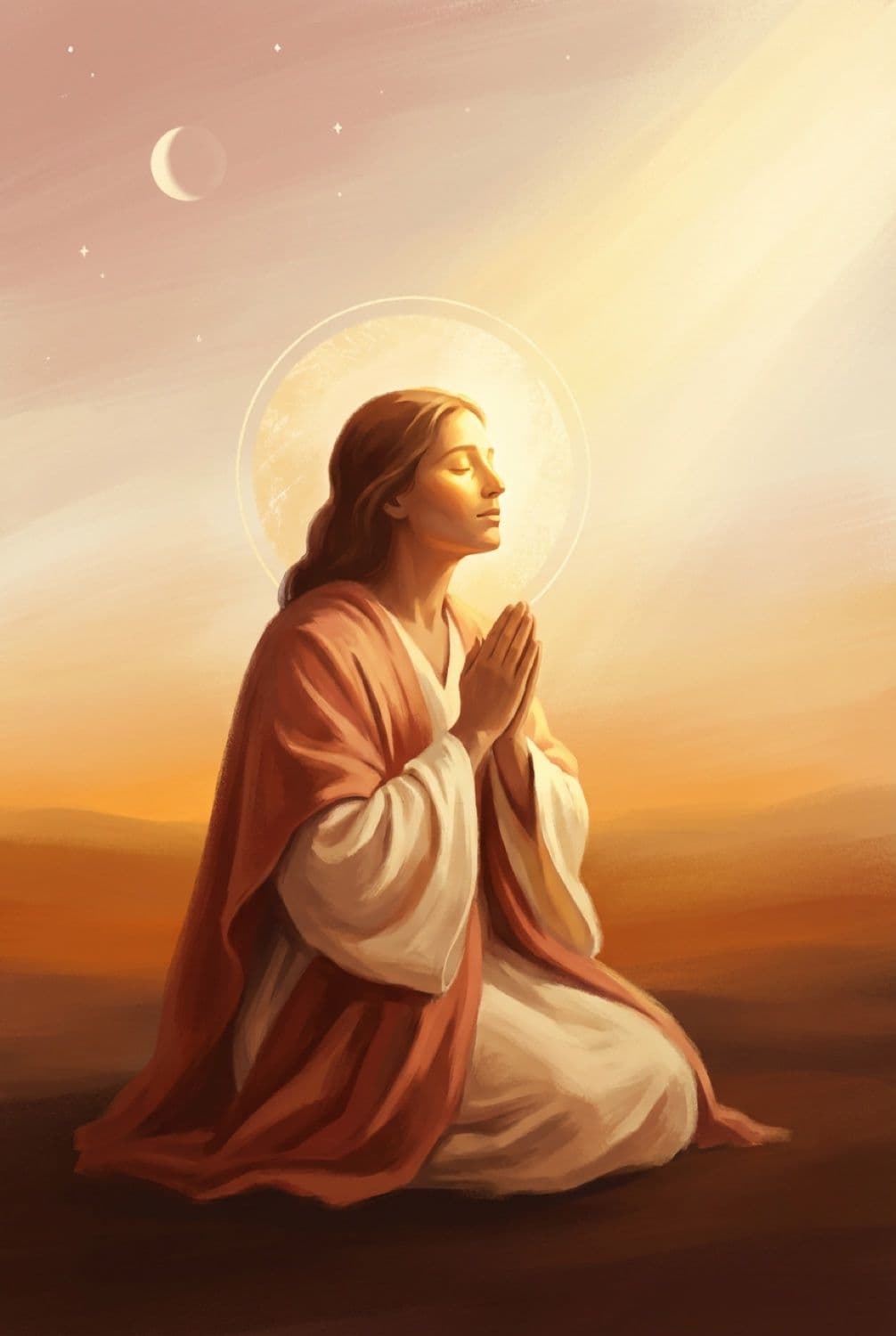
A short prayer of gratitude to God: “Lord, thank you. For my life and my breath, for the people who love me, for the food on my table, for your mercy when I fail, and for the good things I did not notice today. Everything I have comes from you. Let me live today as someone who knows it. Amen.” The psalm to pray it with is Psalm 107:1: “Give thanks to the LORD, for he is good, for his loving kindness endures forever.” In Catholic teaching, thanksgiving is one of the basic forms of prayer, and “every event and need can become an offering of thanksgiving” (CCC 2638). Below: short prayers of gratitude, a longer one, a Catholic prayer of thanks, a daily habit, and the prayer of gratitude before sleep.
Lord, tonight I choose gratitude over worry. Instead of counting the things that went wrong, I want to count the things that went right. Instead of listing my problems, I want to list Your blessings.
"Give thanks to the Lord, for he is good, for his loving kindness endures forever." — Psalm 136:1
THANK YOU FOR TODAY'S BREAD:
I ate today, Lord. I had food on my table. While millions go to bed hungry tonight, I go to bed nourished. I do not take this for granted. Thank You.
THANK YOU FOR TODAY'S BREATH:
Every breath I took today was a gift from You. My heart beat roughly 100,000 times without me having to think about it. My lungs expanded and contracted effortlessly. The miracle of being alive — thank You, Lord.
THANK YOU FOR TODAY'S PEOPLE:
Someone smiled at me today. Someone listened. Someone cared. Even if the day was difficult, there was a human connection that mattered. And behind every kind act, Your love was at work.
THANK YOU FOR TODAY'S GRACE:
I sinned today, and You forgave me. I fell short, and You did not reject me. I forgot about You for hours, and when I remembered, You were still there — patient, faithful, unchanged.
THANK YOU FOR TONIGHT'S BED:
A warm place to sleep. A pillow for my head. A blanket against the cold. Lord, these simple comforts are extraordinary gifts that I so easily take for granted.
THANK YOU FOR TOMORROW'S PROMISE:
I do not know what tomorrow holds, but I know it holds Your mercies — new, fresh, waiting for me like unopened gifts. Whatever challenges come, Your grace will be sufficient.
Lord, if I were to count every blessing, I would never finish. So let me simply say: thank You. For everything. You are good, Lord. Endlessly, relentlessly good.
I go to sleep grateful. Amen.
Go deeper
Short prayers of gratitude
1 min readGratitude does not need many words.
Gratitude does not need many words. The shortest prayer of thanks in the Catholic tradition is the one the congregation answers at Mass after the readings before the Gospel, and again at the dismissal: “Thanks be to God,” in Latin Deo gratias. These are short enough to say at any moment the day gives you a reason:
Thanks be to God.
Thank you, Lord, for this day and everything in it.
Lord, all good things come from you. Thank you.
I will give thanks to the LORD with my whole heart.
Now therefore, our God, we thank you and praise your glorious name.
The last two are Psalm 9:1 and the prayer King David spoke over the gifts for the Temple (1 Chronicles 29:13), which goes on to say what every prayer of gratitude comes back to: “For all things come from you, and we have given you of your own.”
A prayer of gratitude to God
2 min readA longer prayer of thanks works best when it is specific.
A longer prayer of thanks works best when it is specific. Psalm 103 does it by listing: God forgives, heals, redeems, crowns, satisfies. “Praise the LORD, my soul, and don’t forget all his benefits.” This prayer follows the same pattern; add your own list where it pauses.
Father, I thank you.
For my life, which I did not make,
and for every breath of it today.
For the people you have given me: (name them).
For the food on my table and the roof over my head.
For my work, and for the rest that follows it.
For the beauty of the world, and the small joys I almost missed.
For your forgiveness, which I did not earn,
and for your patience with me when I forget you.
For your Son, who gave his life for me,
and for your Spirit, who keeps me close to you.
For the good things I cannot see yet,
and the troubles you kept from me without my knowing.
Everything I have is a gift.
Let me live like someone who knows it.
Amen.
St. Paul asks a question that turns gratitude from a mood into a way of seeing: “And what do you have that you didn’t receive?” (1 Corinthians 4:7). And St. James answers it: “Every good gift and every perfect gift is from above, coming down from the Father of lights” (James 1:17).
A Catholic prayer of gratitude: the Mass as thanksgiving
2 min readFor Catholics, the greatest prayer of gratitude is not a private prayer at all.
For Catholics, the greatest prayer of gratitude is not a private prayer at all. The word Eucharist comes from the Greek for thanksgiving, and the Catechism says so directly: “The Eucharist is a sacrifice of thanksgiving to the Father, a blessing by which the Church expresses her gratitude to God for all his benefits,” and “Eucharist means first of all ‘thanksgiving’” (CCC 1360). The Church’s thanksgiving is Christ’s own: “the thanksgiving of the members of the Body participates in that of their Head” (CCC 2637). Every Mass is a prayer of gratitude, and the most natural time for a personal one is the quiet after Communion:
Lord Jesus, you have come to me,
and I have nothing to give you that you did not first give me.
Thank you for this Communion,
for your Body given for me,
for your mercy in this Mass,
and for the people kneeling around me who received you too.
Stay with me today.
Let everything I do be a thank-you.
Amen.
Mary’s Magnificat is the Church’s other great prayer of thanks, and the Catechism holds it up as the model: to adore God is to confess “with gratitude that he has done great things and holy is his name” (CCC 2097). It is prayed every evening in the Church’s Evening Prayer.
A daily prayer of gratitude
1 min readGratitude is a habit before it is a feeling.
Gratitude is a habit before it is a feeling. St. Ignatius of Loyola made thanks the first step of his daily examination of conscience: its first point “is to give thanks to God our Lord for the benefits received” (Spiritual Exercises §43). Only then does it look at sins. Starting with gifts before faults changes how the whole day looks.
A simple daily form: once a day, at the same time, name three things from the last twenty-four hours you are grateful for, as specifically as you can (“the phone call from my sister,” not “my family”), and thank God for each. Then pray:
Lord, thank you for today:
for (first), for (second), for (third).
I did not deserve them and I did not make them.
Open my eyes tomorrow to the gifts I walk past.
Amen.
The full evening form of Ignatius’s prayer, with the review of the day that follows the thanks, is on the evening examination of conscience. For the same habit at the start of the day, see the morning prayer of gratitude.
A prayer of gratitude before sleep
1 min readThe longer prayer at the top of this page is a prayer of gratitude for bedtime: counting blessings instead of worries, the bread, the breath, the people and the grace of one ordinary day.
The longer prayer at the top of this page is a prayer of gratitude for bedtime: counting blessings instead of worries, the bread, the breath, the people and the grace of one ordinary day. It is the right prayer for a night when the mind wants to replay what went wrong. Psalm 92 says gratitude belongs at both ends of the day, to proclaim God’s loving kindness “in the morning, and your faithfulness every night.” A shorter one for the pillow:
Thank you, Lord, for this day.
For what went well, thank you.
For what went wrong, forgive me, and bring good out of it.
For the people I love, keep them tonight.
In peace I will both lay myself down and sleep, for you alone, LORD, make me live in safety.
Amen.
That line is Psalm 4:8. More night prayers are in releasing the day to God.
A prayer of thanksgiving for answered prayer
1 min readWe are quick to ask and slow to thank.
We are quick to ask and slow to thank. The Gospel story everyone remembers on this is the ten lepers, of whom one came back (Luke 17:11–19); it is told, with Christ’s own prayers of thanks, in the Bible verses about gratitude. When a prayer is answered, go back and say so:
Lord, I asked you for (name it),
and you heard me.
Thank you.
I will not forget what you have done.
Let me tell someone else, so that they will trust you too.
And when my next prayer is answered differently from how I asked,
let me remember this one.
Amen.
“What will I give to the LORD for all his benefits toward me?” (Psalm 116:12). The psalmist’s answer, in the next verse, is to lift the cup of salvation and call on the name of the Lord: the answer of the Mass.
A prayer of gratitude when life is hard
1 min readThe hardest prayer of gratitude is the one said on a bad day, and Scripture does not ask anyone to be thankful that something terrible happened.
The hardest prayer of gratitude is the one said on a bad day, and Scripture does not ask anyone to be thankful that something terrible happened. The Catechism puts it carefully: “Every joy and suffering, every event and need can become the matter for thanksgiving which, sharing in that of Christ, should fill one’s whole life” (CCC 2648). Christ gave thanks at the Last Supper, on the night he was betrayed. Gratitude in hard times is not denial; it is refusing to let the hard thing be the only thing. The Scripture for those days is gathered in Bible verses about gratitude, including “In everything give thanks.”
Lord, today I find it hard to thank you.
But I will look for one thing,
and thank you for that one thing.
(Name it, however small.)
You are still good, even when my life is not easy.
Help me believe it tomorrow, if I cannot tonight.
Amen.
If what you are carrying is grief or despair rather than a bad day, there are prayers for that on prayer for grief.
A prayer of gratitude for the people in my life
1 min readSt. Paul thanked God for people constantly.
St. Paul thanked God for people constantly. His letters open with it: “I thank my God whenever I remember you” (Philippians 1:3). Gratitude for people is the kind most often felt and least often said.
Lord, thank you for the people you have put in my life:
for my family, with all our faults;
for my friends, who choose me;
for the teachers, priests and strangers who helped me along the way;
for the ones I have lost, whom I still thank you for.
Bless each of them today.
And give me the grace to tell one of them, today, that I am grateful.
Amen.
What a prayer of gratitude is, and how to write your own
2 min readThe Catechism names the basic forms of Christian prayer: blessing and adoration, petition, intercession, thanksgiving and praise.
The Catechism names the basic forms of Christian prayer: blessing and adoration, petition, intercession, thanksgiving and praise. Thanksgiving thanks God for what he has done: “As in the prayer of petition, every event and need can become an offering of thanksgiving” (CCC 2638). Praise goes one step further; it “lauds God for his own sake and gives him glory, quite beyond what he does, but simply because HE IS” (CCC 2639). A prayer of gratitude usually moves from the first to the second: from thanks for the gifts to praise of the Giver.
To write your own prayer of gratitude:
- Name the gift, specifically. Not “my blessings” but this person, this meal, this recovery.
- Name the Giver. Say plainly that it came from God, even if it came through people.
- Say what it meant. One sentence on why it mattered to you.
- Give something back. A resolution: to tell the person, to share, to use the gift well.
- End with praise, thanking God not only for what he gave but for who he is.
St. Paul’s instruction to the Colossians could be the rule for the whole day: “Whatever you do, in word or in deed, do all in the name of the Lord Jesus, giving thanks to God the Father through him.” (Colossians 3:17). And to the Ephesians: “giving thanks always concerning all things in the name of our Lord Jesus Christ to God, even the Father” (Ephesians 5:20).
Questions
What is a short prayer of gratitude?
“Thank you, Lord, for this day and everything in it.” Or the answer said at Mass after the readings: “Thanks be to God.” Psalm 107:1 is a whole prayer of gratitude in one verse: “Give thanks to the LORD, for he is good, for his loving kindness endures forever.”
What is a powerful prayer of gratitude?
A specific one. Name the gifts one by one, as Psalm 103 does, and say where they came from: “Father, thank you for my life, for (name the people), for my daily bread, for your forgiveness, and for the good things I cannot see yet. Everything I have is a gift. Amen.” Its power is not in the words but in what it does to the one praying: it teaches the heart to notice.
What is a prayer of gratitude to God?
A prayer that thanks God for what he has given and done, as distinct from asking him for something. The Catechism counts thanksgiving among the basic forms of prayer and says “every event and need can become an offering of thanksgiving” (CCC 2638). The greatest Catholic prayer of gratitude is the Mass; “Eucharist means first of all ‘thanksgiving’” (CCC 1360).
How do you express gratitude in prayer?
Be specific, name the Giver, and give something back. Name each gift (a person, a meal, a recovery), thank God for it by name, say what it meant, and resolve to share it or use it well. St. Ignatius began his daily prayer by giving thanks “for the benefits received” before anything else.
What is a Catholic prayer of gratitude?
The Mass itself, whose name, Eucharist, means thanksgiving (CCC 1360). Outside Mass, Catholics give thanks after Communion, in grace before and after meals, with “Thanks be to God” (Deo gratias), with Mary’s Magnificat, and in the first step of the daily examen.
What is a daily prayer of gratitude?
Once a day, name three specific things from the last twenty-four hours and thank God for each: “Lord, thank you for (first), for (second), for (third). Open my eyes tomorrow to the gifts I walk past. Amen.” Done every day, it changes what you notice.
What is the difference between thanksgiving and praise?
Thanksgiving thanks God for what he has done. Praise, the Catechism says, “lauds God for his own sake and gives him glory, quite beyond what he does, but simply because HE IS” (CCC 2639). A good prayer of gratitude usually moves from one to the other.
How can I be grateful when life is hard?
By giving thanks in the hard thing rather than for it. Look for one small good and thank God for that. The Catechism says “every joy and suffering” can become matter for thanksgiving (CCC 2648), and Christ gave thanks on the night he was betrayed. Gratitude does not deny the pain; it refuses to let it be the only thing.
Its morning pair: morning gratitude — thanks before the day asks anything of you.
For Scripture to count your blessings with: Bible verses about gratitude — thanksgiving as a practice, not a mood.
Pray next
 Night Prayer for ProtectionPlace your household under God’s watch before you sleep.
 Psalm 91 — The Prayer of Protection“He who dwells in the secret place of the Most High will rest in the shadow of the Almighty” (Psalm 91:1).
 A Prayer Against Nightmares and Bad DreamsFor peaceful sleep under God’s protection — when the night brings fear, disturbing dreams, or a child who is afraid of the dark.
 Into Your Arms TonightReleasing the day and resting in God's embrace
 Calming the Storm WithinFinding stillness when anxiety keeps you awake
 A Lullaby from the FatherGod singing over you as you fall asleep
Upcoming · Sep 29
Sts. Michael, Gabriel and RaphaelSee the full liturgical calendar — every feast this year, and an embed for your parish site.