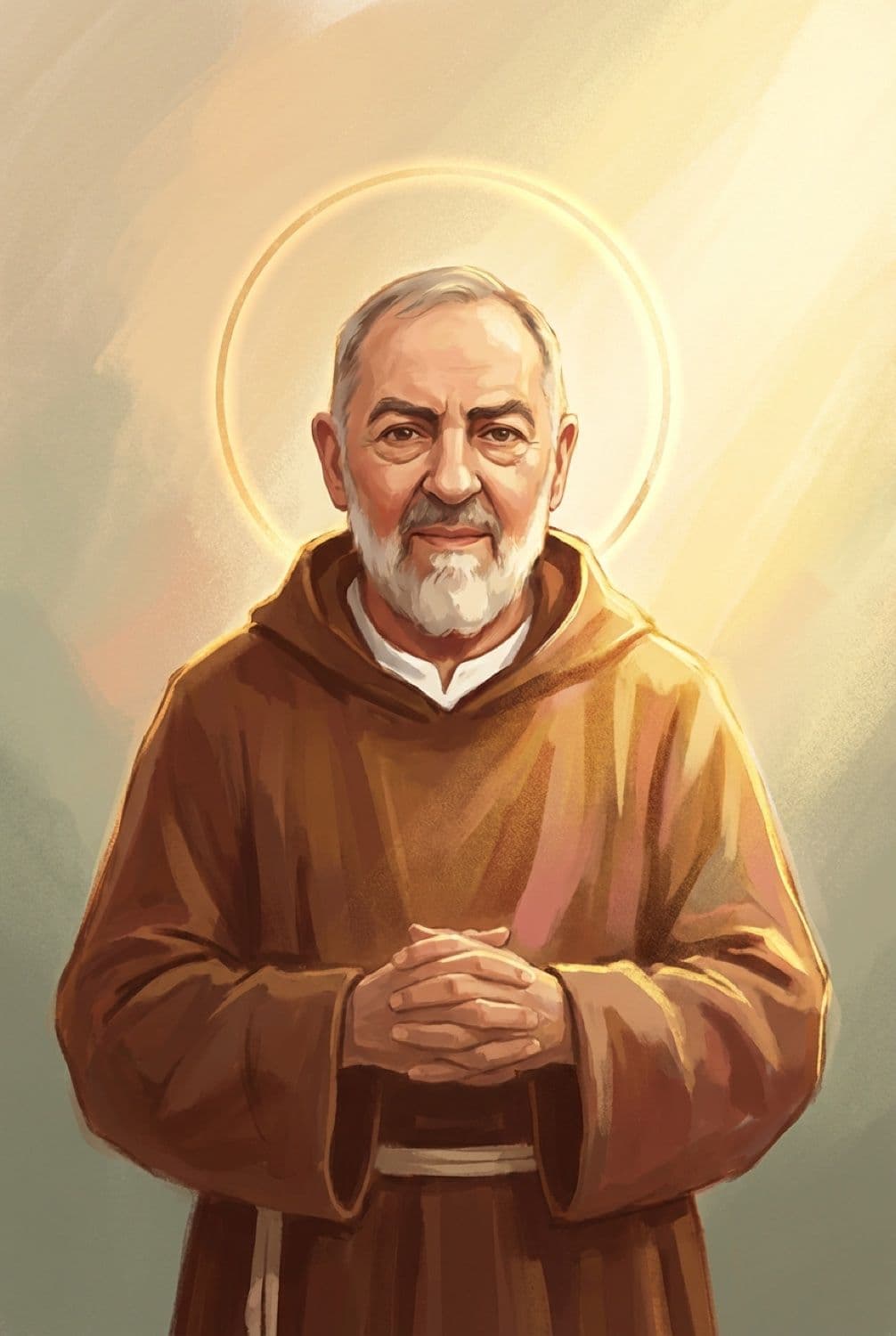
Prayer · Saints & Angels
Padre Pio Prayers: “Stay with Me, Lord” and a Prayer to St. Pio
Pray, hope, and don't worry
The prayer most associated with Padre Pio (St. Pius of Pietrelcina, 1887–1968) is “Stay with me, Lord,” the prayer he said after Holy Communion. It begins: “Stay with me, Lord, for it is necessary to have You present so that I do not forget You. Stay with me, Lord, because I am weak and I need Your strength, that I may not fall so often.” People also ask his intercession, especially for healing, with a prayer like this: “St. Pio of Pietrelcina, you who bore the wounds of Christ and spent your life in the confessional and at the altar, pray for me. Ask Jesus to heal me in body and soul, if it is his will, and to give me the grace to pray, hope, and not worry. Amen.” His feast is September 23. Below: “Stay with me, Lord” explained, a prayer to Padre Pio for healing, a daily prayer, the truth about the “prayer that never fails,” and his life in brief.
In the name of the Father, and of the Son, and of the Holy Spirit.
Saint Pio of Pietrelcina, our beloved Padre Pio, you who carried the wounds of Christ in your own flesh for fifty years, you who heard millions of confessions, you who could see into souls and read hearts, you who interceded for so many that the world is still asking you for help, intercede for me tonight.
You were born in southern Italy in eighteen eighty-seven. You were a Capuchin friar. You bore the stigmata, the visible wounds of Christ, from nineteen eighteen until your death in nineteen sixty-eight. You suffered constantly, slept little, prayed always. And from your suffering came an outpouring of grace for thousands of pilgrims who came to you at the monastery of San Giovanni Rotondo.
You said, Pray, hope, and don't worry. Three commands. Each one harder than it sounds.
Pray. Not just say words. Not just go through routines. Actually communicate with God. Bring Him your day. Bring Him your worries. Bring Him your love. Pray.
Hope. Hope hard. Even when the situation looks dark. Even when prayer seems unanswered. Even when faith is weak. Hope. The opposite of hope is not doubt. The opposite of hope is despair, and despair is the only sin God cannot forgive, because despair refuses to ask for forgiveness.
Don't worry. The hardest of all. Worry is woven into me. The future scenarios. The what-ifs. The replays of the past. You said, Don't worry. Cast all your anxiety on Him because He cares for you, as Saint Peter wrote.
Padre Pio, teach me these three things. Pray. Hope. Don't worry.
Padre Pio, you had the gift of bilocation. You could be in two places at once. People reported seeing you in their hospital rooms when you were known to be in your monastery. You appeared in dreams. You appeared at deathbeds. You appeared to soldiers in foxholes during the war.
I do not need a vision tonight. I just need to know you are praying for me. Across the bridge of heaven, across the centuries, you can intercede now as truly as you did in life. Pray for me, Padre Pio.
Pray for the people I have brought to you in my prayers. The names I have spoken. The intentions I have asked you to carry. Take them with you to the Lord. You who saw the face of Christ on every soul that came to your confessional, intercede for the souls I love.
Pray for my conversion. Padre Pio, you spent eighteen hours a day hearing confessions. You knew the human heart in all its weakness. You also knew the mercy of God in all its abundance. Bring me deeper into the mercy. Burn away in me what is not of Christ.
Pray for the dying tonight. You always asked your spiritual children to pray for the dying. The most consequential moment of any life. Be with the dying as you were so often in life.
Padre Pio, your favorite phrase was, Jesus, my Master and my All. Let it be mine too. Jesus, my Master and my All.
I close with the prayer attributed to Padre Pio. Stay with me, Lord, for it is necessary to have You present so that I do not forget You. Stay with me, Lord, because I am weak and I need Your strength, that I may not fall so often. Stay with me, Lord, for You are my life, and without You, I am without fervor. Stay with me, Lord, for You are my light, and without You, I am in darkness.
Saint Pio of Pietrelcina, pray for us.
In the name of the Father, and of the Son, and of the Holy Spirit. Amen.
Go deeper
“Stay with me, Lord”: Padre Pio’s prayer after Communion
2 min read“Stay with me, Lord” is known everywhere as Padre Pio’s prayer after Holy Communion, the prayer he said in thanksgiving after receiving the Eucharist.
“Stay with me, Lord” is known everywhere as Padre Pio’s prayer after Holy Communion, the prayer he said in thanksgiving after receiving the Eucharist. Every source we read presents it that way; none documents whether he composed it himself or made his own a prayer he had learned. We call it attributed to him, and it is certainly his in the sense that matters: it is what he prayed.
Its refrain echoes the two disciples on the road to Emmaus, who did not yet recognize the risen Jesus and said to him, “Stay with us, for it is almost evening, and the day is almost over” (Luke 24:29). He stayed, and they knew him in the breaking of the bread.
The opening lines, which our narrated prayer above also closes with, are: “Stay with me, Lord, for it is necessary to have You present so that I do not forget You. Stay with me, Lord, because I am weak and I need Your strength, that I may not fall so often. Stay with me, Lord, for You are my life, and without You, I am without fervor. Stay with me, Lord, for You are my light, and without You, I am in darkness.” The prayer goes on, in the same “Stay with me” pattern, to ask, in our own summary:
- to know God’s will and to hear and follow his voice;
- to love him more, and to be faithful to him;
- that the soul may be a place of rest and love for him, however poor;
- for his presence as life draws toward its evening, and against darkness, temptation and discouragement;
- for the grace to recognize him in the Eucharist, as the disciples did in the breaking of the bread;
- to be united with him at the hour of death;
- and, at the end, not for consolations, but for Jesus himself and his love.
The full text is printed by the Padre Pio devotional sites and in many prayer books, in several slightly different English translations. It is best prayed slowly, in the quiet minutes after Communion, or at night before the Blessed Sacrament.
A prayer to Padre Pio for healing
2 min read“Padre Pio healing prayer” is the most searched Padre Pio prayer of all.
“Padre Pio healing prayer” is the most searched Padre Pio prayer of all. The one circulating as “The Most Powerful Healing Prayer by St. Padre Pio” in videos and blog posts gives no source for that title, and “most powerful” is a label, not a judgment of the Church. What is true is that countless sick people went to him, and that the two miracles the Church accepted for his beatification and canonization were both healings, of Consiglia De Martino and of the boy Matteo Pio Colella.
So ask his prayers for healing with confidence, and keep every appointment with the doctor. The Church is honest: “even the most intense prayers do not always obtain the healing of all illnesses” (CCC 1508). Padre Pio himself built a hospital, the Casa Sollievo della Sofferenza, the “House for the Relief of Suffering,” opened on May 5, 1956.
St. Pio of Pietrelcina,
you carried the wounds of Christ in your own body,
and you knew suffering all your life.
You built a house for the relief of suffering,
and you prayed for every sick person who came to you.
I ask your prayers now for (name / myself).
Ask Jesus, the divine physician,
to heal (him / her / me) in body, mind and soul, if it is his will.
Guide the hands of the doctors and nurses.
Give strength to those who care for the sick.
And whatever the Lord gives,
help us to accept it with your faith:
to pray, to hope, and not to worry.
Amen.
For prayers for someone who is ill, before surgery and in hospital, and the Anointing of the Sick, see our prayers for the sick.
A daily prayer to Padre Pio
1 min readPadre Pio told those who asked for his help to pray, and to keep praying.
Padre Pio told those who asked for his help to pray, and to keep praying. “In books we seek God, in prayer we find him. Prayer is the key which opens God’s heart,” he would say, according to the biography the Vatican published for his canonization. “Pray, hope, and don’t worry” is the motto most associated with him, and the narrated prayer above is built around it. This short prayer can be said each morning.
Padre Pio, my spiritual father,
this morning I place the day in the hands of Jesus.
Teach me to pray: to speak to him, and to listen.
Teach me to hope, when the day is hard.
Teach me not to worry, but to trust.
Help me make a good confession when I need one,
and receive Jesus worthily when I go to Mass.
Pray for me, and for everyone I love.
Jesus, my Master and my All, I trust in you.
Amen.
Is there a Padre Pio prayer that never fails?
2 min readNo prayer never fails, and Padre Pio never said one did.
No prayer never fails, and Padre Pio never said one did. The phrase usually attaches to the Efficacious Novena to the Sacred Heart of Jesus, which he prayed every day for the people who asked his prayers; its three petitions each quote a promise of Jesus, the first being “Ask, and it will be given you.” That is a promise that God hears, not a guarantee of a particular outcome. The novena, and why he prayed it, is on our page for the Padre Pio novena.
The Catechism is plain about prayers sold as formulas: “To attribute the efficacy of prayers or of sacramental signs to their mere external performance, apart from the interior dispositions that they demand, is to fall into superstition” (CCC 2111). It asks a searching question of any prayer that is all about results: “What is the image of God that motivates our prayer: an instrument to be used? or the Father of our Lord Jesus Christ?” (CCC 2735). And it gives the consolation that goes with it: “Do not be troubled if you do not immediately receive from God what you ask him; for he desires to do something even greater for you, while you cling to him in prayer” (CCC 2737).
The same is true of the “miracle prayer that works instantly.” The prayer most often searched under that name is Fr. Peter Rookey’s, explained on the Miracle Prayer page, and its own author promised a changed heart, not an instant result.
Padre Pio’s feast day, and his life in brief
1 min readSt. Pius of Pietrelcina, Padre Pio, is remembered on September 23, the day he died, a memorial in the Church’s calendar.
St. Pius of Pietrelcina, Padre Pio, is remembered on September 23, the day he died, a memorial in the Church’s calendar. Many people pray his novena from September 14 to 22.
- May 25, 1887: born Francesco Forgione at Pietrelcina, near Benevento in southern Italy, and baptized the next day.
- January 22, 1903: receives the Capuchin habit at Morcone and the name Brother Pio.
- August 10, 1910: ordained a priest at Benevento; ill health keeps him at home until 1916.
- September 1916: sent to the friary of San Giovanni Rotondo, where he stays for the rest of his life, saying Mass, hearing confessions for more than fifty years, and bearing the wounds of Christ.
- May 5, 1956: opens the Casa Sollievo della Sofferenza, his hospital.
- September 23, 1968: dies at San Giovanni Rotondo, aged eighty-one.
- May 2, 1999: beatified by St. John Paul II, who names September 23 as his feast.
- June 16, 2002: canonized by St. John Paul II.
In the Vatican’s biography he describes himself in one line: “I only want to be a poor friar who prays.”
His full story, the stigmata, and the investigations he submitted to in obedience are on our page for St. Padre Pio.
Pray like Padre Pio: the confessional and the Mass
1 min readThe Vatican’s biography says that the pinnacle of his apostolic life was the celebration of Mass, and that for more than fifty years he welcomed “countless people who had recourse to his ministry and his confessional.”
The Vatican’s biography says that the pinnacle of his apostolic life was the celebration of Mass, and that for more than fifty years he welcomed “countless people who had recourse to his ministry and his confessional.” He sent people back to the sacraments. The best way to honor him is to go where he pointed: to Confession, and to Mass.
If it has been a long time, you are exactly the kind of penitent he waited for. Our guide to how to go to Confession walks through it step by step, and the examination of conscience helps you prepare.
A prayer before Confession, with Padre Pio:
Lord Jesus, you know me better than I know myself.
Padre Pio read hearts in the confessional;
you read mine now.
Show me my sins without despair,
give me true sorrow for them,
and the courage to confess them honestly.
St. Pio, pray for me, that I may make a good confession
and begin again.
Amen.
Questions
What is the prayer to Padre Pio that never fails?
There is no prayer that never fails, and Padre Pio never claimed one. The phrase is often attached to the Efficacious Novena to the Sacred Heart of Jesus, which he prayed daily for everyone who asked his prayers. Pray it with trust, but as a child asks a father, not as a formula: the Catechism calls attributing results to the mere saying of words superstition (CCC 2111).
What is the daily prayer to Padre Pio?
There is no single official one. A simple daily prayer: “Padre Pio, this morning I place the day in the hands of Jesus. Teach me to pray, to hope, and not to worry. Pray for me and for everyone I love. Jesus, my Master and my All, I trust in you. Amen.” Many also pray his own prayer after Communion, “Stay with me, Lord.”
Did Padre Pio write “Stay with me, Lord”?
It is attributed to him and known everywhere as the prayer he said after Holy Communion. The sources we read do not document whether he composed it or adopted it, so it is honest to call it “attributed to St. Pio” rather than written by him.
What is the Padre Pio healing prayer?
Any prayer asking St. Pio to intercede with Jesus for healing. The text circulating as “The Most Powerful Healing Prayer by St. Padre Pio” gives no source for that title. Ask his prayers with confidence, alongside medical care: “even the most intense prayers do not always obtain the healing of all illnesses” (CCC 1508).
When is Padre Pio’s feast day?
September 23, the anniversary of his death in 1968. St. John Paul II named that date as his feast when he beatified him on May 2, 1999, and canonized him on June 16, 2002. His novena is often prayed from September 14 to 22.
What is the miracle prayer that works instantly?
No prayer works instantly or automatically. Jesus asks us to ask, seek and knock, and God answers as a father, in his time. The prayer most often called “the miracle prayer” is Fr. Peter Rookey’s prayer of surrender, whose own promise is a changed heart.
What did Padre Pio say about prayer?
“In books we seek God, in prayer we find him. Prayer is the key which opens God’s heart,” as quoted in the Vatican’s biography. The short motto “Pray, hope, and don’t worry” is also widely associated with him.
Why is Padre Pio called a saint of Confession?
Because for more than fifty years, as the Vatican’s biography puts it, he welcomed countless people to his confessional at San Giovanni Rotondo; he was “almost besieged.” He is remembered for sending people back to the sacraments.
Pray next
 The Padre Pio NovenaNine days with the friar who carried the wounds for fifty years
 The St. Gertrude Prayer and Prayers for the Souls in PurgatoryEternal Father, I offer You the most Precious Blood: for the holy souls in purgatory, in November and every day
 St. Monica Prayer for Wayward ChildrenFor a son or daughter who has left the faith: the mother of St. Augustine, her tears, and her prayers
 Prayers to St. JosephFoster father of Jesus, patron of fathers
 Prayers to St. Thérèse of LisieuxHoliness in small acts of love
 Prayer of Saint Francis — Make Me an Instrument of PeaceMake me an instrument of Your peace
Guided narration · How it’s made
Upcoming · Sep 29
Sts. Michael, Gabriel and RaphaelSee the full liturgical calendar — every feast this year, and an embed for your parish site.