
Lord Jesus, I come to you with a need that is bigger than I am.
You turned water into wine when your mother asked you.
You gave sight to the blind man who called out to you by the road.
You raised your friend Lazarus from the tomb.
Nothing is impossible for you.
I bring you this: (name your need).
You know it already, and you know how much it matters to me.
First, change my heart.
Forgive me my sins, as I forgive everyone who has hurt me.
Take away whatever in me is turned away from you,
and give me a new heart, and a new spirit.
Then, if it is your will, grant what I ask.
If you have something better in mind than I can see,
give me the grace to accept it, and the strength to do whatever you ask of me.
Whatever you do, I will thank you, and I will follow you.
Mary, my mother, who asked your Son at Cana, pray for me.
St. Peregrine, and all you angels and saints, pray for me.
Amen.
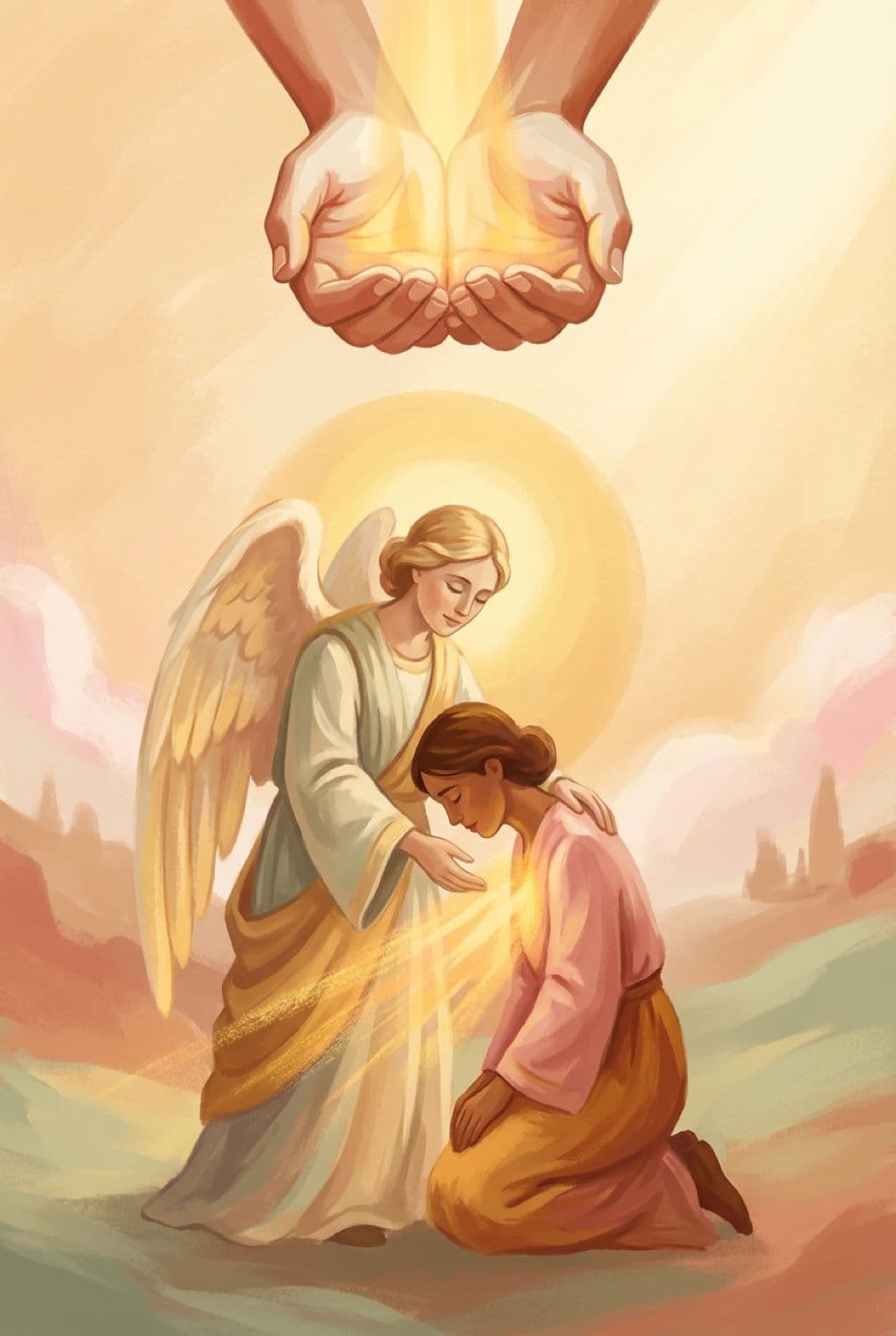
Healing
The Miracle Prayer
Fr. Peter Rookey’s prayer of surrender, what it asks, and what a miracle is
The Miracle Prayer is a short prayer of repentance and surrender to Jesus written by Fr. Peter Mary Rookey (1916–2014), a Servite priest from Chicago known for his healing ministry. It begins “Lord Jesus, I come before you just as I am,” and in about 150 words it asks forgiveness, forgives others, renounces evil, gives the whole self to Christ, asks him to heal and change the one praying, and ends by asking Mary, St. Peregrine and all the saints for help. It carried an imprimatur in 1992 and is copyrighted by the Servite Fathers, so this page summarises it line by line rather than reprinting it. It is not a guaranteed formula: the “miracle” it asks for is first a changed heart. Below: the prayer explained, who Fr. Rookey was, a prayer for a miracle, and what the Church says about prayers that “never fail.”
The Miracle Prayer, line by line
The prayer opens with the words “Lord Jesus, I come before you just as I am.” What follows is, in our own summary, not in Fr. Rookey’s words, a sequence of eight short steps. Each is a thing the Church has always asked of anyone who comes to Christ, and each has deep roots in Scripture.
- Coming as I am. No preparation, no pretending: the prayer begins where the person praying actually is.
- Sorrow for sin. It says sorry, repents, and asks forgiveness. “If we confess our sins, he is faithful and righteous to forgive us the sins” (1 John 1:9).
- Forgiving others. In Jesus’ name, it forgives everyone who has done wrong to the one praying. Christ ties the two together: “For if you forgive men their trespasses, your heavenly Father will also forgive you” (Matthew 6:14).
- Renouncing evil. It renounces Satan, the evil spirits and all their works. This is the renunciation every Catholic makes at Baptism, when the candidate “explicitly renounces Satan” (CCC 1237). It is said to Jesus. It gives no command to any spirit.
- Giving the whole self. It gives the entire self to Jesus, now and forever, invites him in, and accepts him as Lord, God and Savior.
- Asking to be healed and changed. It asks him to heal, change and strengthen the one praying, in body, soul and spirit, to cover them with his Precious Blood and to fill them with the Holy Spirit. God promised exactly this change of heart through Ezekiel: “I will also give you a new heart, and I will put a new spirit within you” (Ezekiel 36:26).
- Love, praise, thanks and a promise. It tells Jesus of love, praise and thanks, and promises to follow him every day of life.
- Asking the saints for help. It closes by asking Mary, Mother and Queen of Peace, St. Peregrine, “the cancer saint,” and all the angels and saints to help.
Where to read the full text. The prayer is printed in full on miracleprayer.org and in many parish bulletins and prayer cards. It carries the note “© 1993 Servite Fathers, O.S.M.” and an imprimatur dated September 8, 1992, given by Francisco Maria Aguilera Gonzales, auxiliary bishop of Mexico, as the site prints it. We quote only its opening words here out of respect for that copyright.
Who was Fr. Peter Mary Rookey?
Peter Rookey was born on October 12, 1916, in Superior, Wisconsin. He entered the Order of Friar Servants of Mary, the Servites, as a boy of thirteen in 1930, and was ordained a priest on May 17, 1941. From 1948 to 1953 he was at the Servite priory of Benburb in Northern Ireland, where he began the ordinary Catholic practice of blessing people after Mass — and people began to report being healed when he prayed for them. He served the order in Rome in the 1950s, then in Belgium and Germany, and in the missions of the Missouri Ozarks, before returning to Chicago in 1984. In 1986 he founded the International Compassion Ministry, which took him to healing services across the world for the rest of his life.
He was clear about whose work it was. Asked about his “gift,” he answered, as his death notice recalls, “It is God’s work, not mine,” adding that God does the healing and he only prays. He died on September 10, 2014, at Our Lady of Sorrows Monastery in Chicago, aged 97, a priest for seventy-three years. The healings people reported at his services are their own testimonies, not findings of the Church.
The saint he asks for help at the end of his prayer belongs to his own order: St. Peregrine Laziosi was a Servite friar of the fourteenth century, now the patron of people with cancer. See the St. Peregrine novena for his story and his prayers.
How to pray the Miracle Prayer
Fr. Rookey attached a short instruction to the prayer, and it is worth reading closely because of what it does not say. In summary: say it faithfully, whatever you feel, and when you come to mean every word with all your heart, “something good spiritually will happen” to you; you will meet Jesus, and he will change your life. The promise is about the heart. It names no illness that will be cured, no deadline, and no number of days.
So the way to pray it is slowly, and daily, for as long as it takes to mean it. Many people pray it:
- Once a day, ideally at the same time, as a daily renewal of Baptism.
- Before Confession, since it already walks through sorrow, forgiveness and a new start; and after it, as thanksgiving.
- For someone else, by praying it in their name, especially someone who is sick and cannot pray it themselves.
- Alongside the sacraments and medical care, never in place of them. Fr. Rookey prayed with the sick; he did not tell them to stop seeing their doctors.
The “3-day miracle prayer that never fails”: what the Church says
Search for a miracle prayer and you will soon find versions with instructions attached: say it for three days, or nine times, and your request will be granted “without fail”; then publish it, or pass it on, or it will not work. These instructions are not in Fr. Rookey’s prayer. They come from chain letters and classified-ad “thank you” notices, and they have attached themselves to several different prayers, including prayers to St. Jude and to the Holy Spirit.
The Catechism answers them directly: “To attribute the efficacy of prayers or of sacramental signs to their mere external performance, apart from the interior dispositions that they demand, is to fall into superstition” (CCC 2111). A prayer is not a mechanism, and God is not a vending machine. The Church asks a searching question of any prayer that is all about results: “What is the image of God that motivates our prayer: an instrument to be used? or the Father of our Lord Jesus Christ?” (CCC 2735).
None of this means that asking for a miracle is wrong. Jesus told us to ask: “Ask, and it will be given you. Seek, and you will find. Knock, and it will be opened for you.” (Matthew 7:7). It means that God answers as a father, not as a machine, and that the answer can be more than we asked. The Catechism quotes an early monk on exactly this: “Do not be troubled if you do not immediately receive from God what you ask him; for he desires to do something even greater for you, while you cling to him in prayer” (CCC 2737).
If you were looking for the St. Jude prayer that is often labelled a “3-day” prayer, see the prayer to St. Jude for impossible causes. There is no need to publish anything, and no penalty for not doing so.
A prayer for a miracle, for the impossible and for an urgent need
Some needs are bigger than anything human effort can reach: a diagnosis, a child in danger, a marriage at its end, a debt that cannot be paid. Scripture gives such prayers their model at Cana. When the wine ran out, Mary said only, “They have no wine,” and then to the servants, “Whatever he says to you, do it” (John 2:3, 5). She named the need, trusted her Son, and left the how to him. The angel told her at the Annunciation, “For nothing spoken by God is impossible” (Luke 1:37).
If the urgent need is your own safety, or someone else’s, or you are thinking of ending your life, please reach out first; prayer can wait a few minutes:
Lord Jesus, I have come to the end of what I can do. This is what I need: (name it). You know it already, and you know how much it matters. I believe that nothing is impossible for you; help me where my faith runs out. If it is your will, grant it. If you have something better in mind, give me the grace to accept it, and the strength to do whatever you ask of me. Mary, you asked your Son at Cana; ask him now for me. Amen.
For an urgent need, many Catholics pray the Memorare nine times in a row, the “Flying Novena.” For a cause that seems hopeless, they ask St. Jude, the patron of lost causes. Neither is a guarantee. Both are ways of asking, again and again, with others praying beside you.
A miracle prayer for healing
Fr. Rookey’s ministry was with the sick, which is why so many people meet his prayer at a hospital bed. It is right to ask God for a miracle of healing: the Gospels are full of people who did, like the blind man by the road to Jericho, whom Jesus asked, “What do you want me to do for you?” (Mark 10:51). But the Church is honest about what she knows: “even the most intense prayers do not always obtain the healing of all illnesses” (CCC 1508). Pray for healing with your whole heart, and keep every appointment with the doctor.
Lord Jesus, you healed every kind of illness of those who were brought to you. I bring you (name). If it is your will, heal them in body; in every case, heal them in soul and spirit. Guide their doctors, strengthen their family, and give them your peace today. St. Peregrine and all the saints, pray for them. Amen.
For more prayers for someone who is ill, including before surgery and in hospital, and the Anointing of the Sick, see prayers for the sick. St. Raphael, the archangel whose name means “God heals,” is the patron saint of healing.
What the Church means by a miracle
A miracle, in Catholic teaching, is not magic and not a reward for the right words. Jesus’ miracles were signs: “The signs worked by Jesus attest that the Father has sent him. They invite belief in him. To those who turn to him in faith, he grants what they ask” (CCC 548). The same paragraph warns that they “are not intended to satisfy people’s curiosity or desire for magic.” And even Jesus did not take away every suffering: “he did not come to abolish all evils here below, but to free men from the gravest slavery, sin” (CCC 549).
That is why Fr. Rookey’s prayer starts with sin and forgiveness rather than with the request. The miracle the Church is surest of is the one it names first: a heart turned back to God. Outward miracles happen, and the Church investigates some of them with great care. But a changed heart is the one she can promise to anyone who asks for it honestly, because God has already promised it.
When a prayer is answered, the Gospel adds one more step. Of ten lepers healed, one came back: “One of them, when he saw that he was healed, turned back, glorifying God with a loud voice” (Luke 17:15). Thank God, and tell someone.
Other prayers people call a miracle prayer
Several other prayers go by the same name, and people often mean one of these:
- St. Anthony’s “miracle prayer” is the Si quaeris (“If then you ask for miracles…”), a responsory written by the Franciscan Julian of Speyer in 1233 and still sung in Padua every Tuesday. See the prayer to St. Anthony.
- Padre Pio’s “secret weapon” is the Efficacious Novena to the Sacred Heart of Jesus, which he prayed every day for those who asked his prayers. See the Padre Pio novena.
- The St. Peregrine prayer, for someone with cancer, which Fr. Rookey’s prayer echoes at its close.
- “The prayer that never fails” is a nickname for the Memorare, taken from its line that no one who fled to Mary’s protection “was left unaided.” It is a nickname, not a promise.
Whichever you pray, pray it the same way: as a child asking a Father, with the need named honestly, and with the outcome left in his hands.
Frequently Asked Questions
A short prayer of repentance and surrender to Jesus, written by the Servite priest Fr. Peter Mary Rookey and published with an imprimatur in 1992–93. It begins “Lord Jesus, I come before you just as I am,” asks forgiveness, forgives others, renounces evil, gives the whole self to Christ, asks to be healed and changed in body, soul and spirit, and ends by asking Mary, St. Peregrine and all the angels and saints for help.
Fr. Peter Mary Rookey, O.S.M. (1916–2014), a priest of the Servants of Mary from Chicago, known worldwide for his healing services and founder of the International Compassion Ministry in 1986. The text is copyrighted by the Servite Fathers (1993).
There is no prayer that is guaranteed to work in three days. The “3-day” and “never fails” instructions, often with a demand to publish the prayer, come from chain letters, not from the Church or from Fr. Rookey. The Catechism calls attributing results to the mere saying of words superstition (CCC 2111). It is still good to ask God for a miracle; just ask as a child asks a father, not as a formula.
The Church does not rank prayers by power. The greatest prayer she has is the Mass. Beyond that, the most honest prayer for a miracle is Mary’s at Cana: name the need (“They have no wine”) and trust her Son with the rest (“Whatever he says to you, do it”). Many also pray the Memorare, a novena, or Fr. Rookey’s Miracle Prayer.
Catholics usually turn to St. Jude, the patron of impossible and lost causes, and to Mary through the Memorare. The angel’s words to Mary are the reason for confidence: “For nothing spoken by God is impossible” (Luke 1:37). Confidence is not a guarantee; it is trust that God will answer in the way that is truly good.
The prayer most Catholics use for an urgent need is the Memorare, prayed nine times in a row as the “Flying Novena.” A simple prayer in your own words is just as real: name the need, ask for it if it is God’s will, and ask for the grace to accept his answer. If the urgent need is someone’s safety, contact emergency services first.
It was published with an imprimatur, dated September 8, 1992, from Francisco Maria Aguilera Gonzales, an auxiliary bishop of Mexico. An imprimatur is the permission a bishop gives to publish a book of prayers (Code of Canon Law, can. 826 §3), part of the pastors’ duty to see that “no harm is done to the faith or morals” of the faithful through writings (can. 823 §1). It means the text contains nothing contrary to faith or morals. It is not an endorsement of any promised result.
Because Fr. Rookey and St. Peregrine belonged to the same order, the Servants of Mary, and because so many of the people who came to Fr. Rookey’s healing services were sick with cancer. St. Peregrine Laziosi, a fourteenth-century Servite friar, is the patron of people with cancer.
Fr. Rookey’s own promise was spiritual: that anyone who prays it faithfully until they mean every word will meet Jesus and be changed. That is the miracle the Church can promise, because God has promised a new heart to anyone who asks. Outward miracles are his to give; no prayer, including this one, guarantees them.
Free: 3-Day Healing Prayer Devotional
Three days of guided healing prayers for body, mind, and spirit.
From AngelGuard
A guided prayer every morning
He’ll send The Miracle Prayer to you tomorrow at a time you choose — then a fresh prayer each morning after, about four minutes each. Setup takes 90 seconds.
Start my daily prayerFree daily prayer email. No account needed. Unsubscribe anytime.
More Healing Prayers

Our guided prayers are read by a synthetic narration voice, not by an ordained priest or any named person. How this app is made
Begin Your Healing Journey
Unlock guided healing prayers with the guided narration, plus the complete framework for physical, emotional, and spiritual restoration.
7 days free, then $39.99/year. Cancel anytime — in the app or on the web.
Upcoming · Sep 29
Sts. Michael, Gabriel and RaphaelSee the full liturgical calendar — every feast this year, and an embed for your parish site.