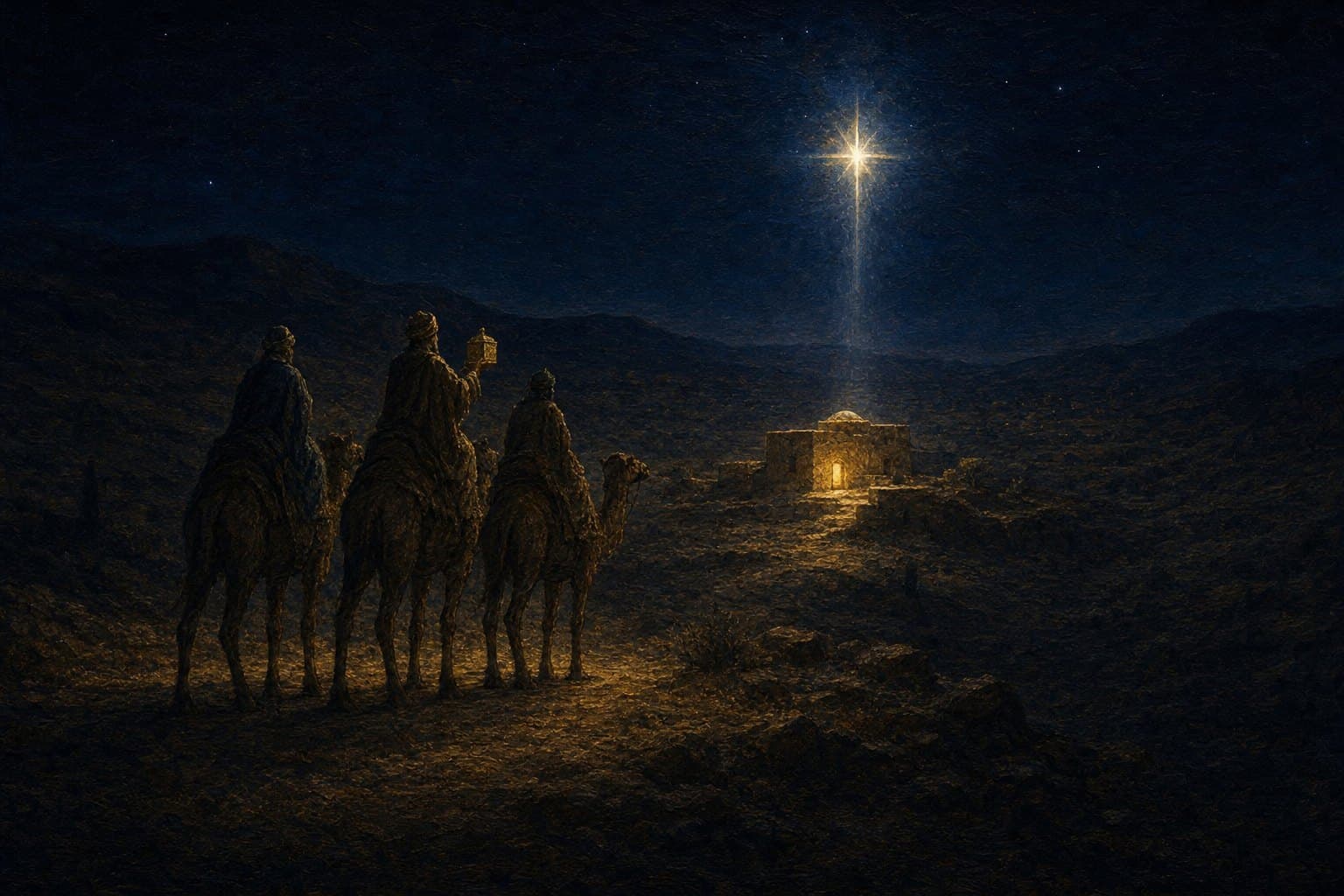
The Epiphany
Epiphany 2027 is Wednesday, January 6, its traditional date, but in the United States the Feast of the Epiphany is celebrated on Sunday, January 3: the feast of the Magi, the wise men from the east who followed a star to Bethlehem (Matthew 2:1-12).
An Epiphany house blessing
at the front door, before you write 20 + C + M + B + 27
Lord our God, Father of all peoples:
the Magi came from far away, following a star,
and found your Son with Mary, his mother.
Today we open the door of this house to you.
Bless all of us who live here
and everyone who crosses this threshold:
the ones who are always here, the ones who come to visit,
and those who come from far away, looking for a home.
Watch over our loved ones who are away from home today.
May our table never lack bread or forgiveness,
may our children grow up knowing you,
and may no one feel like a stranger among us.
And when we lose our way,
bring us back to your Son,
as you brought the Magi to him.
We ask this through Jesus Christ our Lord. Amen.
AngelGuard text. The chalk and the inscription do not protect by themselves: they are a prayer written where everyone can see it (Catechism, nos. 1670 and 2111). The story of the Magi: Matthew 2:1-12.
January 6 is the twelfth day after Christmas, and the United States and other countries that transfer the feast keep it on the Sunday between January 2 and January 8. The day celebrates the manifestation of Christ to the whole world. Families mark it by chalking the door (20 + C + M + B + 27) and blessing the house, and the Christmas season runs on to the Baptism of the Lord.
The Epiphany 2027: all the dates
- The Epiphany (traditional date)Wednesday, January 6, 2027
- Where transferred, the SundaySunday, January 3, 2027
- Baptism of the LordSunday, January 10, 2027
Go deeper
What is the Feast of the Epiphany?
2 min readThe Epiphany is the feast of Christ shown to the nations.
The Epiphany is the feast of Christ shown to the nations. The Greek epiphaneia means an appearance or manifestation, and the Catechism gives the feast its full content in one paragraph: “The Epiphany is the manifestation of Jesus as Messiah of Israel, Son of God and Saviour of the world. The great feast of Epiphany celebrates the adoration of Jesus by the wise men (magi) from the East, together with his baptism in the Jordan and the wedding feast at Cana in Galilee” (CCC 528).
In the West the Magi carry the day. The Catechism calls them “the first-fruits of the nations” (CCC 528): the first people from outside Israel who came looking for Christ and found him. That is why the feast matters to almost everyone who will ever read this page. The Church’s first reading at Mass is Isaiah’s: “Arise, shine; for your light has come, and the LORD’s glory has risen on you!” (Isaiah 60:1). The second reading, from St. Paul, names the mystery: “that the Gentiles are fellow heirs and fellow members of the body” (Ephesians 3:6).
It is one of the greatest days of the year. In the Church’s table of liturgical days it is named with Christmas, the Ascension and Pentecost, directly after the Easter Triduum (Universal Norms on the Liturgical Year, no. 59).
The Epiphany celebrates the manifestation of Christ to the nations, told in Matthew’s account of the Magi who follow a star from the east and find the child at Bethlehem. The word means showing or appearance, and that is the whole theme of the day: the birth was not private.
The Magi matter because of who they are not. They are not Jewish, not from Israel, not part of the covenant, and they are the first outsiders in the Gospel to seek Christ deliberately and find him. The feast is the Church saying, on the twelfth day of Christmas, that this was never a local event. Everything that follows in the New Testament about the Gospel going to all nations is already contained in that visit.
Scripture does not say there were three, and it does not call them kings. It names three gifts, which is where the number came from: gold for a king, frankincense for God, myrrh for burial. The third gift is the one that unsettles the scene, and it is placed there on purpose. Myrrh at a crib is a funeral spice at a birth.
In many countries the Epiphany is kept on January 6, its traditional date. In others, including the United States, it is transferred to the Sunday falling between January 2 and January 8 so that more people can celebrate it. Both are entirely legitimate. In 2027 the traditional date is Wednesday, January 6, and where it is transferred it falls on Sunday, January 3.
When is the Epiphany, and why January 6?
3 min readThe Epiphany falls on January 6, but in the United States, as wherever it is not a holy day of obligation, it moves to the Sunday between January 2 and January 8.
The Epiphany falls on January 6, but in the United States, as wherever it is not a holy day of obligation, it moves to the Sunday between January 2 and January 8. The Epiphany of the Lord is celebrated on January 6, unless, where it is not kept as a holy day of obligation, it has been assigned to the Sunday between January 2 and January 8 (Universal Norms on the Liturgical Year, no. 37). Canon law allows bishops’ conferences to move certain holy days to a Sunday (canon 1246 §2), and the bishops of the United States have done so: in their words, “the traditional date of Epiphany is January 6, but in the United States it is celebrated on the Sunday between January 2 and January 8.”
So there are two correct answers to “when is the Epiphany?”, and which one is yours depends on where you go to Mass:
- The Epiphany 2027: Wednesday, January 6, 2027 on the General Roman Calendar and wherever the feast is kept on its own day; Sunday, January 3, 2027 in the United States and the other countries that transfer it to Sunday. The Baptism of the Lord falls on Sunday, January 10, 2027, whether the Epiphany is kept on January 6 or on Sunday, January 3, 2027.
- The Epiphany 2028: Thursday, January 6, 2028 on the General Roman Calendar and wherever the feast is kept on its own day; Sunday, January 2, 2028 in the United States and the other countries that transfer it to Sunday. The Baptism of the Lord falls on Sunday, January 9, 2028, whether the Epiphany is kept on January 6 or on Sunday, January 2, 2028.
Every date above is computed, not typed. If you are travelling, or your parish keeps an Eastern calendar, check locally. For the other days the Church in the United States keeps as obligations, see the holy days of obligation, and for any date of the year, the liturgical calendar.
Because the two feasts grew up in different places. January 6 is the older feast in much of the East, where it began as a feast of Christ’s manifestation that took in both his birth and his baptism. St. Epiphanius of Salamis, in the fourth century, calls January 6 Christ’s “Birthday; that is, His Epiphany.” The first mention of it as a Christian feast is from 361. The Latin West, even before 354, kept the birth on December 25 and reserved January 6 for Christ’s manifestation, to the Magi above all, but also at his baptism and at Cana. As the East took up December 25 in turn, the twelve days between the two became one festal season. The Armenian Apostolic Church still keeps the Nativity itself on January 6.
That is the significance of January 6 in the Catholic Church: it is the oldest feast of the Incarnation made visible, and it closes the twelve days of Christmas. The evening before, January 5, is Twelfth Night.
The Epiphany does not close Christmas. Christmas Time runs from Evening Prayer on Christmas Eve up to and including the Sunday after the Epiphany, or after January 6 (Universal Norms, no. 33). The season as a whole is on the Christmas page.
The Magi: the Gospel and who they were
4 min readThe Gospel read at every Mass of the Epiphany is Matthew 2:1-12, here in the World English Bible (Catholic Edition).
The Gospel read at every Mass of the Epiphany is Matthew 2:1-12, here in the World English Bible (Catholic Edition).
1 Now when Jesus was born in Bethlehem of Judea in the days of King Herod, behold, wise men from the east came to Jerusalem, saying, 2 “Where is he who is born King of the Jews? For we saw his star in the east, and have come to worship him.” 3 When King Herod heard it, he was troubled, and all Jerusalem with him. 4 Gathering together all the chief priests and scribes of the people, he asked them where the Christ would be born. 5 They said to him, “In Bethlehem of Judea, for this is written through the prophet, 6 ‘You Bethlehem, land of Judah, are in no way least among the princes of Judah; for out of you shall come a governor who shall shepherd my people, Israel.’”
7 Then Herod secretly called the wise men, and learned from them exactly what time the star appeared. 8 He sent them to Bethlehem, and said, “Go and search diligently for the young child. When you have found him, bring me word, so that I also may come and worship him.” 9 They, having heard the king, went their way; and behold, the star, which they saw in the east, went before them until it came and stood over where the young child was. 10 When they saw the star, they rejoiced with exceedingly great joy. 11 They came into the house and saw the young child with Mary, his mother, and they fell down and worshiped him. Opening their treasures, they offered to him gifts: gold, frankincense, and myrrh. 12 Being warned in a dream not to return to Herod, they went back to their own country another way.
Three things are worth noticing. The Magi find the child “with Mary, his mother” (2:11), in a house, not a stable. The chief priests know exactly where the Messiah will be born and do not go; the foreigners who know almost nothing make the journey. And the last line is the one every preacher returns to: having met Christ, they go home “another way” (2:12).
Magi. Matthew’s word is magoi, from the Old Persian name of the Zoroastrian priestly class, whose priests paid close attention to the stars. “From the east” is all he says of where they came from; the Parthian empire, whose religion had such priests, lay in that direction.
Three? Matthew never counts them. He names three gifts, and the number followed from the gifts.
Kings? Not in the Gospel. They became kings in Christian memory because of the prophecies the Church reads alongside the story: “Nations will come to your light, and kings to the brightness of your rising” (Isaiah 60:3), and “All from Sheba will come. They will bring gold and frankincense” (Isaiah 60:6); “The kings of Tarshish and of the islands will bring tribute. The kings of Sheba and Seba shall offer gifts. Yes, all kings shall fall down before him” (Psalm 72:10-11).
Their names. Caspar, Melchior and Balthasar first appear in the Excerpta Latina Barbari, an eighth-century Latin chronicle translated from a Greek original perhaps two centuries older. Syriac Christians remember them by quite different names. The names are tradition, not Scripture.
The gifts. The reading that has lasted is Origen’s, from the third century: “gold, as to a king; myrrh, as to one who was mortal; and incense, as to a God.” Myrrh was used to embalm the dead.
Cologne Cathedral holds a golden shrine said to contain their relics, brought there from Milan in the twelfth century; the story of how they reached Milan, by way of St. Helena and Constantinople, is legend. What the Church does say is that in the Magi “the Gospel sees the first-fruits of the nations, who welcome the good news of salvation through the Incarnation” (CCC 528). Simeon had said the same of the child in the Temple: “a light for revelation to the nations” (Luke 2:32).
Three manifestations: the Magi, the Baptism and Cana
1 min readThe Epiphany was never only about the Magi.
The Epiphany was never only about the Magi. The Catechism joins three moments in one feast (CCC 528): the Magi, when the nations see him; the Baptism in the Jordan, when the Father’s voice says, “This is my beloved Son, with whom I am well pleased” (Matthew 3:17); and the wedding at Cana, where, as St. John writes, Jesus “revealed his glory; and his disciples believed in him” (John 2:11).
The Eastern Churches put the Baptism at the centre. They call the feast Theophany, the showing of God, and celebrate it with the Great Blessing of Waters, often outdoors at a river or the sea; the blessed water is taken home to bless houses. In the Roman Rite the Magi have the Epiphany itself, and the Baptism has its own feast on the Sunday that follows.
The house blessing and chalking the door
4 min readThe best-known Epiphany custom at home is to write the year and three letters over the main door in chalk.
The best-known Epiphany custom at home is to write the year and three letters over the main door in chalk. For 2027 it reads:
20 + C + M + B + 27
What it means. The numbers are the year, split in two around the letters. C, M and B are the initials of the names tradition gives the Magi, Caspar, Melchior and Balthasar, and also of the Latin blessing Christus mansionem benedicat, “May Christ bless this house.” The crosses are for Christ.
How to do it.
- Get chalk. In some parishes the priest blesses chalk on the feast for people to take home; ordinary chalk will do if yours does not.
- Gather the household at the front door, on the Epiphany or on any day of the season after it. Twelfth Night, January 5, is also traditional.
- Begin with the Sign of the Cross, read the Gospel of the Magi, Matthew 2:1-12 (above), and say the prayer below.
- Write the inscription on the lintel, or on the frame above the door. Children can do the writing.
- Leave it up. It stays over the door all year, and next Epiphany it is washed off and written again with the new year.
Lord our God, Father of all peoples:
the Magi came from far away, following a star,
and found your Son with Mary, his mother.
Today we open the door of this house to you.
Bless all of us who live here
and everyone who crosses this threshold:
the ones who are always here, the ones who come to visit,
and those who come from far away, looking for a home.
Watch over our loved ones who are away from home today.
May our table never lack bread or forgiveness,
may our children grow up knowing you,
and may no one feel like a stranger among us.
And when we lose our way,
bring us back to your Son,
as you brought the Magi to him.
We ask this through Jesus Christ our Lord. Amen.
Who may do it, and what it is not. Any member of the household may lead it. The Catechism teaches that every baptised person is called to bless, and that “lay people may preside at certain blessings” (CCC 1669). The chalk is a sacramental: sacramentals “prepare us to receive grace and dispose us to cooperate with it” (CCC 1670). It is not a charm, and it guards nothing by the mark alone; to treat a sacred sign as working by its mere performance is what the Catechism calls superstition (CCC 2111). It is a prayer written where you will see it every day.
The bishops of the United States publish a short Blessing of the Home and Household on Epiphany for families to pray at home, with one of the household leading. Its order is simple:
- A song, if you like, then the Sign of the Cross and a greeting: “Let us praise God, who fills our hearts and homes with peace.”
- A reading from Scripture. The USCCB suggests Luke 19:1-9, Zacchaeus, the man whose house Jesus chose to stay in.
- Intercessions, each answered “Stay with us, Lord”: for the family to know Christ as its guest, for the homeless, and that the household may use its gifts, as the Magi gave theirs, to God’s glory.
- The Our Father.
- The prayer of blessing, which asks God, who revealed his Son “to every nation by the guidance of a star,” to bless the house and all who live in it.
- A closing blessing with the Sign of the Cross, and a carol: the USCCB suggests “O Come, All Ye Faithful” or “We Three Kings.”
Many families chalk the door at the end of it, and sprinkle each room with holy water; see the holy water blessing. A priest will also bless a house on request. For a house blessing you can pray at any time of year, see the house blessing prayer.
Three Kings Day traditions around the world
2 min readIn much of the world the Epiphany is simply the Day of the Kings, and in some places it is a bigger day for children than Christmas.
In much of the world the Epiphany is simply the Day of the Kings, and in some places it is a bigger day for children than Christmas.
- Spain (Día de los Reyes Magos). Children polish their shoes and leave them out on the night of January 5 for the Kings’ gifts, with a lump of sugar “coal” for anyone who has misbehaved. Towns hold parades of the Kings, the cabalgata; the oldest, in Alcoy, has run since 1885.
- Mexico and Latin America. The Kings, not Santa Claus, traditionally bring the presents, left in or near the children’s shoes, and families share the rosca de reyes, a ring-shaped sweet bread.
- Puerto Rico (Día de los Tres Reyes Magos). Children fill a box with fresh grass or hay and put it under the bed for the Kings’ animals, which in Puerto Rico are horses rather than camels, and wake to find gifts in its place.
- Germany and Austria. The Sternsinger, star singers, go door to door dressed as the Kings, carrying a star, singing and collecting for charity, and chalk the blessing over each door.
- Poland. Families bring chalk, incense and a gold ring to church to be blessed, then mark every door with K+M+B and the year; big cities hold parades of the Kings.
- Ireland. January 6 is Little Christmas, or Nollaig na mBan, Women’s Christmas, when women traditionally rest after the work of the holidays.
- France. The galette des rois hides a bean or a small figure, and whoever finds it is king or queen for the day, paper crown included. Louisiana takes the idea further: the Epiphany opens the Carnival season and its king cakes.
- Italy. The Befana, an old woman whose name comes from Epifania, brings children their gifts on the night of January 5.
The simplest custom of all works anywhere: if the Magi figures have been travelling across the room since Christmas, they arrive at the crib on the Epiphany.
The Epiphany announcement of Easter, and the Baptism of the Lord that follows
2 min readAn old custom, still in the Roman Missal: on the Epiphany, after the Gospel or after the prayer after Communion, a deacon, cantor or reader may sing the dates of the coming year’s great feasts, to the same chant as the Easter Proclamation.
An old custom, still in the Roman Missal: on the Epiphany, after the Gospel or after the prayer after Communion, a deacon, cantor or reader may sing the dates of the coming year’s great feasts, to the same chant as the Easter Proclamation. It comes from a time when calendars were scarce and every parish needed to know when Easter would fall, because so much of the year depends on it. For 2027 the dates it announces are:
- Ash Wednesday: Wednesday, February 10, 2027.
- Easter Sunday: Sunday, March 28, 2027.
- The Ascension: Thursday, May 6, 2027; in most of the United States it is kept on the following Sunday, May 9, 2027.
- Pentecost: Sunday, May 16, 2027.
- The Body and Blood of Christ: Thursday, May 27, 2027, or where it is not a holy day of obligation, as in the United States, the Sunday after Trinity Sunday, May 30, 2027.
- The First Sunday of Advent: Sunday, November 28, 2027.
Each of these is computed from Easter, which is itself computed; see the Easter countdown for how the date is worked out.
The Sunday after the Epiphany is the Feast of the Baptism of the Lord (Universal Norms, no. 38), and it closes the Christmas season. In 2027 it falls on Sunday, January 10, 2027, whether the Epiphany is kept on January 6 or on Sunday, January 3, 2027. Ordinary Time begins the next day.
Matthew tells it this way: “Jesus, when he was baptized, went up directly from the water: and behold, the heavens were opened to him. He saw the Spirit of God descending as a dove, and coming on him. Behold, a voice out of the heavens said, ‘This is my beloved Son, with whom I am well pleased’” (Matthew 3:16-17). The Catechism calls this too a manifestation, an “Epiphany,” of Jesus “as Messiah of Israel and Son of God” (CCC 535).
It is the feast on which to remember your own baptism: find out the date, bless yourself with holy water, and renew the promises. The Magi came to him from far away; at the Jordan the heavens open over him, and at every baptism since, the same Spirit is given.
A prayer for the Feast of the Epiphany
1 min readFor the day itself, at the crib, at the table, or before the chalk goes up.
For the day itself, at the crib, at the table, or before the chalk goes up. Like every prayer on this site, it is addressed to God.
God of every nation,
you led the Magi by a star
to your Son, and they knelt before him.
Lead us to him too,
by whatever light you give us.
Accept what we bring:
our work, our love, our sorrows,
as you accepted gold, frankincense and myrrh.
And when we have found him,
send us home another way.
We ask this through Christ our Lord.
Amen.
Observance & Rules
1 min readWhere the Epiphany is celebrated on January 6 it is a holy day of obligation in some countries and not in others.
Where the Epiphany is celebrated on January 6 it is a holy day of obligation in some countries and not in others. Where it is transferred to a Sunday, the ordinary Sunday obligation applies. Because this varies so widely, check your own diocese rather than assuming.
The Epiphany does not end the Christmas season. The season continues to the Baptism of the Lord. In 2027 it falls on Sunday, January 10, 2027, whether the Epiphany is kept on January 6 or on Sunday, January 3, 2027.
The blessing of chalk, and with it the blessing of homes, is customary on this day. It is a sacramental rather than a sacrament, and any member of the household may mark the door. Where a priest is available he blesses the chalk beforehand.
In Spanish, for Día de Reyes in Mexico and Latin America: Día de Reyes 2027.
Practical Guide
1 min readA family can keep the Epiphany at home in a few small ways, beginning at the front door.
A family can keep the Epiphany at home in a few small ways, beginning at the front door.
Bless the house. The custom is to chalk the lintel of the main door with the year and the letters C, M, B, separated by crosses, so that 2027 is written as 20 + C + M + B + 27. The letters carry two meanings at once: the traditional names given to the Magi, and the Latin phrase Christus mansionem benedicat, may Christ bless this house. It takes two minutes, children can do the writing, and the mark stays over the door all year.
Move the Magi figures to the crib on the day, if you have kept them travelling across the twelve days. It is the simplest possible way to make the season legible to a child.
Keep the decorations up until the Baptism of the Lord. Epiphany is not the end of Christmas, and taking the tree down on the 6th is early by the Church’s reckoning.
And if the feast has passed before you noticed, bless the house anyway. Nothing about it depends on the date being exact.
Questions
What is the Feast of the Epiphany?
It is the solemnity on which the Church celebrates Christ made known to the world. The Catechism names three such showings: the adoration of the Magi, his baptism in the Jordan and the wedding at Cana (CCC 528). In the West the day centres on the Magi, the first people from outside Israel to come looking for him.
When is the Epiphany in 2027?
The traditional date is Wednesday, January 6, 2027. In countries where the feast is transferred, including the United States, it is celebrated on the Sunday between January 2 and January 8, which in 2027 is Sunday, January 3.
Why is the Epiphany twelve days after Christmas?
Because the two feasts grew up separately. Many Eastern Churches kept January 6 as the great feast of Christ’s manifestation, including his birth, while Rome kept December 25. When each adopted the other’s feast, the twelve days between them became one season. The Armenian Apostolic Church still keeps the Nativity itself on January 6.
Is the Epiphany a holy day of obligation?
In the Church’s universal law, yes: canon 1246 lists it. But the same canon lets bishops’ conferences move it to a Sunday, and many have, the United States among them. There the Epiphany is always on a Sunday, so the ordinary Sunday obligation covers it. Where it is kept on January 6, ask your diocese whether that day binds.
Were there three wise men?
Scripture does not give a number. Matthew names three gifts, gold, frankincense, and myrrh, and the number three followed from the gifts rather than from the text. Nor does the Gospel call them kings; it calls them Magi.
What are the names of the three wise men?
In the Western tradition, Caspar (or Gaspar), Melchior and Balthasar. The Gospel gives no names. They first appear in a Latin chronicle of the eighth century translated from a lost Greek original, and other Churches remember different names altogether.
What do the gifts of the Magi mean?
Gold is the gift for a king, frankincense is used in worship and so points to divinity, and myrrh is a burial spice. The third is the one that carries the shadow of the Passion into the crib, and the Church has always read it that way.
What is Three Kings Day?
Another name for the Epiphany, used above all in Spanish-speaking countries, Puerto Rico and the Philippines, where it is Día de Reyes. Children leave out their shoes, or boxes of grass for the Kings’ camels or horses, on the night of January 5, and wake to gifts; families share a ring-shaped rosca de reyes.
What does the chalk over the door mean?
The inscription 20 + C + M + B + 27 carries two meanings. The letters stand for the traditional names of the Magi, Caspar, Melchior, and Balthasar, and also for Christus mansionem benedicat, may Christ bless this house. The numbers are the year, split around the letters.
Does Christmas end at the Epiphany?
No. The Christmas season continues to the feast of the Baptism of the Lord. In 2027 it falls on Sunday, January 10, 2027, whether the Epiphany is kept on January 6 or on Sunday, January 3, 2027.
Many families move the Magi across the house toward the manger until Epiphany. The blessing of the Nativity scene that begins it is among our Christmas prayers — with a prayer for Christmas Eve and a grace for the Christmas table.
Many Hispanic parishes gather for Día de Reyes; for a parish evening in Spanish there is the Noche de juegos parroquial — a free game night with prayer, ready to print.
Prayers for the Epiphany
Scripture for This Season
Where this falls in the year
Solemnity
All Souls DaySee the full liturgical calendar — every feast this year, and an embed for your parish site.