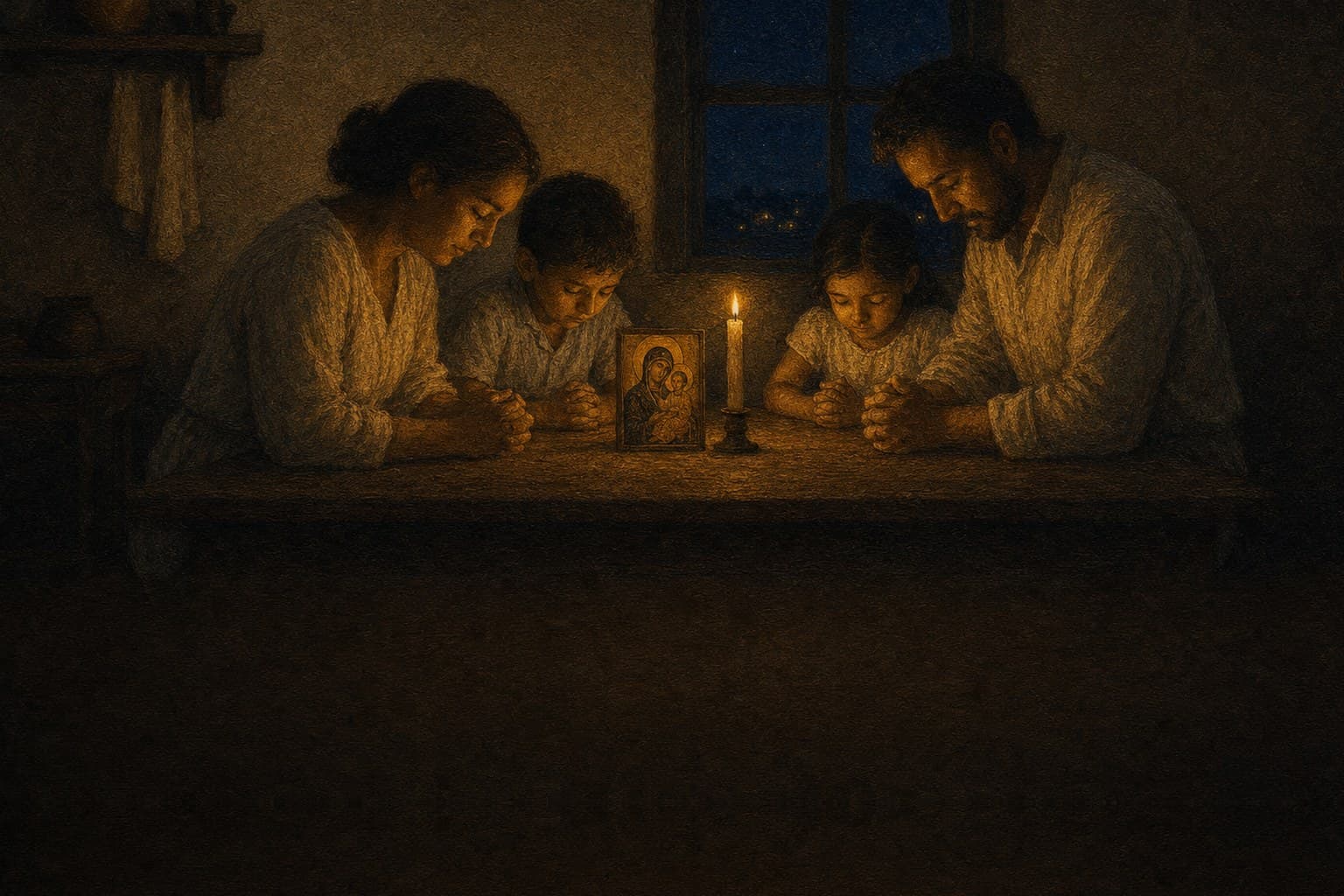
For New Year’s Eve and Day
A Catholic New Year Prayer, with the Te Deum
A family prayer of thanks for the year, with the Te Deum in English and Latin and the Veni Creator for January 1
A Catholic New Year prayer thanks God for the year that is ending and entrusts the new one to Him, with Mary, Mother of God, whose solemnity opens the year on January 1.
Lord God, Father of all our days,
one year is closing and another opening, and we come to You.
Thank You for every day of it:
for everyone at this table and the ones we miss,
for work and rest, for meals and laughter,
for the prayers You answered, and the ones You answered in Your own way.
(Each person names one thing to thank God for.)
In the hard days, too, we thank You,
because You were in them with us.
Forgive what was not love this year:
the sharp word, the visit we kept putting off,
the good we meant to do and did not do.
Help us to forgive one another, beginning now.
Remember those who died this year, and give them eternal rest.
(Say their names.)
Comfort everyone who is missing someone,
and everyone who is working, sick or alone.
Into Your hands we give the year that is coming.
We do not ask You for luck, but for Your company in every day of it.
Give us what we need, and hearts that notice who needs us.
Bless our home with Your peace, and give peace to the world.
Through the prayers of Holy Mary, Mother of God,
who kept all these words, pondering them in her heart,
teach us to keep what You give us this year.
Through Christ our Lord.
Amen.
On New Year’s Eve the Church thanks God with the Te Deum, her ancient hymn of praise, and on New Year’s Day she asks the Holy Spirit’s help with the Veni Creator. This page gives you a short prayer for the family table, at midnight or on the morning of the 1st, and both hymns in full.
Go deeper
How to pray on New Year’s Eve and Day, as a family or alone
2 min readPray on New Year’s Eve before the meal or a little before midnight, while the house is still calm, rather than in the last seconds of the countdown.
Pray on New Year’s Eve before the meal or a little before midnight, while the house is still calm, rather than in the last seconds of the countdown. Ten minutes is enough. Turn the television off, light a candle on the table or by the Nativity scene if it is still up, and begin with the Sign of the Cross. Keep a minute of silence for the year, then pray the New Year prayer. At the pause, each person names one thing to thank God for; give the youngest children a turn too. Then say aloud the names of those who died this year. If it is the first New Year without someone you love, there are also prayers for grief for the days after.
After the prayer comes the Te Deum. Pray it in two choirs, one side of the table taking a line and the other side answering. With small children you can stop at “in glory everlasting,” or pray an Our Father and a Hail Mary instead. Parents can end the evening by tracing a small cross on each child’s forehead and asking God to bless them through the year.
On New Year’s Day, begin at Mass; later, at breakfast or at the main meal, pray the New Year prayer again and add the Veni Creator, the hymn that asks the Holy Spirit to guide the year that has just begun.
If you are on your own tonight. Pray the same words, saying “I” where they say “we.” You are less alone than the room suggests: on this night the Te Deum is sung in cathedrals and parishes around the world, and in Rome the Pope leads it at the end of First Vespers of the solemnity in St. Peter’s Basilica.
It is still Christmas. December 31 is the seventh day of the Octave of Christmas and January 1 its eighth, so leave the crib and the tree up. If your family prayed our Christmas prayers on Christmas Eve, this is the same table gathered again, a week later, to give thanks. And the feast keeps going after that: the Christmas season lasts until the Baptism of the Lord in January.
The Te Deum prayer in English, for New Year’s Eve
3 min readWhen the Church wants to thank God for something great, she sings the Te Deum, a hymn named for its first two Latin words, Te Deum laudamus, “We praise Thee, O God.”
When the Church wants to thank God for something great, she sings the Te Deum, a hymn named for its first two Latin words, Te Deum laudamus, “We praise Thee, O God.” It praises the Father with the angels, apostles, prophets and martyrs, confesses Christ, born of the Virgin, risen and coming as Judge, and closes with petitions drawn largely from the Psalms. In the Liturgy of the Hours it follows the readings of the Office of Readings on Sundays outside Lent, in the octaves of Christmas and Easter, and on solemnities and feasts (General Instruction of the Liturgy of the Hours, 68). On the last night of the year, parishes sing it to thank God for the twelve months behind them.
The English below is the one printed in the Manual of Prayers for the Use of the Catholic Laity, the prayer book ordered by the Third Plenary Council of Baltimore and approved by Cardinal Gibbons in 1889. Its words are kept as printed. Each verse is set on two lines, broken where the book marks the half-verse for chanting.
We praise Thee, O God,
we acknowledge Thee to be the Lord.
All the earth doth worship Thee,
the Father everlasting.
To Thee all Angels,
to Thee the Heavens and all the Powers therein;
To Thee the Cherubim and Seraphim
cry with unceasing voice:
Holy, Holy, Holy,
Lord God of Hosts.
The heavens and the earth are full
of the majesty of Thy glory.
Thee the glorious choir
of the Apostles,
Thee the admirable company
of the Prophets,
Thee the white-robed army of Martyrs
praise.
Thee the Holy Church throughout all the world
doth acknowledge:
The Father
of infinite Majesty;
Thine adorable, true
and only Son;
Also the Holy Ghost,
the Paraclete.
Thou art the King of Glory,
O Christ.
Thou art the everlasting Son
of the Father.
Thou having taken upon Thee to deliver man,
didst not abhor the Virgin’s womb.
Thou having overcome the sting of death,
didst open to believers the kingdom of heaven.
Thou sittest at the right hand of God,
in the glory of the Father.
We believe that Thou shalt come
to be our Judge.
We beseech Thee, therefore, help Thy servants,
whom Thou hast redeemed with Thy precious Blood.
Make them to be numbered with Thy Saints
in glory everlasting.
O Lord, save Thy people,
and bless Thine inheritance.
Govern them,
and lift them up for ever.
Day by day
we bless Thee.
And we praise Thy name for ever,
and world without end.
Vouchsafe, O Lord, this day
to keep us without sin.
Have mercy on us, O Lord;
have mercy on us.
Let Thy mercy, O Lord, be upon us,
as we have hoped in Thee.
O Lord, in Thee have I hoped:
let me never be confounded.
The 1889 Manual adds a note at “We beseech Thee, therefore, help Thy servants”: during this petition it is usual to kneel. The last part of the hymn, from “O Lord, save Thy people,” may be left out (General Instruction, 68), which is a kindness to small children at a late hour.
The Te Deum in Latin
2 min readThe Latin text below follows the booklets the Holy See prints for the First Vespers and Te Deum of December 31 in St. Peter’s, accents included, since they guide the singing.
The Latin text below follows the booklets the Holy See prints for the First Vespers and Te Deum of December 31 in St. Peter’s, accents included, since they guide the singing. A parish choir can sing the Latin while the people follow the English above.
Te Deum laudámus:
te Dóminum confitémur.
Te ætérnum Patrem,
omnis terra venerátur.
Tibi omnes ángeli,
tibi cæli et univérsæ potestátes:
tibi chérubim et séraphim
incessábili voce proclámant:
Sanctus, Sanctus, Sanctus,
Dóminus Deus Sábaoth.
Pleni sunt cæli et terra
maiestátis glóriæ tuæ.
Te gloriósus apostolórum chorus,
te prophetárum laudábilis númerus,
te mártyrum candidátus laudat exércitus.
Te per orbem terrárum
sancta confitétur Ecclésia,
Patrem imménsæ maiestátis;
venerándum tuum verum et únicum Fílium;
Sanctum quoque Paráclitum Spíritum.
Tu rex glóriæ, Christe.
Tu Patris sempitérnus es Fílius.
Tu, ad liberándum susceptúrus hóminem,
non horruísti Vírginis úterum.
Tu, devícto mortis acúleo,
aperuísti credéntibus regna cælórum.
Tu ad déxteram Dei sedes,
in glória Patris.
Iudex créderis esse ventúrus.
Te ergo quǽsumus, tuis fámulis súbveni,
quos pretióso sánguine redemísti.
Ætérna fac cum sanctis tuis
in glória numerári.
Salvum fac pópulum tuum, Dómine,
et bénedic hereditáti tuæ.
Et rege eos, et extólle illos
usque in ætérnum.
Per síngulos dies benedícimus te;
et laudámus nomen tuum in sǽculum,
et in sǽculum sǽculi.
Dignáre, Dómine, die isto
sine peccáto nos custodíre.
Miserére nostri, Dómine,
miserére nostri.
Fiat misericórdia tua, Dómine, super nos,
quemádmodum sperávimus in te.
In te, Dómine, sperávi:
non confúndar in ætérnum.
Who wrote the Te Deum? Nobody knows for certain. A story first written down in the late eighth century tells how St. Ambrose and St. Augustine sang it, verse by verse, at Augustine’s baptism in Milan in 387, and the hymn is sometimes called the Ambrosian Hymn. Scholars no longer hold to that story. In 1894 the Benedictine Germain Morin proposed Nicetas, a missionary bishop of Remesiana in what is now Serbia, who died around 414; ten manuscripts, most of them Irish, give his name, and many scholars have followed Morin, though the question remains open. The age of the hymn is not in doubt. The monastic rule of St. Caesarius of Arles, written before 502, already names it, and St. Benedict tells the abbot to begin it at the Sunday night office (Rule, chapter 11).
The Veni Creator for New Year’s Day
2 min readOn January 1 the Church opens the year by calling on the Holy Spirit with the Veni Creator Spiritus, “Come, Creator Spirit,” the same hymn she sings at Pentecost.
On January 1 the Church opens the year by calling on the Holy Spirit with the Veni Creator Spiritus, “Come, Creator Spirit,” the same hymn she sings at Pentecost. Pray it after the New Year prayer at breakfast, or before the main meal of the day. The English is the one printed in the 1910 Raccolta, the English edition of the Church’s collection of indulgenced prayers.
Come, O Creator Spirit blest!
And in our souls take up thy rest;
Come, with thy grace and heavenly aid,
To fill the hearts which Thou hast made.
Great Paraclete! to Thee we cry:
O highest gift of God most high!
O fount of life! O fire of love!
And sweet Anointing from above!
Thou in thy sevenfold gifts art known!
Thee, Finger of God’s hand, we own;
The promise of the Father Thou!
Who dost the tongue with pow’r endow.
Kindle our senses from above,
And make our hearts o’erflow with love;
With patience firm, and virtue high,
The weakness of our flesh supply.
Far from us drive the foe we dread,
And grant us thy true peace instead;
So shall we not, with Thee for guide,
Turn from the path of life aside.
O, may thy grace on us bestow
The Father and the Son to know,
And Thee, through endless times confess’d,
Of Both th’eternal Spirit blest.
All glory, while the ages run,
Be to the Father and the Son,
The same, O Holy Ghost, to Thee,
Now and through all eternity. Amen.
The last verse is the one for most of the year. In Eastertide the Raccolta gives another, which praises the Son “Who rose from death.”
The New Year’s Eve and New Year’s Day indulgence
2 min readA plenary indulgence is attached to each of these two days by the Enchiridion of Indulgences (fourth edition, 1999, grant 26 §1).
A plenary indulgence is attached to each of these two days by the Enchiridion of Indulgences (fourth edition, 1999, grant 26 §1). On December 31 it is granted to the faithful who devoutly take part, in a church or oratory, in the solemn singing or recitation of the Te Deum, to thank God for the blessings received over the whole year. On January 1 it is granted for taking part, in a church or oratory, in the solemn singing or recitation of the Veni Creator, to ask God’s help for the whole year to come; the same grant covers the Veni Creator on Pentecost.
The usual conditions apply: sacramental confession, Holy Communion and a prayer for the Holy Father’s intentions, for which one Our Father and one Hail Mary are enough, together with freedom from all attachment to sin, even venial sin (norm 20). They can be fulfilled several days before or after, though Communion and the prayer for the Pope are best on the day itself. Only one plenary indulgence can be gained in a day (norm 18), and the Te Deum on the 31st and the Veni Creator on the 1st are two indulgences: one confession can serve for both, but each needs its own Communion and prayer for the Pope (norm 20). If something is lacking, the indulgence is partial (norm 20), and any indulgence may be gained for yourself or offered for the dead (norm 3).
At home. Prayed at the family table, the Te Deum and the Veni Creator carry a partial indulgence. Grant 26 §2 gives one to whoever devoutly prays an approved prayer of petition and thanksgiving at the beginning or end of the day, at the beginning or end of their work, or before or after a meal, and it names both hymns among its examples. An indulgenced prayer may be said in any language, in a translation approved by Church authority (norm 22). The English on this page comes from approved Catholic books: the Te Deum from the 1889 Manual of Prayers and the Veni Creator from the 1910 Raccolta. The Latin above, or the English of your parish’s Liturgy of the Hours, serves just as well.
January 1: Mary, Mother of God, and Mass in 2027
2 min readJanuary 1 is the eighth day of Christmas, the Octave Day of the Nativity, and the Church keeps it as the Solemnity of Mary, the Holy Mother of God.
January 1 is the eighth day of Christmas, the Octave Day of the Nativity, and the Church keeps it as the Solemnity of Mary, the Holy Mother of God. The title is first about her Son. Her Child is God’s own eternal Son, and so the Church calls her by the Greek title Theotokos, “God-bearer” (CCC 495), which the Council of Ephesus proclaimed in 431 (CCC 466). Our page on Mary, Mother of God tells the history of the title and answers the questions people ask about it.
The Gospel at Mass is Luke 2:16–21, and in the Douay-Rheims it holds the verse a whole year can be built on: “But Mary kept all these words, pondering them in her heart” (Luke 2:19). Two verses later the Child receives his name: “his name was called JESUS” (Luke 2:21). The first reading is the blessing God gave Aaron and his sons to pray over Israel, which parents can pray over their children on this morning: “The Lord bless thee, and keep thee. The Lord shew his face to thee, and have mercy on thee. The Lord turn his countenance to thee, and give thee peace” (Numbers 6:24–26).
The day is also the World Day of Peace. Paul VI proposed it for New Year’s Day 1968 and asked that it be kept each year from then on, without changing the feast, since the calendar keeps New Year’s Day for the divine motherhood of Mary and the Holy Name of Jesus. January 1, 2027, is the sixtieth. That is why the New Year prayer asks for peace in the home and in the world.
Mass on January 1, 2027. In 2027, New Year’s Day is a Friday, and the Mass obligation holds for Catholics across the United States, except in Hawaii, where since 1992 it binds only on Christmas and the Immaculate Conception. The bishops lift that obligation only in years when the first of January is a Saturday or a Monday, and the USCCB calendar for 2027 marks it as a holy day of obligation. An evening Mass on Thursday, December 31, also fulfills it (Code of Canon Law, can. 1248 §1). And since a solemnity outranks the Friday, no one has to give up meat that day (can. 1251). Elsewhere, the obligation depends on your bishops’ conference, so check with your parish.
A short examen for the end of the year
1 min readBefore the year closes, give it ten quiet minutes with God.
Before the year closes, give it ten quiet minutes with God. Five questions are enough, taken one at a time:
- What am I grateful for? Name three things, as specifically as you can: a person, an answered prayer, an ordinary good day.
- Where did I see God at work? Often it shows more clearly in the hard months than in the easy ones.
- What do I regret? Tell God plainly, without putting the whole year on trial. If there is serious sin, bring it to confession during the Christmas season.
- Whom do I need to forgive, or ask to forgive me? One name is a good beginning.
- What do I want to give God next year? One habit of prayer you will keep, rather than a list of resolutions.
St. Paul puts all five into one line: “In all things give thanks; for this is the will of God in Christ Jesus concerning you all” (1 Thessalonians 5:18). Then pray the New Year prayer slowly, and let the Te Deum say the rest.
Questions
What should a Catholic New Year prayer include?
A good New Year prayer does four things: it thanks God for the year, asks forgiveness for what was not love, remembers the dead, and puts the coming year in God’s hands. Ours does all four in under two minutes and ends through the prayers of Mary, Mother of God. The Church’s own prayer for the night is the Te Deum.
What is a good Bible verse for New Year’s Eve?
The blessing the Church reads at Mass on January 1: “The Lord bless thee, and keep thee. The Lord shew his face to thee, and have mercy on thee. The Lord turn his countenance to thee, and give thee peace” (Numbers 6:24–26). For looking back over the year, St. Paul’s “In all things give thanks” (1 Thessalonians 5:18).
What is a short New Year prayer?
Two lines from our New Year prayer can stand on their own: “Into Your hands we give the year that is coming. We do not ask You for luck, but for Your company in every day of it.” Or the last line of the Te Deum: “O Lord, in Thee have I hoped: let me never be confounded.”
What is the English translation of the Te Deum?
Te Deum laudamus means “Thee, O God, we praise,” and the traditional Catholic English begins “We praise Thee, O God, we acknowledge Thee to be the Lord.” The full text on this page is the version of the 1889 Manual of Prayers, followed by the Latin. Today’s Liturgy of the Hours uses a newer English translation.
When is the Te Deum prayed?
The Te Deum is sung above all on December 31, to thank God for the year, often after an evening Mass or Vespers. In the Liturgy of the Hours it comes in the Office of Readings on Sundays outside Lent, during the octaves of Christmas and Easter, and on solemnities and feasts, and families can pray it at home any day they have something great to thank God for.
Is there an indulgence for praying the Te Deum on New Year’s Eve?
Yes. On December 31 a plenary indulgence is granted for devoutly taking part in the solemn singing or recitation of the Te Deum in a church or oratory, to thank God for the year, with confession, Communion and a prayer for the Holy Father as the usual conditions. Prayed at home at the start or end of the day or at a meal, it carries a partial indulgence (Enchiridion of Indulgences, grant 26).
Is New Year’s Day 2027 a holy day of obligation?
In the United States, yes, except in Hawaii. The Solemnity of Mary, Mother of God, falls on Friday, January 1, 2027, and the US bishops lift the obligation only in years when the first of January is a Saturday or a Monday. An evening Mass on December 31 counts (can. 1248 §1), and since the solemnity outranks the Friday, Catholics may eat meat that day (can. 1251).
Keep praying
- Christmas Morning Prayer: The Word Was Made FleshFor the morning of December 25: the Nativity Gospel from St. Luke and St. John, a short reflection, and a prayer for the whole house and for anyone alone
- Come, Holy Spirit: the Prayer to the Holy Spirit in FullEach line explained, where it comes from, the Latin Veni Sancte Spiritus, and when Catholics pray it
- The Magnificat: Mary’s Song in Full, Verse by VerseMary’s song of praise from Luke 1:46–55 in the Douay-Rheims Bible: what each verse means, its roots in Hannah’s song, the Latin, and how the Church prays it every evening
A prayer from AngelGuard · Written for AngelGuard
Upcoming · Oct 28
Sts. Simon and Jude
See the full liturgical calendar — every feast this year, and an embed for your parish site.